
Geely Launches Galaxy M9 SUV, Finalizing Lineup to Challenge BYD's Dominance
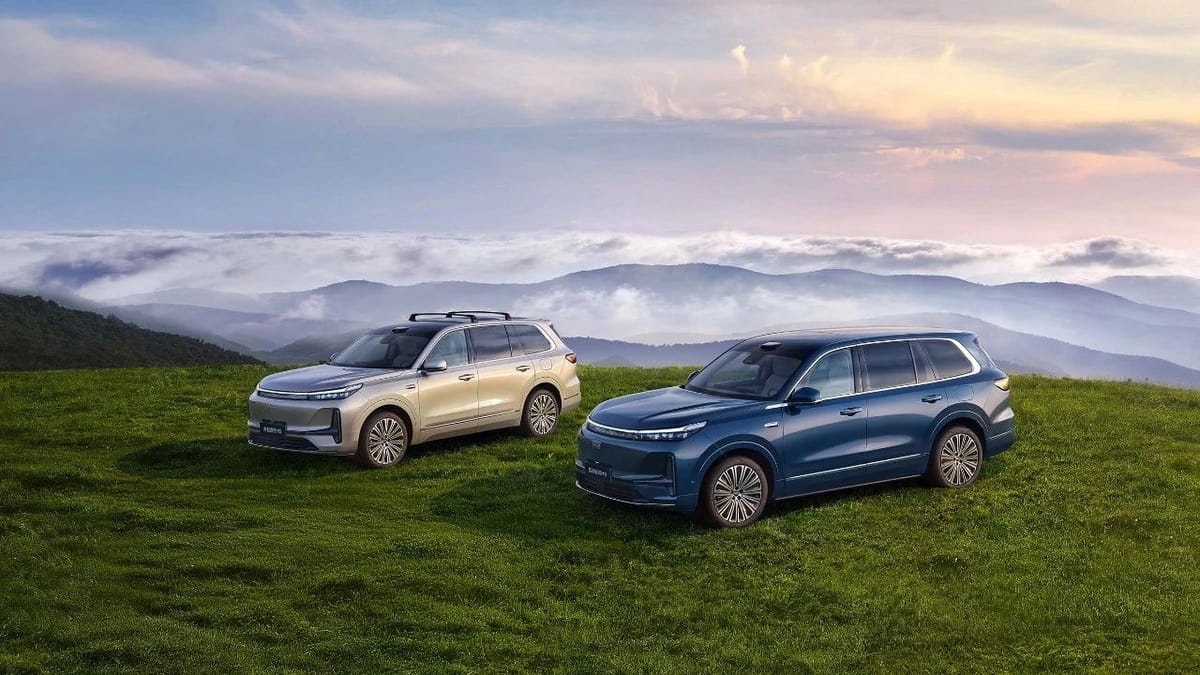
Geely Automobile has launched its Galaxy M9 large SUV, the final piece of a comprehensive product strategy aimed squarely at challenging market leader BYD across every key vehicle segment, escalating the rivalry between two of China's largest automakers.
The six-seater Galaxy M9 officially went on sale on September 17, with a limited-time introductory price range of RMB 173,800 yuan (US$23,970) to 238,800 yuan. The launch marks Geely’s strategic entry into the large family SUV market, a segment where BYD’s Tang model line has long been a dominant force.
Positioned to directly compete with the BYD Tang DM-i, the Galaxy M9 enters the market at a comparable price point but with what Geely frames as superior core specifications. The move underscores an aggressive strategy: to outperform BYD on features while undercutting or matching its rival on price.
The debut of the M9 completes a strategic puzzle for Geely. The company’s Galaxy series now features six distinct models, each designed to rival one of BYD’s top-selling vehicles. This systematic lineup signals a full-scale offensive aimed at eroding BYD's market share and challenging its reign as China’s best-selling domestic auto brand.
A Feature-Packed Challenger
Geely has equipped the Galaxy M9 with a host of features intended to give it a competitive edge. The vehicle’s large dimensions (5205mm long, 1999mm wide, 1800mm tall) and 3030mm wheelbase provide a spacious six-seat cabin with a completely flat floor.
Inside, the M9 emphasizes technology and comfort. It features a 30-inch 6K dashboard screen, a 17.3-inch 3K rear-seat entertainment screen, and a 9.1-liter refrigerator. The first two rows of seats offer heating, ventilation, and massage functions, while the third row includes heating and power recline. The cockpit is powered by a Qualcomm 8295P chip running the Flyme Auto 2.0 operating system.
Under the hood, the M9 is powered by the new-generation Raytheon EM-P AI plug-in hybrid system, featuring an engine with a thermal efficiency of 47.26%. This system delivers a tri-motor all-wheel-drive configuration producing 640 kW of total power and over 1,100 Nm of torque, enabling a 0-100 km/h acceleration time of 4.5 seconds. The vehicle boasts a low fuel consumption of 4.8L/100km in hybrid mode, a pure electric range of 230 km, and a total combined range exceeding 1,500 km. Its advanced chassis, tuned by Lotus Engineering, includes a double-wishbone front and multi-link rear suspension, dual-chamber air suspension, and active damping. For autonomous driving, the vehicle is equipped with Lidar, three millimeter-wave radars, and 11 cameras to support advanced driver-assistance systems (ADAS) for both highway and urban environments.
A Calculated All-Out Assault
The Galaxy M9 is the culmination of Geely's strategic pivot in 2025 to counter BYD's market leadership. Geely has systematically rolled out models from its Galaxy series to shadow BYD's most popular offerings. The lineup includes the Star Wish targeting the BYD Seagull, the Galaxy E5 against the Yuan PLUS, the Galaxy A7 against the Qin L, and the Starship 7 competing with the Song Pro, among others.
This strategy of mirroring and attempting to surpass BYD's portfolio appears to be showing early signs of success, creating significant pressure on BYD's core volume models. With the launch of the M9, which analysts suggest could be a "one-to-fight-two" strategy against both the BYD Tang and the forthcoming Tang L, Geely is now challenging BYD in one of its most profitable and well-established segments.
Roots of an Intensifying Rivalry
The competition between Geely and BYD has deep roots. In the internal combustion engine era, Geely's Emgrand was a flagship for the brand and a top seller in China’s critical A-segment sedan market. However, the rise of new energy vehicles saw BYD's Qin series disrupt the segment with aggressive pricing and compelling performance, ultimately capturing the sales crown.
BYD's ascendancy continued, and it has held the title of China's best-selling domestic auto brand for three consecutive years from 2022 to 2024, with Geely finishing as the runner-up. Geely's comprehensive product offensive in 2025 represents a determined campaign to reclaim the top spot, turning the competition into a head-to-head battle for market supremacy.