
AWE 2026 Signals China Appliances’ AI Pivot as Sales Slide and Brands Chase Replacement Demand
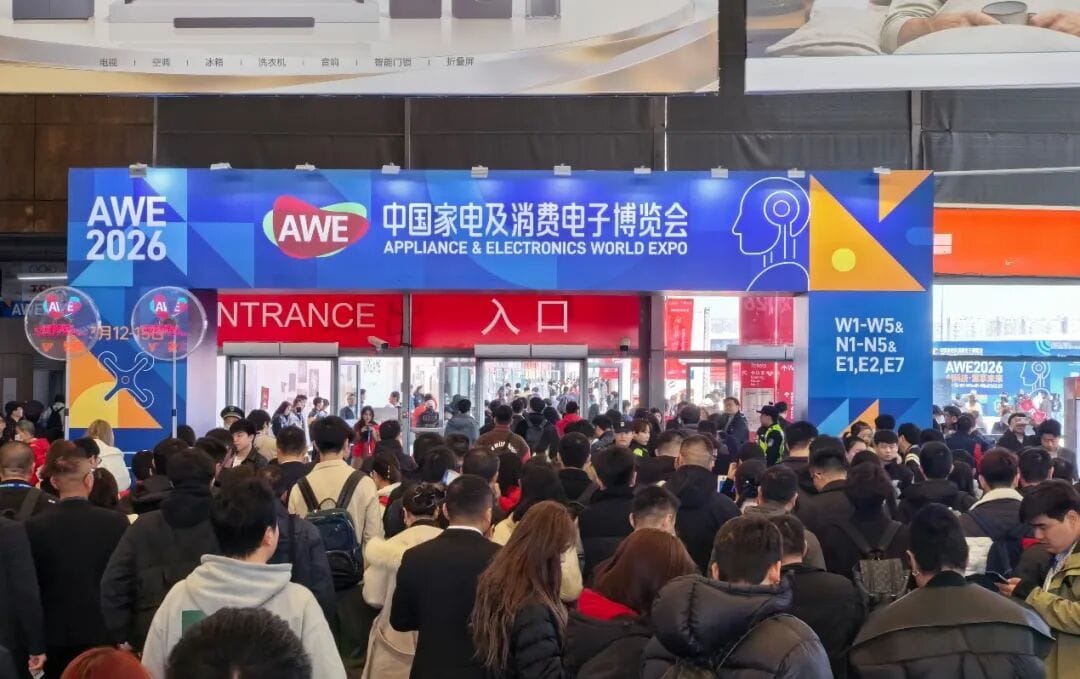
China’s biggest appliance show ended with a paradox: AWE 2026 was packed with AI robots, smart glasses and “appliance-as-agent” demos, while the core domestic home-appliance market is shrinking—forcing makers from Haier to Gree to use AI to defend pricing, deepen distribution and manufacture a new reason for households to upgrade.
The shift is no longer about adding voice control. Exhibitors pushed “appliance + AI” into task automation—robotic arms on floor cleaners, “L4” agent-based home systems, and appliances that respond to indoor air quality or food-recognition models—signaling that vendors see software-led differentiation as the only viable lever in a market pressured by property weakness and fading replacement cycles.
Early market feedback from exhibitors and researchers points to a tougher near-term demand backdrop. AVC estimates that China’s 2025 full-channel retail sales of home appliances, excluding 3C products, fell 4.3% to RMB 893.1 billion (US$124.0 billion).It expects the split air-conditioner market to decline again in 2026, with retail sales projected to fall 6.9% to RMB 230.5 billion, following 2025 sales of RMB 235.7 billion and an average selling price of RMB 3,099 (about US$430).Meanwhile, China’s TV shipments fell to 27.63 million units in 2025, according to AVC.
AI Adds Pricing Power as Volume Weakens
For investors, the core question is whether AI features can rebuild margins faster than unit volumes erode. Vendors are positioning on-device AI chips and scenario-based services as a new value stack—especially in TVs, where compute is becoming a headline spec.
AVC data show far-field voice TVs accounted for 86.8% of China’s 2025 TV sales, while “large-model” AI TVs reached a 38.1% share. That penetration suggests the next battleground is not adoption but monetization: better content recommendation, multi-user recognition and “proactive” service are being framed as reasons to trade up rather than buy cheaper.
Hisense Visual Technology said it is combining AI picture chips with LED advances to push RGB Mini LED TVs and is also preparing AI glasses positioned as a large-screen viewing device. TCL and global brands including Sony and LG used AWE to emphasize display performance and responsiveness—underscoring that premiumization will be fought through hardware-software co-design, not panel size alone.
Robots and Agents Redraw the Product Map
AWE’s most visible “new species” were home-service robots and appliance prototypes with mechanical execution systems—moving white goods toward robotics. Haier Smart Home showcased home-service robots and a food-ingredient AI model for refrigerators, while also promoting an “AI Vision” lineup informed by direct user feedback. Haier’s chairman and CEO Zhou Yunjie said he received more than 9,000 product suggestions via social media over the past year, with 17 converted into product initiatives.
In practice, this user-led iteration shortens the loop between pain points and SKUs—an attempt to keep replacement demand alive even when housing turnover slows. Brands are also segmenting aggressively: Haier highlighted offerings for families with children, older consumers and tea drinkers, signaling a move to demographic-specific product design rather than one-size-fits-all smart features.
In floor care, Dreame and MOVA showcased devices with secondary bionic arms and edge-cleaning mechanisms. Tineco said it is prioritizing functional upgrades—smaller docking stations and foldable designs—over “gimmicks,” a stance that reflects a wider industry dilemma: AI raises bill-of-materials costs, but consumers still anchor on price in a down market.
Retailers and Installers Become the New Battlefield
If AI is the product story, fulfillment is the channel story. Gree Electric Appliances said it will work with JD.com to sell 10 million AI air conditioners over the next three years—an unusually explicit volume target that signals how strongly manufacturers now rely on platform traffic and subsidy-style promotions to move inventory.
Gree has opened more than 1,000 “Dong Mingzhu Health Home” stores nationwide over the past year to expand whole-home smart appliances. It said non-air-conditioner revenue in that channel now accounts for more than 40%—evidence that offline formats are being repurposed from brand showrooms into cross-category conversion engines. The company is also working with Meituan Instashopping to push half-day delivery, removal and installation services, turning logistics speed into a differentiator for bulky goods where installation is often the friction point.
That operational focus matters because many AI features require in-home setup, connectivity and user onboarding. Manufacturers and platforms are effectively competing on “time-to-first-use,” not just retail price.
Standards and Penetration Push AI Toward the Mass Market
China will begin implementing general technical requirements for smart home appliances in May 2026, a regulatory step that should lower interoperability risks and accelerate mainstream adoption. The timing aligns with rising penetration rates across categories, according to AVC.
In air conditioners, “comfortable airflow” smart models reached 26% online penetration and 23% offline penetration in 2025. Offline penetration for voice-enabled split AC units and floor-standing models reached 10.1% and 8%, respectively. In refrigerators, online penetration for models positioned around precise temperature control and energy optimization reached 57.35%.
Those levels imply the market is entering a second phase: differentiation shifts from adding “smart” labels to proving measurable outcomes—energy savings, air-quality management and reduced maintenance. AVC’s He Jinming framed the playbook as “make the value real” and “make the channels deep,” arguing that online-offline integration is essential to deliver the experience AI features promise.
Multinationals Reposition China as an Export R&D Hub
Panasonic is using the same AI wave to reframe China’s role inside its global structure. Panasonic’s CSO and head of its China Northeast Asia business, Masaharu Nakayama, said a newly established Panasonic Corporation will begin operating on April 1, 2026 with business divisions for major appliances, small appliances and AVC products. He described China Northeast Asia as the only region-based unit under the new company with cross-business coordination authority.
Strategically, Panasonic is shifting from “in China, for China” to “in China, for global,” bringing Japan and other Asian sales teams to AWE to evaluate products developed in China for overseas rollout. Panasonic expects the revenue share from Asian markets excluding China and Japan to double to 20% within three years, Nakayama said.
For the wider supply chain, that stance highlights a potential 2026 inflection: China’s appliance makers are not only defending a soft domestic market with AI differentiation—they are also trying to export AI-enabled SKUs and manufacturing capabilities, using AWE as a launchpad to win orders from visiting buyers from Korea and Europe.
Related Coverage:
Chinese Appliance Giants Bet on AI Glasses to Seize Next Hardware Frontier