
Momenta R7 Goes into Production in SAIC Volkswagen ID. ERA 9X, Signaling China’s Shift Toward ‘Physical AI’
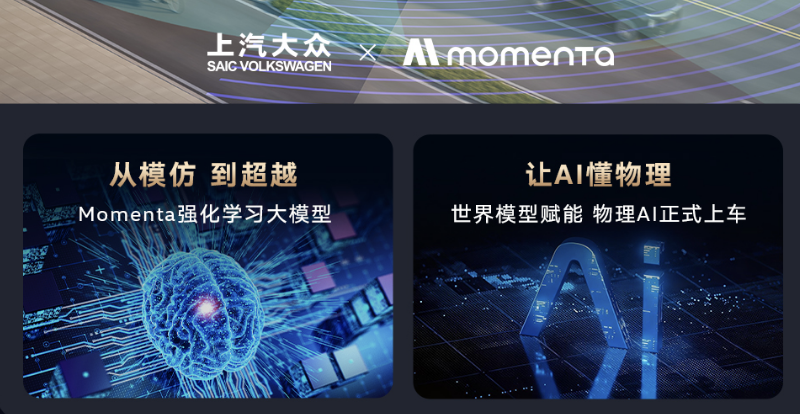
Momenta said it will debut its next-generation autonomous driving foundation model, R7, on SAIC Volkswagen’s flagship SUV, the ID. ERA 9X—an inflection point that reframes China’s driver-assistance race from “seeing the road” to reasoning about physics in real time.
At an ID. ERA technology event on March 16, Momenta Chief Executive Officer Cao Xudong positioned R7 as the company’s first production step into “world model” autonomy, where the system builds an internal representation of objects, motion and causality rather than relying mainly on statistical correlations.
The pairing also matters strategically: SAIC Volkswagen’s adoption marks one of the clearest moves yet by a legacy joint-venture brand to close the perceived software gap versus Tesla, Huawei-backed ecosystems and China’s domestic EV startups—using a supplier whose model roadmap is explicitly moving beyond imitation learning.
World modeling reframes autonomy from pattern matching to causality
For most of the last decade, mainstream autonomous driving stacks improved by scaling perception and imitation learning—training systems to replicate human driving trajectories. That approach delivered fast gains but capped performance at “average human,” because the data fundamentally encodes human limits.
The industry’s pivot toward reinforcement learning around 2024 aimed to break that ceiling by rewarding safer, more optimal actions rather than copying humans. Momenta’s R6, launched in 2025, exemplified the shift: decision-making moved from replaying trajectories to selecting optimal ones in multi-agent scenarios such as pedestrian crossings, cut-ins and complex intersections.
R7 pushes the next step. A world model, as described by Momenta, is designed to represent physical attributes and dynamics—how objects move, interact and constrain each other—so the system can predict outcomes under changing conditions. The investment thesis is straightforward: long-tail events are less about recognizing objects and more about inferring what they will do under physical constraints.
Combining reinforcement learning with a world model targets iteration speed
Momenta’s bet is that reinforcement learning without an internal physics-based simulator remains sample-inefficient and costly to validate, because real-world trial-and-error is expensive. A world model can narrow the search space by letting the agent explore strategies inside a learned representation of physical rules, then transfer policies to real driving.
Cao argued the result should resemble human driving logic—continuous prediction and planning—rather than reactive rule execution. For automakers, that promise translates into a potentially faster software iteration cycle and a clearer narrative to consumers: fewer edge-case surprises and more consistent behavior in dense traffic.
Momenta has previously said it sees “Moore’s law-like” improvements in driving experience—historically about a 10x gain every two years—accelerating toward 10x per year as reinforcement learning and world models mature. While the company did not disclose R7 parameter counts, it explicitly contrasted its approach with VLA (Vision-Language-Action) systems that often scale toward ~100 billion parameters, arguing that language capacity is not the bottleneck for driving.
SAIC Volkswagen’s adoption raises the stakes for joint ventures
For SAIC Volkswagen, putting R7 into the ID. ERA 9X is less a feature update than a repositioning. Joint-venture brands have ceded mindshare in China’s “smart driving” marketing war, where software perception often outweighs hardware specs. Moving to a reinforcement-learning-plus-world-model stack gives SAIC Volkswagen a way to claim parity on architecture, not just on sensors.
That shift could ripple through procurement. A world-model roadmap prioritizes data flywheels and closed-loop engineering over incremental sensor additions. Momenta’s own hierarchy places real-world data first, unified architecture second, and continuous engineering iteration third—ranking compute and sensors below those capabilities. If that ordering becomes consensus, it would pressure suppliers that compete primarily on sensor bills-of-materials and push OEMs to concentrate spend on data pipelines, simulation, and model tooling.
Scale and geography position Momenta as a cross-border software supplier
Momenta said it has accumulated more than 170 design wins, over 70 production models, and more than 700,000 vehicles on the road with its technology. The company also cited deployments in markets including the UK, Norway, Australia, the UAE and Thailand—an important point for global automakers that want software suppliers with compliance experience beyond mainland China.
The R7 launch on a high-profile SAIC Volkswagen model will be watched as a test of whether “physical AI” can deliver measurable safety and comfort gains under production constraints—latency, compute budgets and validation requirements—rather than in curated demos. For investors and strategists, the bigger signal is that China’s autonomy competition is tilting from hardware differentiation toward model architecture and data scale, with joint-venture brands now re-entering the fight through supplier-led software resets.
Related Coverage:
Volkswagen pivots to range-extended EVs in China with SAIC VW’s ID. ERA 9X
Volkswagen Adopts Xpeng's XNGP Technology as CARIAD Shifts to Integration Role