
China's AI Healthcare Market: A ¥150B Industry Still Searching for a Business Model
What Is AI Healthcare — and Why Does It Keep Attracting Capital?
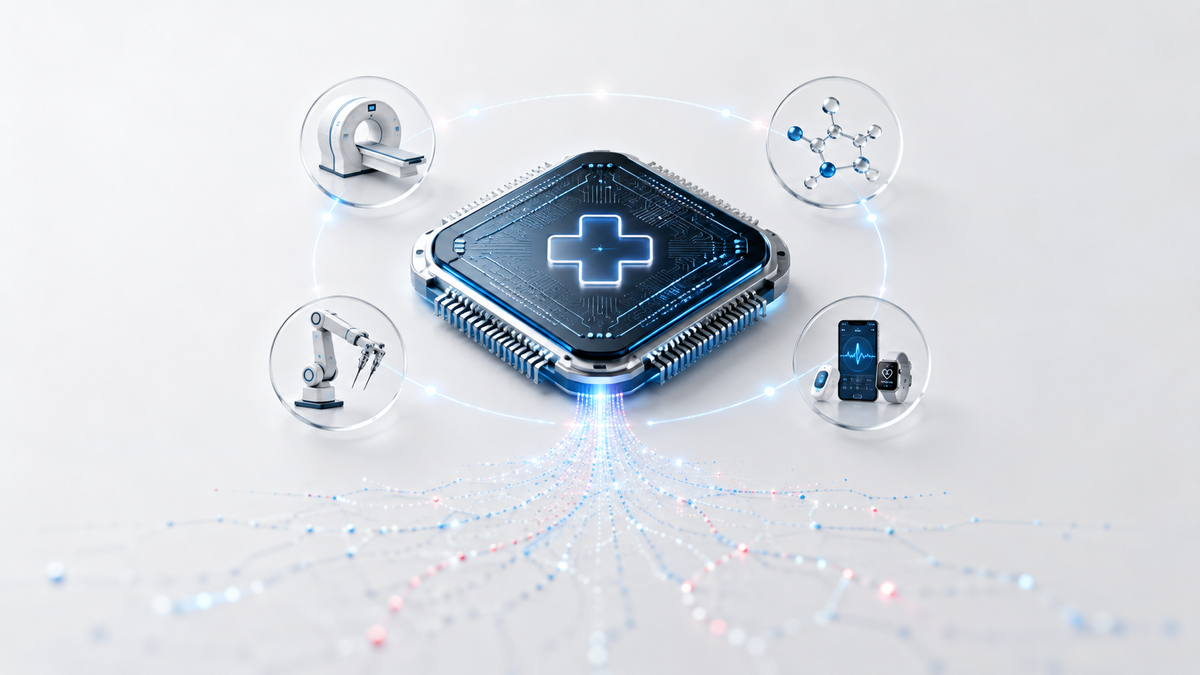
AI healthcare refers to the application of artificial intelligence across the medical value chain: helping doctors read scans, accelerating drug discovery, guiding surgical planning, and managing chronic conditions at scale. In China, the sector has attracted successive waves of investment over the past decade, driven by a combination of structural pressures — an aging population, a shortage of specialist physicians, and rising chronic disease burdens — that make the case for automation unusually compelling.
The numbers reflect sustained investor conviction. According to Analysys, China's AI-plus-healthcare market has surpassed ¥150 billion (approximately $21 billion) in total market size, growing at a compound annual rate of 40–50% — far outpacing the broader healthcare sector. Penetration is deepening: AI-assisted diagnostic systems now reach more than 65% of China's top-tier (Class III) hospitals and 40% of secondary hospitals. By the end of 2025, China's National Medical Products Administration (NMPA) had approved more than 120 Class III AI medical device registrations — the highest regulatory category — with 134 AI medical imaging software approvals recorded by mid-2026.
Yet despite the headline figures, the industry's central tension remains unresolved: market size and profitable revenue are not the same thing.
Why This Moment Feels Different From the Last Cycle
China's AI healthcare sector experienced a prior boom around 2020–2021, when four high-profile startups — Keya Medical, Infervision, Shukun Technology, and Airdoc — simultaneously pursued IPOs. Of the four, only Airdoc successfully listed. The others stalled. Airdoc's own stock has since fallen from a peak of HK$75 to single digits.
The structural problems exposed by that cycle were consistent across companies: core AI products could not generate revenue at scale, R&D spending was unsustainable, and no viable commercialization pathway could be demonstrated to investors.
What distinguishes the current wave is a combination of two factors.
Technology discontinuity. The emergence of large language models — accelerated in China by DeepSeek's breakout in early 2025 — introduced generalization and multimodal reasoning capabilities that earlier narrow AI systems lacked. Industry participants describe this as the moment AI shifted from being a specialized tool to something resembling a general-purpose assistant. Medical vertical large models entered a period of dense releases and rapid iteration through 2025. For the first time, the technology appeared capable of handling unstructured clinical data — patient histories, physician notes, complex imaging — rather than only standardized, labeled datasets.
Policy inflection. In 2024, China's National Healthcare Security Administration introduced an "extension item" category for AI-assisted diagnosis within its medical service pricing framework — the first formal signal that AI diagnostic services could eventually be reimbursed through the public insurance system. Subsequent national-level communications have encouraged local governments to explore AI application scenarios in healthcare settings.
Together, these shifts have reignited both capital interest and strategic positioning among incumbents and new entrants alike.
How AI Is Actually Being Used in Chinese Hospitals
The practical applications of AI in healthcare fall along a spectrum of technical maturity and commercial readiness. Four domains define the current landscape.
AI-Assisted Diagnosis: The Most Mature Segment
Medical imaging AI is the furthest along commercially. The underlying mechanism is straightforward: algorithms trained on large annotated datasets of CT scans, X-rays, and retinal photographs learn to identify pathological patterns and flag regions of interest for physician review. China's AI medical imaging market exceeded ¥15 billion in 2025 and is projected to reach ¥23.6 billion in 2026.
Clinical adoption, however, is more nuanced than market figures suggest. A neurosurgeon at a Beijing Class III hospital described to one industry publication how AI's genuine clinical value in imaging lies primarily in quantitative analysis — for example, calculating the precise volume of a cerebral infarction by reconstructing three-dimensional models from sequential imaging slices. This reduces estimation error that would otherwise affect treatment planning. He estimated that three-dimensional reconstruction systems with this capability are installed in 70–90% of top-tier hospitals.
At the same time, he cautioned that a significant proportion of products marketed as "AI imaging" remain, in substance, advanced digital image processing — outputs of the previous generation of deep learning image recognition, not the newer reasoning-capable systems. Full autonomous lesion identification in complex cases remains an unsolved problem. No large model is yet capable of independently completing a diagnostic workflow end-to-end.
AI Drug Discovery: Largest Addressable Market, Longest Validation Timeline
Drug development's "double-ten dilemma" — a decade of development time and $1 billion in cost per approved compound, with high failure rates — makes it an obvious target for AI intervention. AI's primary role is at the front end of the pipeline: target identification, molecular design, and protein structure prediction, compressing laboratory trial-and-error into computational simulation.
As of mid-2026, more than 170 drug candidates designed or optimized by AI have entered clinical trials globally, with over ten reaching Phase III — the final human trial stage before regulatory submission. The industry has designated 2026 the "clinical validation year" for AI drug discovery.
The critical caveat: no drug designed entirely by AI from scratch has yet received regulatory approval. Human physiology introduces variables that computational models cannot fully anticipate. Candidates that perform well in silico have failed in clinical trials. The neurosurgeon's assessment was measured: AI may compress the development cycle for an innovative drug from 15–20 years to perhaps 10–15 years, but the mandatory safety validation stages of clinical trials cannot be bypassed or accelerated.
AI in Treatment and Surgery: High Potential, High Barriers
AI applications in treatment span treatment protocol matching, surgical pathway planning, and robotic-assisted surgery. The first two layers — both operating at the pre-operative planning stage — have seen some commercial deployment. Robotic-assisted surgery, where mechanical arms replicate a surgeon's movements with sub-millimeter precision under physician control, represents the most discussed and most contested application.
The barriers are substantial. Da Vinci surgical systems, the global benchmark, have been installed in a limited number of Chinese hospitals but face constraints from high equipment and consumable costs and lengthy surgeon training requirements. Remote surgery, frequently cited in technology media, faces a more fundamental obstacle than AI capability: network latency and signal reliability. In surgical contexts, these are not engineering inconveniences — they are patient safety risks.
The more promising near-term pathway, according to clinical practitioners, is the intersection of medicine and engineering design: AI facilitating collaboration between engineers who lack anatomical knowledge and physicians who lack materials science and fluid dynamics expertise, enabling better medical device innovation.
AI Health Management: Scale Without Monetization
Consumer-facing health management is structurally the lightest segment — lower regulatory barriers, faster user acquisition, and business models more familiar to internet companies. The numbers are large: Ant Group's Afu health application has surpassed 100 million cumulative users and 30 million monthly active users, handling more than 10 million health consultations daily. JD Health reports AI consultation penetration of 80%. Ping An Good Doctor's AI physician handles up to 4 million consultations per day.
The structural problem is payment. Consumer willingness to pay for digital health management services remains low. One industry observer described a recurring failure mode in AI health consultation products: over-responding to minor symptoms while under-flagging serious conditions — a consequence of knowledge boundary limitations that erodes user trust. In this segment, scale effects matter more than technical differentiation, but converting free users to paying subscribers is harder than user acquisition.
Three Types of Players — and Why Most Won't Survive
The competitive landscape in China's AI healthcare sector can be organized into three distinct categories, each with different structural advantages and vulnerabilities.
Category One: Big Tech Platforms
Tencent, Ant Group, JD Health, ByteDance, and Alibaba Health bring capital scale, large user bases, and strong general-purpose AI infrastructure. Their strategic logic is to establish consumer health management entry points and use that scale to penetrate hospital-facing B2B markets.
ByteDance has made the most aggressive commitment: a ¥6 billion investment to build what it describes as China's first "AI-native hospital" in Beijing's Chaoyang district, building on earlier acquisitions of premium women-and-children hospitals. Ant Group has pursued a pure consumer platform approach. Tencent operates through investment and cloud services. Alibaba and JD Health remain primarily anchored in pharmaceutical e-commerce — JD Health's 2025 revenue of ¥73.4 billion was more than 80% derived from drug and health product sales, with AI functioning as a conversion optimization tool rather than a core product.
The structural limitation of this category is temporal mismatch. Big tech companies are optimized for fast iteration and scale. Healthcare operates on long regulatory cycles, requires deep clinical validation, and monetizes slowly. One industry analyst assessed that Tencent and Ant Group's contributions remain concentrated around scheduling and payment infrastructure — maintaining existing workflows rather than transforming clinical practice.
Category Two: Medical Equipment Manufacturers
Companies such as United Imaging Healthcare, Mindray, and Cofoe Medical integrate AI as a value-added layer on top of established hardware and software products. Their competitive advantages are distribution relationships, regulatory approvals, and installed base.
United Imaging's AI subsidiary has accumulated 20 NMPA Class III certifications — the most of any single entity — and has deployed AI products across more than 4,000 healthcare institutions. The hardware-software bundling model provides a defensible commercialization pathway that pure software companies struggle to replicate.
The constraint is transformation speed. Hardware upgrade cycles are inherently slower than software iteration. As healthcare procurement increasingly shifts from relationship-driven to product-driven purchasing — a consequence of ongoing medical procurement reform and volume-based purchasing policies — these companies face pressure to compete on demonstrable clinical value rather than established sales relationships.
Category Three: AI-Native Healthcare Companies
This category includes companies built entirely around AI for healthcare — Shukun Technology, Airdoc, Yidu Tech, and DeepWise — as well as general-purpose AI companies that have pivoted to healthcare, most notably Baichuan AI, which announced a full strategic pivot to medical AI in March 2025 and launched its Baichuan-M4 medical large model.
SenseTime Medical, spun out of AI vision company SenseTime, completed a strategic financing round of over ¥500 million in April 2026 and a subsequent Series B of over $100 million, pushing its post-money valuation above ¥10 billion. The company has entered pre-IPO preparations, positioning itself around the concept of a "medical world model."
Yidu Tech achieved its first full-year profitability in fiscal year 2026, reporting net profit of ¥78.77 million. Airdoc reported 2025 revenue of ¥173 million, up 10.8% year-on-year, with losses narrowing 90.2% — though the improvement was driven primarily by cost reduction, provision reversals, and interest income rather than revenue acceleration. Revenue in the first half of 2025 actually declined 10.67% year-on-year.
The structural vulnerability of software-first AI-native companies is access. Since 2021, some hospital primary system integrators have stopped granting API access to third-party developers. Without integration into core hospital information systems, AI products function as add-ons that cannot fully embed in clinical workflows. When a large model encounters unstructured or incorrect patient inputs during a consultation, the output quality degrades in ways that external "patch" solutions cannot reliably address.
The Central Question: Who Pays?
Market size figures describe potential. The more revealing question is the structure of actual revenue flows. Four payment pathways currently exist, with very different characteristics.
Public insurance reimbursement remains the most consequential but least certain pathway. Policy signals in 2024 opened the conceptual door to AI diagnostic reimbursement, but standardized pricing and reimbursement schedules have not been established at national scale. If and when this pathway matures, it would provide the most stable and scalable revenue base for the sector.
Hospital procurement is the most direct current pathway but faces intensifying price pressure. Under cost-containment policies and expanding volume-based procurement, hospitals have become more price-sensitive. Software products are particularly vulnerable — hospitals' acceptable price points sometimes fall below vendor cost structures.
Pharmaceutical company partnerships offer the clearest commercial logic for AI drug discovery companies. Insilico Medicine signed four multinational pharmaceutical partnerships in the first half of 2026 with a combined potential value approaching $7 billion. XtalPi achieved its first full-year profitability in 2025. Drug companies will pay for tools that demonstrably reduce development timelines and increase success rates. This pathway, however, is structurally limited to AI drug discovery players and is not available to diagnostic or health management companies.
Consumer direct payment has the largest theoretical addressable population but the lowest realized monetization. Health management behaviors in China remain predominantly reactive rather than preventive. Users who access AI health consultations for free show limited willingness to pay for premium services.
The practical implication: profitable companies in AI healthcare currently cluster in two categories — hardware-integrated manufacturers with established hospital relationships, and AI drug discovery companies with pharmaceutical partnerships. Pure software AI companies face the most difficult commercialization environment.
What Determines Long-Term Survival
Industry practitioners converge on a consistent view: companies that cannot adapt to both market dynamics and technological evolution will exit. The timing varies; the direction does not.
The business model that appears most defensible is one that avoids dependence on any single product or revenue stream. One analyst framed it using an infrastructure analogy: SpaceX's launch business alone remains unprofitable, but Starlink creates a complementary revenue stream that subsidizes launch capacity and distributes fixed costs. The equivalent in healthcare AI would be a platform that covers full hospital system infrastructure while simultaneously serving adjacent markets — commercial insurance, health management, retail health — with shared underlying technology.
The hardware-software integration thesis follows similar logic. Neither pure software nor pure hardware is likely to achieve durable market leadership independently. The companies best positioned to consolidate are those that can combine proprietary hardware distribution with AI software capabilities and adjacent service revenues — effectively making the AI layer inseparable from the broader clinical workflow.
The sector's consolidation dynamic is not unique to China. Globally, AI healthcare is moving toward a smaller number of better-capitalized platforms. In China, the combination of regulatory complexity, hospital procurement reform, and the technical demands of large model deployment accelerates this concentration. The question for investors and operators is not whether consolidation will occur, but which structural position — hardware anchor, platform scale, or drug discovery specialization — will prove most defensible when it does.
Related Coverage:
SenseTime Pivots Smart Home to Break Auto AI Bottleneck
China’s Tech Giants Race Into AI Pharma With Five Distinct Playbooks