
China’s AI Office Race Is Becoming a Test of Enterprise Monetization
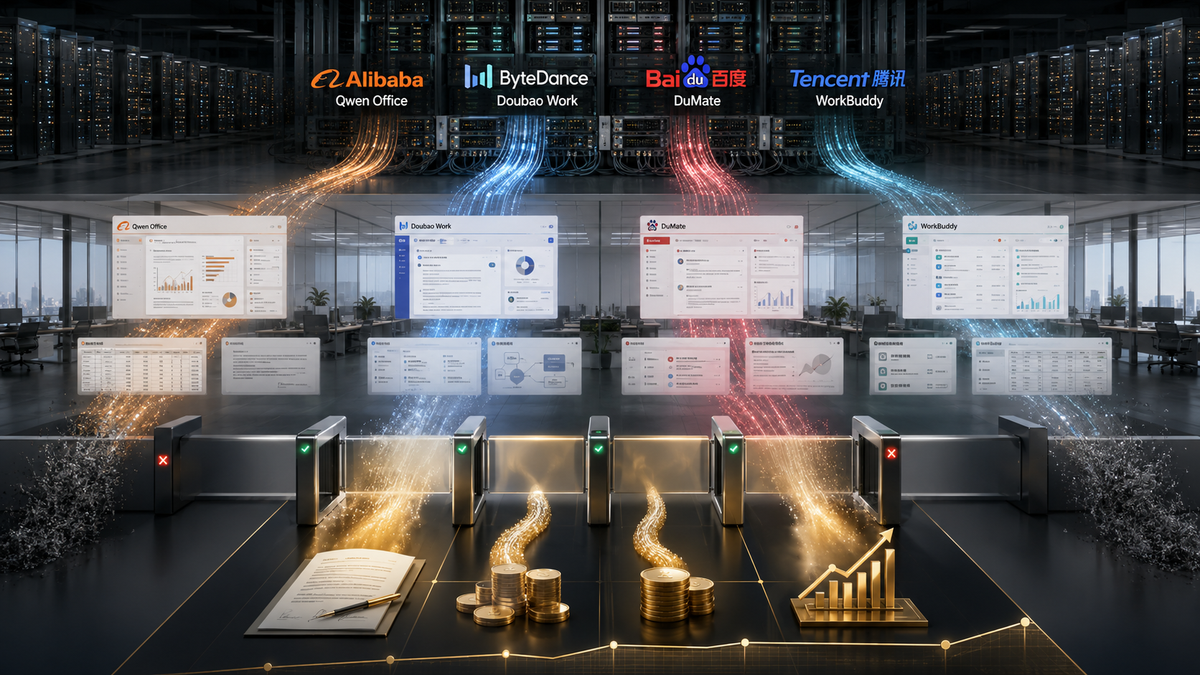
A five-month sprint by ByteDance, Alibaba, Tencent and Baidu to dominate AI-powered workplace software masks a deeper commercial imperative: converting runaway AI infrastructure losses into recurring enterprise revenue before shareholders demand accountability.
The convergence became unmistakable in the final week of August 2026. On Aug. 25, ByteDance formally launched "Doubao Work", a unified AI office entry point fusing its Feishu collaboration suite with its Doubao large language model—less than a month after the two product teams merged. Two days later, Baidu rolled out a comprehensive upgrade to its "DuMate" platform spanning personal, enterprise and professional-suite tiers. The announcements capped a 60-day window that also saw Alibaba Group consolidate three agent products into "Qwen Office" and Tencent ship its WorkBuddy enterprise suite with a native Agent Suite on June 5. Kingsoft Office, the lone pure-play productivity incumbent, countered with its "Lingxi Professional" AI agent at a Shanghai launch event.
The simultaneity is not coincidental. Interviews with insiders at Baidu and Kingsoft Office, combined with publicly disclosed financial data, reveal that the pivot to AI office is less a product bet than a balance-sheet repair strategy—one driven by the urgent need to monetize sunk costs that are now visibly eroding group-level profitability.
Ballooning Losses Force a Monetization Pivot
The financial pressure underpinning the office land-grab is stark. Alibaba's latest quarterly results show its "AI Labs & Applications" segment posted an adjusted EBITA loss of RMB 13.861 billion (approximately US$1.93 billion), a year-on-year deterioration of 330%. Despite AI-related product revenue clocking 12 consecutive quarters of triple-digit growth—with quarterly revenue reaching RMB 12.376 billion (US$1.72 billion) and annualized recurring revenue (ARR) surpassing RMB 49.5 billion (US$6.88 billion)—the group's Q2 2026 operating profit fell 57% year-on-year as AI capex consumed margin.
Tencent's Q2 2026 capital expenditure reached RMB 52.784 billion (US$7.33 billion), up 176% year-on-year, pushing free cash flow into negative territory at -RMB 13.8 billion (US$1.92 billion) for the first time—even after stripping out computing-capacity prepayments, free cash flow stood at a thinning RMB 37.6 billion (US$5.22 billion). ByteDance, according to a May 2026 Reuters report, raised its 2026 AI infrastructure capex budget by approximately 25% to RMB 200 billion (US$27.78 billion).
Pure-play model companies are equally strained. MiniMax reported a net loss of US$358 million in H1 2026, even as revenue reached 1.5 times its full-year 2025 figure. DeepSeek recorded a net loss of RMB 715 million (US$99.3 million) in the first seven months of 2026, despite generating revenue equivalent to 10 times its full-year 2025 total. Zhipu AI hit a US$1 billion ARR milestone in July 2026.
The lone profitable data point is instructive: Moonshot AI, the only model company to have disclosed a profit, derives more than 70% of its B2B revenue from API calls. DeepSeek's API business carries a gross margin of 82.9%. The message for platform giants is unambiguous—token-based B2B monetization works; consumer novelty use cases do not justify the capex.
Four Distinct Strategies Emerge From Apparent Homogeneity
Surface-level product comparisons reveal near-identical feature sets: document and spreadsheet processing, automated task scheduling, content generation, and browser control. Pricing, too, clusters tightly. Monthly personal subscriptions run RMB 59 (Baidu DuMate), RMB 68 (Doubao Work), RMB 70 (WorkBuddy) and RMB 78 (Qwen Office). Enterprise per-seat pricing converges around RMB 166–198 per month, with all four platforms adopting a "seat-plus-execution-credit" model that ties billing to task throughput rather than flat access fees—an implicit acknowledgment that value delivery, not feature availability, is the commercial proposition.
Beneath the pricing parity, however, four differentiated strategic postures are discernible:
Alibaba's Qwen Office inherits DingTalk's enterprise IM infrastructure and existing corporate client base, positioning it as an AI layer grafted onto an established workflow rather than a greenfield product. Its core advantage is organizational depth within Alibaba's existing enterprise ecosystem.
ByteDance's Doubao Work integrates TRAE, Coze and Feishu, with a desktop sidebar architecture emphasizing multi-agent orchestration. Deep Feishu integration allows the AI to ingest group chat logs, meeting minutes, documents and calendar data within user-defined permissions—reducing the onboarding friction of context-loading that plagues generic LLM assistants.
Tencent's WorkBuddy is the sole platform to remain model-agnostic, supporting DeepSeek, GLM, Kimi and MiniMax alongside its proprietary Hunyuan model. Its standalone knowledge-base infrastructure—bridging Tencent Docs, ima knowledge base and Lexiang repositories—functions as a persistent memory layer, enabling users to train personalized agents over time.
Baidu's DuMate leans on full-stack technical breadth, bundling Baidu Search, deep-research tools and vertical agent skills (Shengsuang, Famou, Miaoда) into a professional task-delivery framework suited to research-intensive workflows.
Kingsoft Office's Lingxi Professional occupies a distinct position as the only non-conglomerate entrant, drawing on 38 years of document-editing expertise. It supports all major third-party models—including Doubao, Qwen and Xiaomi's MiMo—without any proprietary model lock-in or token-traffic monetization dependency. Its "Favorites" feature for long-term knowledge accumulation targets individual power users rather than enterprise IT buyers.
Enterprise Adoption Lags Individual Validation
Despite the product offensive, monetization timelines remain uncertain. A Baidu insider told 36Kr's Jingzhe Research Institute that internal task analytics show 60% of user tasks now span more than three workflow stages—search, analysis, content creation and formatting—while 86% have a defined deliverable endpoint such as a report submission or publication. Critically, 95% of users immediately download, export, share or continue editing AI-generated outputs, signaling that demand has shifted from content generation to end-to-end task completion.
Individual users have demonstrated willingness to pay for measurable productivity gains. Enterprise conversion is a different matter. A Kingsoft Office insider framed the bottleneck precisely: "The CEO and CFO will ultimately ask—how much did AI cost, where did the money go, what costs were saved, and what value was created." Until AI office platforms can answer that question with auditable ROI data, corporate procurement cycles will remain cautious.
The structural tension is well-defined: employees adopt AI tools to reduce personal workload; enterprises fund AI tools to increase organizational output. These incentives are not always aligned, and the mismatch is slowing the transition from viral individual adoption to contracted enterprise deployment.
Capability Gap, Not Capital, Determines Long-Term Winners
The Kingsoft Office insider offered the sharpest competitive framework: "AI capability and office capability are fundamentally two different capability stacks. Tech giants need to build office competency; office software companies need to build intelligence competency. The real competition is not who has the strongest single-point capability, but who first integrates both into a complete closed loop."
The Baidu insider concurred from a different angle: "What determines long-term competitiveness is not model parameters or feature count, but whether complex tasks can be completed reliably, whether outputs can be used directly, and whether individual experience can be converted into organizational capability."
That framing repositions the competitive landscape. Conglomerate advantages—model scale, compute access, capital and existing user bases—accelerate product iteration and user education. They do not automatically translate into deep office competency. Kingsoft Office's 38-year document-processing heritage, or the workflow intimacy that DingTalk has built within Alibaba's enterprise client base, represent moats that cannot be replicated through model upgrades alone.
The AI office market in China is, by all credible accounts, still in early-stage commercial development. Individual users have validated the value proposition; enterprise budgets have not yet followed. The next 12 months will test whether any platform can close the loop between AI capability and measurable organizational ROI—the only metric that will ultimately determine whether this is a winner-take-most market or a segmented one where specialized incumbents retain durable ground.
Related Coverage:
China’s AI Office War: How Tencent, Alibaba and ByteDance Are Squeezing Model Startups