
China's AI Office War: Why ByteDance, Alibaba, and Tencent Are Rebuilding the Workplace
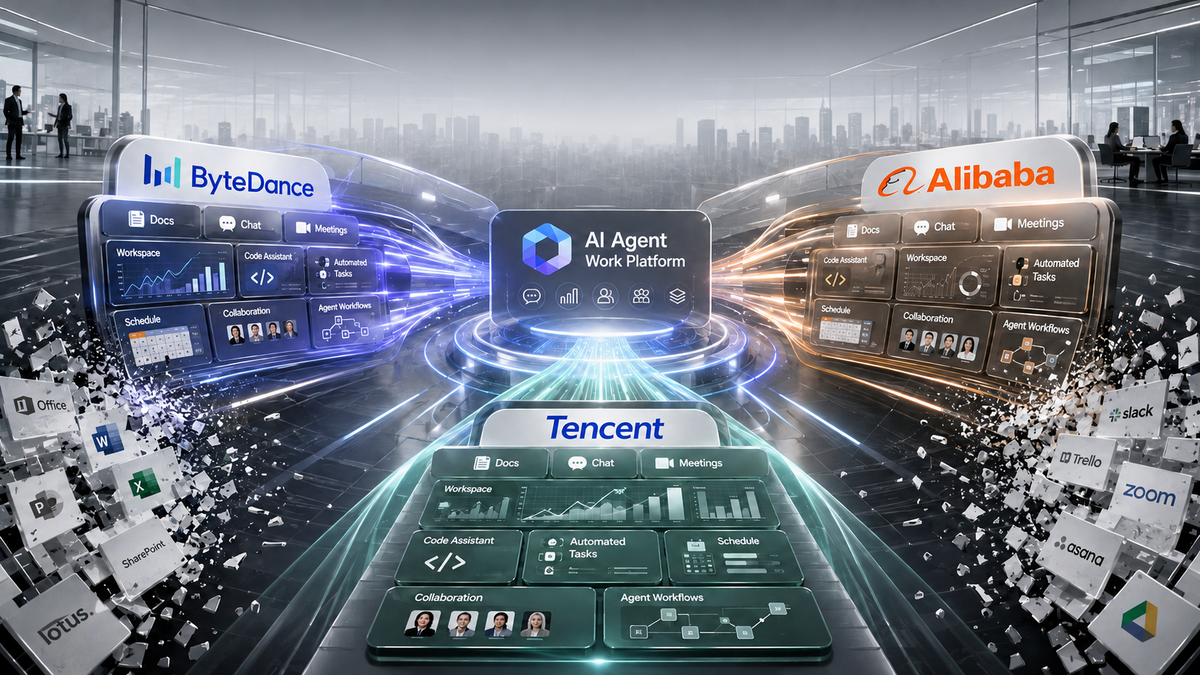
How three tech giants are racing to own the next generation of enterprise productivity — and why the window to win is closing fast.
What Is AI-Native Office Software — and Why Does It Matter?
For most of the past decade, "AI in the workplace" meant bolt-on features: a smart autocomplete here, an automated meeting summary there. The underlying architecture of office software — documents, spreadsheets, messaging channels — remained unchanged.
That model is now being dismantled.
A new category is emerging: AI-native office platforms, where artificial intelligence is not a feature layered on top of existing tools, but the foundational logic around which the entire workflow is designed. Users don't just open a document and ask AI for help — the AI agent operates autonomously across tasks, orchestrates multi-step processes, and collaborates with human workers in real time.
In China, the race to build and own this category has entered a decisive phase. Within a single two-week window in late July 2026, ByteDance, Alibaba, and Tencent each announced major structural reorganizations — not product updates, but fundamental changes to how their AI and office divisions are organized. The simultaneity was not coincidental.
What Did Each Company Actually Do?
Understanding the competitive dynamics requires looking at each move on its own terms.
ByteDance: Absorbing Lark Into Doubao
On July 30, ByteDance CEO Liang Rubo issued an internal memo announcing that Lark (Feishu), the company's enterprise collaboration suite, would be split and absorbed into other units. The product team was merged into Doubao — ByteDance's flagship AI model and consumer application — while the sales and go-to-market functions were folded into Volcano Engine, ByteDance's cloud and enterprise services arm.
The strategic logic is straightforward. Doubao has reached 382 million monthly active users and an annualized revenue run rate exceeding $4 billion as of July 2026 — more than all other Chinese AI model companies combined, according to ByteDance's own disclosures. Over 90% of Lark's newly signed enterprise clients were simultaneously purchasing AI feature modules. Rather than maintain two separate teams building toward the same destination, ByteDance collapsed the distance between its AI capability layer (Doubao) and its enterprise workflow layer (Lark).
The result is a new organizational unit called the "Doubao Product Team" that owns both the AI model and the office application built on top of it.
Alibaba: Three Agents Become One
Alibaba's reorganization was a consolidation of fragmentation. The company had accumulated three separate AI agent products targeting the enterprise market: QoderWork (desktop), MuleRun (web), and Wukong (enterprise-grade). On August 3, these were unified into a single product: Qwen Office, which entered public beta.
Organizationally, the three products ceased to exist as independent entities. All personnel were absorbed into a new Qwen Office Business Unit within Alibaba's ATH (Alibaba Token Hub) group, led by Chen Yusen. Senior leadership, including group-level executives, participated directly in key product decisions — a signal of strategic priority.
Alibaba's declared positioning is explicitly B2B: an AI productivity platform for enterprise organizations, not a consumer tool. This distinguishes it from Doubao's dual consumer-enterprise model and reflects Alibaba's historical strength in enterprise software through DingTalk.
Tencent: Building a Standalone AI Office Agent
Tencent's approach was less a restructuring than a product maturation. Its AI office agent, WorkBuddy, launched as a standalone app across iOS, Android, and Huawei's HarmonyOS on July 18 — the first desktop office agent on the HarmonyOS platform.
On July 30, WorkBuddy introduced "human-AI co-writing": a collaborative editing mode where users, colleagues, and AI agents can simultaneously edit the same document, spreadsheet, or presentation. Natural language instructions trigger direct modifications to source files, with changes synced in real time. The feature covers Tencent Docs as well as local Word, Excel, PowerPoint, and Markdown files.
The growth trajectory is notable: WorkBuddy's monthly visits grew from 8.85 million in March to 20.97 million in June 2026, more than doubling in a single quarter, according to Analysys data published in July 2026.
Why Are All Three Moving at the Same Time?
The synchronization of these moves is not coincidental. Three structural forces converged to create a shared urgency.
1. Office Is the Highest-Value Token Consumption Environment
AI models generate revenue primarily by processing tokens — the units of text, data, and instructions that flow through the system. Not all use cases are equal: consumer chatbot queries are low-frequency and low-value; enterprise office workflows are high-frequency, high-retention, and high-willingness-to-pay.
A single knowledge worker using an AI-native office platform generates continuous token demand across document drafting, data analysis, meeting summarization, task orchestration, and inter-system communication. ByteDance's revenue surge from Doubao has been attributed specifically to deep embedding in coding assistance and agent workflows — precisely the kind of sustained, complex task environments that office work represents.
For AI companies, capturing enterprise office workflows is not just a product goal — it is the most direct path to monetizing model capability at scale.
2. Agent Capability Has Crossed a Usability Threshold
Earlier generations of AI in the workplace were constrained by the models themselves. AI could answer questions, summarize documents, and generate drafts — but it could not reliably execute multi-step tasks without human intervention at each stage.
That constraint is lifting. Industry observers, including Staircase AI's chairman Yin Qi, have noted that 2026 represents an inflection point: AI agents have progressed from handling tasks measured in seconds to operating autonomously for hours-long work sessions. This is the capability threshold required for genuine workflow integration — not just answering a question, but completing a project.
Office work is, by nature, a long-horizon task environment. Preparing a financial report, coordinating a product launch, or managing a client relationship involves dozens of interdependent steps over hours or days. The moment agents can reliably navigate this complexity is the moment AI-native office software becomes genuinely superior to traditional tools with AI features added on.
3. The Entry-Point Window Is Narrowing
The competitive pressure is not only domestic. OpenAI has integrated ChatGPT with Codex in a product called ChatGPT Work, and Microsoft has confirmed that a Copilot "super-app" will launch before the end of 2026. Both moves point toward the same architectural vision: a unified AI interface that serves as the primary entry point for all workplace activity.
If Chinese tech companies fail to consolidate their internal fragmentation before that window closes, they risk losing the platform entry-point advantage in their home market — the ability to be the default AI layer through which enterprise users access all their tools. Entry points, once established, are difficult to displace.
What Is the Underlying Business Logic?
All three reorganizations reflect the same structural insight: standalone AI features do not create defensible businesses; unified workflow entry points do.
A company that offers an AI writing assistant competes on feature quality — a race that any well-funded competitor can run. A company that owns the platform through which a user accesses documents, data, communications, task management, and external integrations holds something categorically different: a distribution moat reinforced by workflow lock-in.
IDC, in a joint report with Tencent Cloud, framed the transition this way: the future of collaborative office software is not "AI embedded in traditional tools" but "native architectures designed for deep human-AI collaboration." The report projects that by 2030, 95% of job roles will be redefined, with workers shifting from executing repetitive tasks to acting as "task architects" — directing AI agents rather than performing the underlying work themselves.
This framing matters for understanding why the reorganizations look the way they do. ByteDance is not upgrading Lark's AI features; it is building a new kind of platform that happens to include what Lark used to do. Alibaba is not adding agents to DingTalk; it is constructing an agent-first productivity system that operates alongside DingTalk's communication infrastructure. Tencent is not making its documents smarter; it is creating a collaborative environment where AI is a co-equal participant in the editing process.
Who Are the Key Players — and Why Will Few Survive?
The Chinese AI office market currently has three credible platform-level competitors, each with distinct strategic assets:
|
Company |
Core
Asset |
AI Entry
Point |
Strategic
Positioning |
|
ByteDance |
Doubao's
382M MAU + $4B ARR |
Doubao
Enterprise |
Consumer-to-enterprise
AI model leader |
|
Alibaba |
DingTalk's
enterprise install base |
Qwen
Office |
B2B-first
AI productivity platform |
|
Tencent |
WeChat/WeCom
ecosystem + WorkBuddy |
WorkBuddy |
Human-AI
collaborative editing |
Beyond these three, a range of smaller players — dedicated AI office startups, vertical SaaS companies adding AI features, and international entrants — compete for specific niches. But platform competition in enterprise software historically consolidates toward a small number of winners for structural reasons: data network effects (more usage improves the AI), integration depth (the more systems a platform connects, the harder it is to replace), and organizational switching costs (retraining employees and migrating workflows is expensive).
The current reorganizations are designed to accelerate consolidation around each company's core platform before these network effects fully calcify around any single competitor.
What Are the Key Variables Going Forward?
Several factors will determine how this competition resolves:
Model quality relative to cost. Enterprise buyers are price-sensitive. The company that delivers the best agent performance per unit of compute cost will have a structural pricing advantage. ByteDance's current ARR lead suggests Doubao has an edge here, but model capability is improving rapidly across the industry.
Enterprise data integration. AI agents are only as useful as the data they can access. Companies with deeper integrations into enterprise data systems — HR, ERP, CRM, internal knowledge bases — will deliver more valuable agents. Alibaba's enterprise software heritage through DingTalk is a potential advantage.
Regulatory environment. Chinese enterprises operate under strict data localization and security requirements. AI office platforms that handle sensitive internal data must navigate compliance carefully. This creates a structural barrier to foreign competitors and a compliance cost that favors established players with existing enterprise relationships.
International expansion. Lark had made meaningful inroads in Southeast Asia before the restructuring. How ByteDance's new Doubao-integrated product approaches international markets — and whether it can compete with Microsoft Copilot and Google Workspace AI outside China — remains an open question.
What Comes Next?
The immediate competitive battleground is enterprise agent depth: which platform can most reliably complete complex, multi-step office workflows without human intervention. The companies that win this will not do so by having the best AI writing assistant — that feature is already commoditized. They will win by becoming the system through which enterprise users manage the full arc of their work.
The medium-term question is whether the current three-player structure holds or further consolidates. Enterprise software markets tend toward oligopoly. With Microsoft and Google competing globally and ByteDance, Alibaba, and Tencent competing domestically, the most likely outcome is a two-tier market: global platforms dominating multinational enterprises, and Chinese platforms dominant within China's domestic enterprise base.
The longer-term structural shift — the one that makes this moment significant beyond the competitive maneuvering — is the redefinition of what office software is for. If IDC's projection holds and AI agents absorb the majority of repetitive knowledge work by 2030, the platform that mediates the relationship between human workers and their AI agents will occupy a position of extraordinary economic and organizational importance.
That is what ByteDance, Alibaba, and Tencent are each trying to build. The reorganizations of July 2026 are early moves in a competition whose stakes extend well beyond market share.
Related Coverage:
China’s AI Office Race Enters Consolidation as Tencent, Alibaba and ByteDance Shift Strategy