
China's AI Super-App Battle: How the 2026 Spring Festival Became a Billion-Dollar User Acquisition War
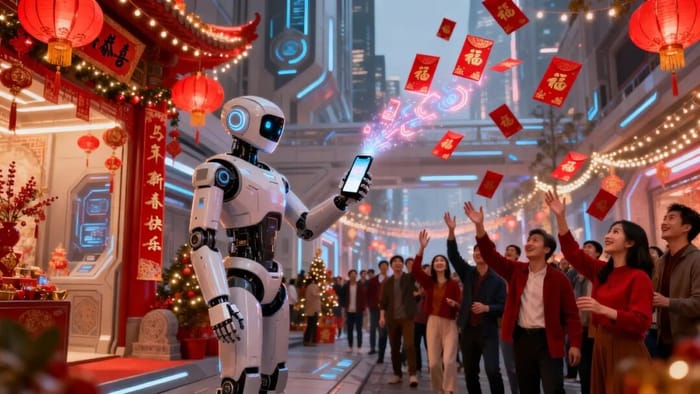
China's technology giants turned the 2026 Spring Festival holiday into an unprecedented battlefield for artificial intelligence supremacy — and the early results reveal as much about the limits of subsidy-driven growth as they do about the ambitions of the country's biggest platforms.
In a research note published March 2, 2026, Morgan Stanley's Asia internet team — led by analysts Gary Yu and Eddy Wang — dissected the CNY AI campaign blitz, concluding that while all major players achieved dramatic short-term user surges, the race to become China's next "AI super gateway" is far from settled. The report's central finding is blunt: buying users is easy; keeping them is the hard part.
An Arms Race With a Billion-Dollar Price Tag
Morgan Stanley estimates that combined promotional spending across the major platforms likely exceeded RMB 8 billion yuan (approximately US$1.1 billion), encompassing cash red packets, per-order subsidies, ecosystem traffic leverage, and media exposure. That figure alone signals how seriously China's internet incumbents are treating the consumer AI land grab.
Alibaba Group led with the most aggressive commercial integration, launching its "RMB 3 billion CNY Treat Plan" — offering RMB 25 no-threshold vouchers redeemable across its sprawling ecosystem including Taobao, Freshippo, Fliggy, and Alipay. Actual spending likely surpassed RMB 5 billion, Morgan Stanley estimates, as roughly 200 million orders were processed through its Qwen AI assistant between February 6 and 23. ByteDance's Doubao went the spectacle route, securing deep integration with the CCTV CNY Gala and distributing cash red packets of up to RMB 8,888 per draw alongside 100,000 high-value tech prizes. Tencent deployed RMB 1 billion in cash red packets through its Yuanbao app, though WeChat's decision to block direct promotional links mid-campaign — forcing a pivot to "password red packets" — highlighted the internal tensions within its own ecosystem. Baidu, by contrast, allocated a more modest RMB 500 million and leaned on its role as chief AI partner of Beijing TV's CNY Gala, with comparatively muted results.
The Scorecard: Traffic, Engagement, Retention
Morgan Stanley's analysis, drawing on Questmobile data, evaluates the campaigns across three dimensions — and the rankings tell different stories depending on what you measure.
Traffic expansion went to ByteDance. Doubao's daily active users climbed from 84 million pre-peak to 144.5 million on CNY Eve, a gain of 60.5 million incremental DAUs at peak. Qwen surged from a 17 million baseline to 73.5 million (+56.5 million), while Yuanbao rose from 7 million in January to 40.5 million at peak. The sheer scale of user mobilization was, by any measure, remarkable.
User engagement, however, told a more sobering story. Rapid DAU expansion came at the cost of per-user depth. Qwen's average daily time spent per user collapsed from 6.3 minutes pre-campaign to just 3 minutes in the week of February 16–22 — a 51% decline — suggesting users were opening the app to redeem vouchers, not to engage with AI. Yuanbao saw a 32% drop in time-per-user versus January levels. Doubao fared best here, with a comparatively modest 15% decline to 8.7 minutes, implying that its entertainment-heavy, CCTV-integrated approach generated more genuine interaction.
Post-campaign retention is where the structural divergence becomes most apparent — and most consequential for investors. After February 16, all platforms experienced traffic normalization, but the magnitude of pullback varied sharply. Yuanbao suffered the sharpest reversion, with DAU retreating close to pre-campaign levels — a damning signal for an app that spent heavily on incentives but appears to have generated little organic stickiness. Doubao maintained a user base structurally above its pre-CNY baseline. Qwen's DAU also remained elevated, though Morgan Stanley notes this resilience is partly artificial, reflecting multiple extensions of voucher validity through March 3.
Beyond the Holiday Window
The deeper question Morgan Stanley is asking — and which investors should be asking — is whether any of these platforms has yet demonstrated the product utility and ecosystem integration required to convert subsidized trial users into habitual AI consumers. The report is explicit: "long-term success depends on the ability to retain users post-holiday via product utility, seamless ecosystem integration and genuine value creation beyond financial incentives."
Baidu's Ernie Assistant, notably, reported a December 2025 MAU of 202 million — a figure built over a longer arc rather than a single holiday sprint — yet its CNY campaign failed to generate meaningful incremental momentum, with both WAU and DAU declining week-over-week despite active promotion. That trajectory raises questions about whether scale alone translates to platform durability.
For now, the 2026 CNY campaign has established Doubao as the most resilient performer across the engagement and retention dimensions, Qwen as the most commercially integrated, and Yuanbao as the most aggressive spender relative to its retention outcome. The AI super-gateway crown remains firmly up for grabs — and the next spending cycle is almost certainly already being planned.