
China's Auto Exporters Shift from Trade to Conquest as Domestic Market Implodes
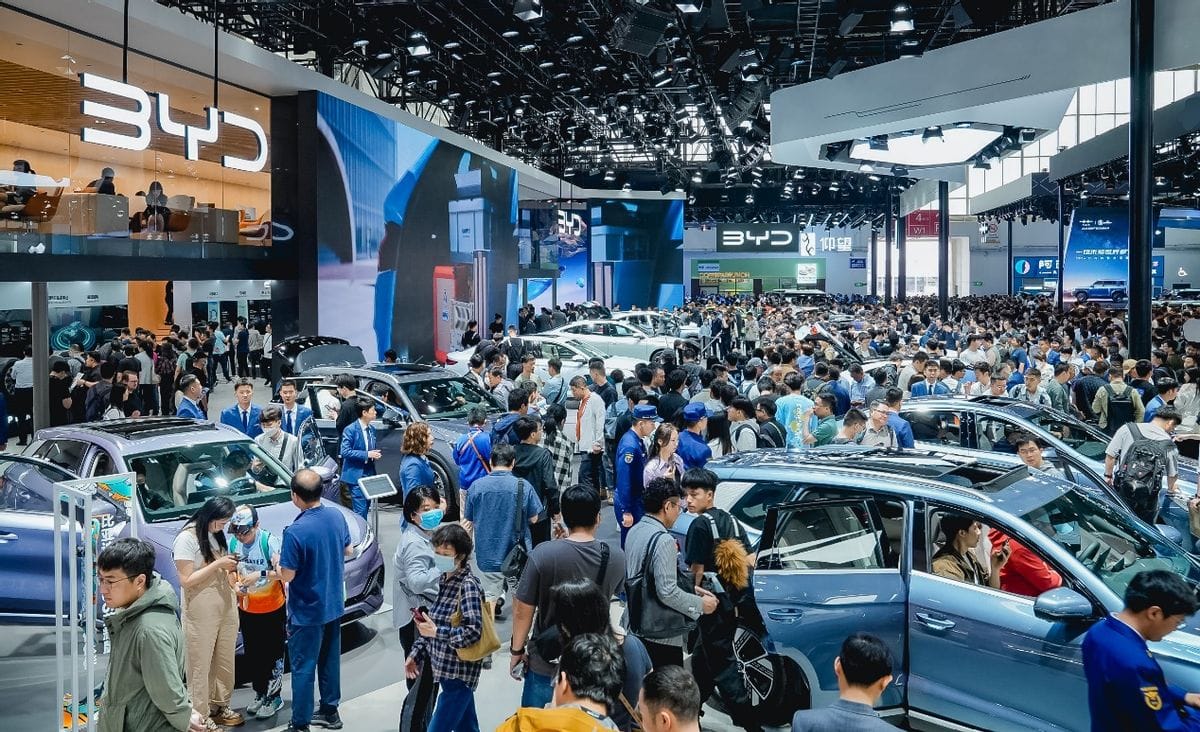
BYD and Chery are rewriting the global automotive order in real time: China shipped 930,000 vehicles overseas in May 2026—a 68.7% year-on-year surge—as a catastrophic domestic demand contraction forces the country's automakers to treat exports not as a supplementary channel but as the primary engine of survival and scale.
The pivot is structural, not cyclical. China's passenger car domestic retail fell 23.4% year-on-year in May, with cumulative January-to-May sales sliding 23.8% to 6.79 million units. Traditional internal combustion engine passenger vehicles sold just 497,000 units domestically in May—a 41.8% collapse—dragging the five-month ICE total down by 1.243 million units compared with the same period a year earlier. Against that backdrop, exports now account for 35% of total vehicle output, up sharply from roughly 20% in 2025, according to data compiled by the China Passenger Car Association (CPCA).
The market's initial read is unambiguous: automakers with the deepest overseas pipelines are decoupling from domestic distress. Those without them face an existential squeeze.
Exports Absorbing What Domestic Demand Refuses to Buy
The arithmetic is stark. China's total auto exports for January through May 2026 reached 4.059 million units, up 63% year-on-year. Passenger car exports alone hit 3.528 million units over the same period, a 69.6% gain, while new-energy vehicle (NEV) passenger car exports reached 1.792 million units—more than doubling year-on-year.
Within the NEV breakdown, battery-electric vehicle (BEV) exports in May stood at 269,000 units (+94.3% YoY), while plug-in hybrid (PHEV) exports hit 178,000 units, surging 1.4 times. For the January-May period, BEV exports totaled 1.125 million units (+110% YoY) and PHEV exports 708,000 units (+120% YoY). The PHEV acceleration is particularly significant: it signals that Chinese automakers are no longer selling a single technology proposition overseas but a tiered electrification portfolio calibrated to markets with variable charging infrastructure.
Industry analyst Cui Dongshu, secretary-general of the CPCA, noted that the "strong exports, weak domestic" bifurcation has become the defining characteristic of China's 2026 auto market. With the first-half export tally on course to approach 5 million units, a full-year figure of 10 million units—once considered aspirational—now appears to be a baseline scenario.
BYD Breaks Records While Chery Holds Ground
The competitive divergence among Chinese exporters is accelerating as fast as the aggregate numbers.
BYD posted total May sales of 383,453 units, of which 376,990 were passenger vehicles—a 20% month-on-month jump. Overseas sales reached 160,644 units, up 80.4% year-on-year, marking the first time BYD's monthly export volume has breached the 160,000-unit threshold. Overseas sales now account for more than 40% of BYD's total volume, a ratio that would have been unimaginable three years ago.
Chery, historically the dominant force in emerging-market exports, is not ceding ground without a fight. The group exported 181,871 vehicles in May, also up 80.5% year-on-year, setting a record for the third consecutive month. Chery's cumulative January-May exports reached 752,755 units (+69.5%), lifting its global cumulative user base past 19.62 million, with overseas users exceeding 6.59 million.
SAIC Motor, Geely Automobile, Changan Automobile, and Great Wall Motor each surpassed 50,000 monthly export units—a threshold that has become table stakes rather than a milestone.
The critical vulnerability for Chery, however, is product mix. The company built its overseas franchise primarily on ICE vehicles. As NEVs—particularly PHEVs—rapidly displace ICE in export volumes, Chery's structural advantage narrows. BYD's stated target of 5 million annual sales in 2026, combined with its NEV-first product architecture, positions it to overtake Chery in overseas rankings if the current trajectory holds through the second half.
Chinese OEMs Executing Structural Embedding, Not Just Shipping Cars
What distinguishes 2026's export wave from prior cycles is the shift in strategic intent. China's leading automakers are no longer content with direct exports; they are systematically acquiring or activating idle production capacity in target markets to embed themselves into local automotive ecosystems—replicating, with deliberate precision, the playbook deployed by Japanese and Korean manufacturers in previous decades.
Specific moves in motion include: BYD in discussions with Stellantis to take over underutilized European factory assets; Geely evaluating acquisition of Ford's Body 3 final assembly line at the Almussafes plant in Valencia, Spain; Dongfeng Motor exploring localized production of its NEV models at Stellantis' Rennes facility in France; and Xpeng potentially utilizing Volkswagen's idle capacity for vehicle manufacturing under a partnership arrangement.
These are not opportunistic capital deployments. They represent a coordinated, multi-front effort to establish local manufacturing footholds that would insulate Chinese brands from tariff escalation, reduce logistics costs, and generate the "made-in-Europe" or "made-in-Southeast-Asia" credentials that increasingly matter for regulatory compliance and consumer acceptance.
Domestic Carnage Creates the Pressure That Fuels Overseas Aggression
The overseas push is being turbocharged by conditions at home that leave automakers with little alternative. The CPCA's May data shows total auto sales of 2.61 million units, down 2% year-on-year, with the January-May cumulative at 12.19 million units, down 4%. Narrow-definition passenger car sales for January-May reached 10.19 million units, down 6%.
The policy backdrop explains much of the damage. After an exceptionally aggressive consumer subsidy regime in 2025—which pulled forward substantial demand—Beijing sharply curtailed entry-level purchase incentives entering 2026. The hangover is severe: dealer networks are contracting, consumer confidence is fragile, and high fuel prices are further depressing ICE demand while simultaneously failing to generate a compensating NEV surge domestically, as the NEV subsidy renewal cycle creates its own demand disruption.
Industry profit margins reflect the stress. January-April 2026 data shows the automotive sector's profit margin at just 3.4%, with revenues up 1%, costs rising 2%, and profits falling 17% year-on-year. The margin compression is forcing consolidation: automakers without export scale or NEV competitiveness are being squeezed toward the exit.
Winners Consolidating, Laggards Facing Irrelevance
The competitive landscape is bifurcating into a two-tier structure with increasing finality. BYD leads the domestic NEV market and is rapidly extending that lead overseas. Chery remains the volume export champion but faces a technology-mix challenge. Geely, Changan, and Great Wall occupy a strong second tier. SAIC, despite its scale, continues to grapple with its joint-venture-heavy portfolio as foreign brand volumes erode.
Joint-venture brands—particularly those anchored to ICE—are losing ground at a pace that suggests structural rather than cyclical displacement. FAW-Volkswagen and SAIC-Volkswagen both posted weak May results. Toyota is outperforming its Japanese peers but cannot fully offset the broader JV deterioration.
The CPCA's Cui estimates that approximately 80% of Chinese automakers will find themselves in a passive, marginal position in overseas markets once the top-tier consolidation completes. The implication for investors is direct: exposure to the two or three companies that capture the overseas commanding heights will generate returns categorically different from exposure to the broader sector.
For global OEMs watching from Detroit, Stuttgart, and Tokyo, the message embedded in China's May export data is not subtle. The country that once absorbed the world's automotive surplus is now generating it—and the companies leading that charge are no longer building toward global competitiveness. They have already arrived.
Related Coverage:
BYD Remains No.1 as China EV Rebound Masks Export- and Tech-Led Divergence in 2026