
China's Auto Exports to Russia Plunge 58% as Tax Hikes and Market Shifts Reshape Trade
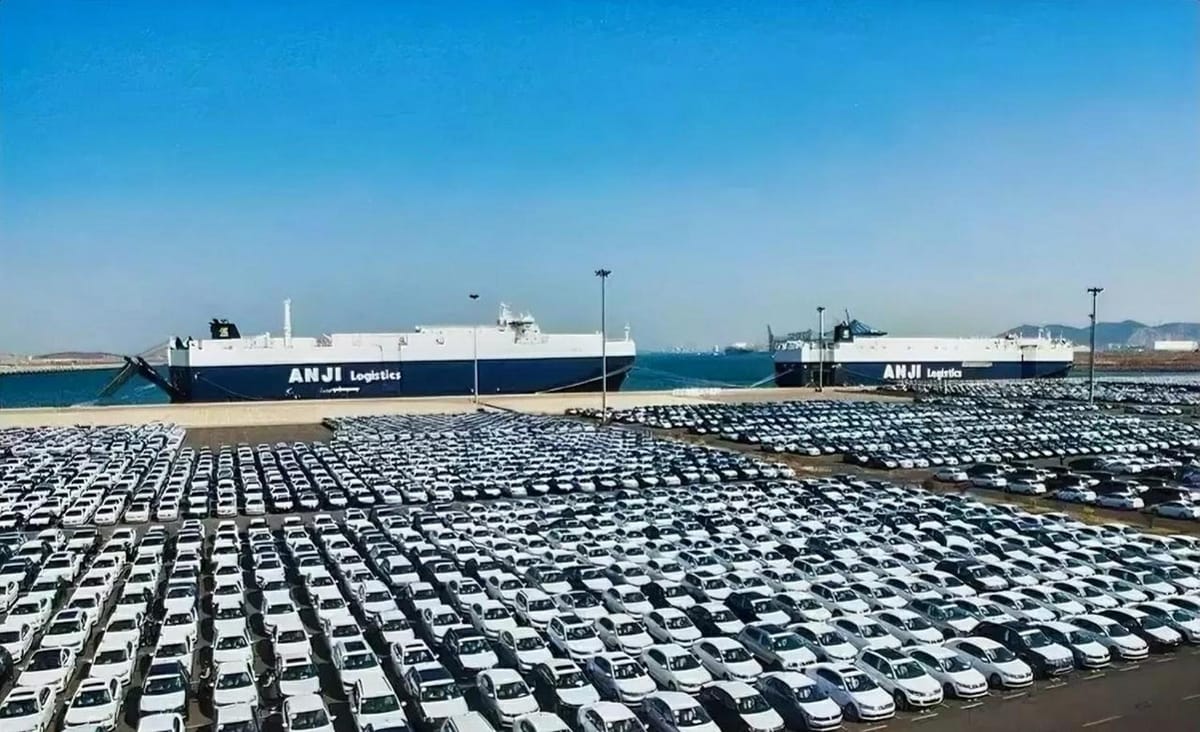
Chinese auto exports to Russia have tumbled 58% in the first nine months of 2025, marking a dramatic reversal for what was once China's largest automotive export market. The decline comes as Russia's steep tax increases, economic headwinds, and shifting consumer sentiment force Chinese automakers and dealers to recalibrate their strategies in a market that previously delivered profits of tens of thousands of yuan per vehicle.
Russia, which held the top spot as China's premier auto export destination for two years, has now fallen to third place behind Mexico and the United Arab Emirates. During the January-September period, China exported 357,700 vehicles to Russia, compared with 410,700 to Mexico and 367,800 to the UAE, according to data from the China Passenger Car Association (CPCA).
The shift reflects both punitive tax policies and structural economic challenges. Since October 2024, Russia has raised vehicle recycling fees by 70% to 85%, while import tariff coefficients were adjusted to 20%-38% starting January 2025. These measures, combined with inflation at 10% and car loan rates soaring to 30%, have severely dampened demand.
"Previously, exporting a new energy vehicle to Russia could generate net profits of tens of thousands of yuan. Now, some peers are suspending Russian operations," said Liu Lei, deputy general manager at Tianjin Shengtai Rentong International Trade.
Tax Surge Crushes Margins
The Russian Ministry of Industry and Trade's decision to dramatically increase recycling fees has hit dealers and consumers hard. For used cars with engine displacements between 2-3 liters and over three years old, the recycling tax jumped from 1.3 million rubles to 2.37 million rubles, an 83% increase.
The tax increases have directly impacted sales of Chinese brands. In September, Haval's sales in Russia fell 15.5% year-on-year to approximately 17,000 units, while Geely dropped 39.3% to 9,741 units. Chery and Changan saw declines of around 50%. Chinese brands held six of the top 10 positions in Russia's sales rankings but all reported declining volumes.
Wang Xiangyu, founder of Yiwei New Energy Technology (Chengdu), described the anxiety gripping dealers. "A batch order for 10 domestic new energy SUVs has only delivered one vehicle. The customer may abandon the rest due to fears of high recycling taxes," he said.
According to media reports, approximately 213 of the 274 auto showrooms that closed in Russia during the first quarter of 2025 were Chinese, representing 78% of closures. Even Chery, one of Russia's best-selling Chinese brands, has begun retreating. In its prospectus, Chery disclosed: "In 2025, we began to reduce our operating scale in Russia and entered into agreements to sell certain local assets and distribution channels."
Economic Headwinds Mount
Beyond taxation, Russia's wartime economy and monetary policy are constraining consumer purchasing power. With the central bank's benchmark interest rate held at 21%, financing costs have become prohibitive. The ruble's volatility further complicates pricing and profitability for importers.
"Russia's economic structural decline, its wartime economy relying on military industrial investment, and inflation of 10% with ruble exchange rate volatility have all contributed to weakened purchasing power," said Cui Dongshu, secretary-general of the CPCA. "These factors, along with car loan rates of 30%, have suppressed demand."
Russian consumers are also waiting for Western brands to return. "Many Russian clients are very much expecting Toyota, BMW and other brands to return to the Russian market. They have a wait-and-see attitude, which has affected local sales," Liu said. Although Western automakers face significant obstacles to resuming production in Russia quickly, the preference persists.
The rapid influx of Chinese vehicles over the past two years has also exposed gaps in after-sales service. "Early on, Russian consumers were curious about Chinese intelligent electric vehicles. But after purchasing, they discovered after-sales service couldn't keep up. For example, if a battery issue cannot be repaired promptly, the impact on brand reputation is significant," Liu explained.
Localization as Long-Term Strategy
As margins compress and short-term opportunities evaporate, Chinese automakers are pivoting from quick profits to sustainable market presence through localization. Great Wall Motor's Tula plant, which opened in 2019, exemplifies this approach. Operating under a complete knock-down assembly model with over 65% localization, the factory avoids high import duties and qualifies for local industrial subsidies.
"The previous high profits drove thousands of Chinese dealers to rush into exports. But when they actually did it, they found profits were far lower than expected. When the trend changed, many dealers withdrew," Wang said. His company is building an integrated platform spanning vehicle sourcing, cross-border logistics and digital services, including providing Russian customers with "after-sales guarantee services" for parts and consumables.
Chery is also expanding its dealership network and retail presence in Russia, signaling commitment despite near-term headwinds. According to AUTOSTAT, between 2019 and January 2025, Russia signed 4,302 auto dealer contracts, with 62% for Chinese brands.
Cui recommends Chinese automakers deepen local production with core component localization rates above 60%, strengthen product development for extreme cold conditions by optimizing battery low-temperature performance, and build comprehensive after-sales service systems with over 90% coverage. He also advises reshaping brand value to counter perceptions of "low price, low quality" through technical credentials and scenario-based marketing.
Yin Tongyue, chairman of Chery Automobile, recently noted risks during overseas market visits. "China's auto export wave is facing 'acclimatization' challenges: some brands stumble on safety and quality, others trigger complaints from local governments and users due to insufficient localization support," he said. "Globalization cannot only pursue scale and speed, but must establish a new image of 'safety, reliability and premium quality.'"
Market Rebalancing Underway
China's overall auto exports reached 5.71 million units in the first nine months of 2025, up 21% year-on-year, indicating diversification is offsetting Russia's decline. Mexico's emergence as the top destination reflects growing demand in Latin America, while the UAE serves as a gateway to Middle Eastern markets.
"Auto export development is not achieved overnight, but a 'protracted war,'" Wang said. "People often ask whether it's still appropriate to enter in 'autumn' after missing the 'spring' layout. Actually, if you plan to cultivate this field deeply, it's never too late to start."
He added: "Chinese auto exports still need time to mature, possibly a three-to-five-year cultivation period. However, we have full confidence."