
China's Auto Industry Endgame: Fewer Groups, More Brands
What Is Actually Happening in China's Auto Market Consolidation?
China's auto industry is not simply shrinking — it is restructuring. The widely asked question, "how many carmakers will survive?", frames the issue incorrectly. The more precise question is: how many groups will survive, and how many brands will those groups carry?
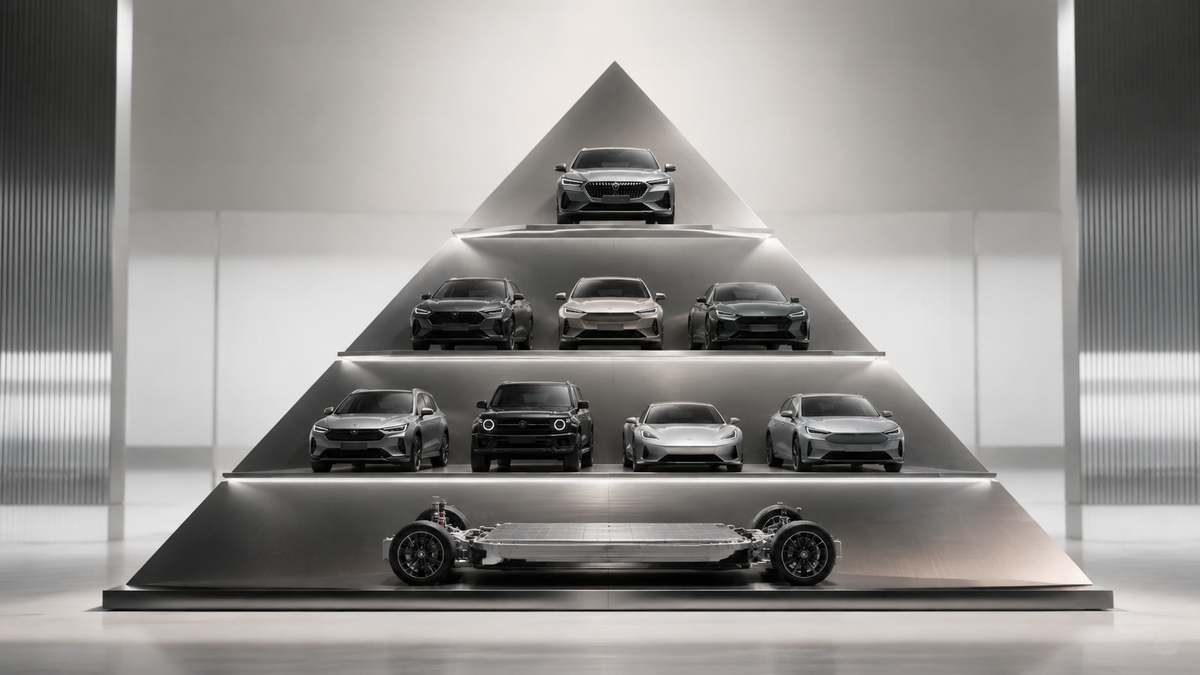
The answer emerging from market dynamics points toward a dual outcome: a sharp contraction in the number of independent corporate entities, alongside a sustained proliferation of sub-brands operating under the umbrella of a small number of dominant conglomerates. This pattern — fewer groups, more brands — is not a contradiction. It is the same structural logic that reshaped the global auto industry over the past century, now playing out at accelerated speed in China.
Why Is This Consolidation Happening Now?
Three structural forces are driving the current shakeout simultaneously.
Electrification costs are non-negotiable and ongoing. Developing competitive EV platforms, battery management systems, and over-the-air software capabilities requires sustained capital investment that smaller independent automakers simply cannot maintain. Unlike the internal combustion era, where a capable engineering team could produce a competitive powertrain on a modest budget, the EV and intelligent-driving stack demands platform-level investment spread across high volumes.
Price competition has become structural. China's passenger car market has entered a phase of persistent price pressure. New energy vehicle (NEV) penetration reached 58% of total passenger car sales as of June 2026, intensifying competition across every segment. Smaller players with limited cost-absorption capacity face margin compression that is existential, not temporary.
Regulatory and compliance costs are rising. Dual-credit (NEV and fuel economy) policies, battery recycling obligations, and evolving safety standards impose fixed compliance costs that disproportionately burden smaller manufacturers without shared engineering platforms.
How Does the "Group + Multi-Brand" Model Actually Work?
The operational logic of a mature automotive group differs fundamentally from a single-brand automaker. Understanding this distinction is essential to reading the industry's trajectory.
A leading Chinese auto group today operates on a shared back-end, differentiated front-end architecture:
- Shared back-end: Vehicle architectures, electric drivetrains, battery systems, intelligent driving software, manufacturing facilities, supply chain procurement, and talent pools are centralized at the group level. Each sub-brand draws from this common resource base without bearing the full cost of developing it independently.
- Differentiated front-end: Individual brands are positioned to address distinct consumer segments — a mainstream family brand anchoring volume, a premium brand targeting the upper-mid market, a youth-oriented or lifestyle brand serving niche demand, and a flagship NEV brand carrying the group's technology narrative.
This structure allows each sub-brand to operate with the economics of a large enterprise while maintaining the market positioning of a focused brand. A sub-brand does not need to build its own supply chain or R&D center; it needs only to sustain a credible identity within a specific segment.
The practical result is that sub-brands within a major group are not at risk of elimination in the same way independent automakers are. Their survival depends on segment relevance, not standalone financial viability.
Who Are the Main Players, and Why Will Only a Few Groups Remain?
China's leading domestic auto groups — including SAIC, BYD, Geely, Chery, Changan, GAC, and BAIC — have each completed this transformation from single-brand manufacturers to multi-brand conglomerates with proprietary technology platforms. They now compete not as individual brands but as integrated industrial ecosystems.
The barriers that protect these groups are systemic:
|
Barrier |
Why
Smaller Players Cannot Replicate It |
|
Platform-level
EV architecture |
Requires
billions in upfront R&D investment, with returns only realized at
sufficient scale |
|
Vertical
supply chain integration |
Negotiating
power depends on large-volume commitments and long-term supplier
relationships |
|
Multi-brand
cost sharing |
Shared
technology investment only becomes viable when group-wide sales volume can
justify the cost |
|
Software
and OTA capability |
Continuous
iteration requires dedicated engineering teams and long-term software
development capabilities |
|
Global
manufacturing footprint |
International
expansion requires overseas production capacity and established logistics
infrastructure |
Independent automakers without these foundations face a structural disadvantage that cannot be overcome through product innovation alone. The consolidation logic is therefore not primarily about which brands consumers prefer — it is about which organizations can sustain the investment cycle.
Is This Pattern Unique to China?
No. The "large group, multiple brands" model is the universal endpoint of mature auto markets globally, not a China-specific phenomenon.
Volkswagen Group operates Volkswagen, Audi, Škoda, Porsche, Bentley, Lamborghini, and multiple commercial vehicle brands on shared electrical and mechanical platforms. The group's MEB electric platform underlies vehicles across vastly different price points and brand identities.
Toyota Group retains Daihatsu as a brand serving entry-level and lightweight vehicle segments in Asia, while Lexus addresses the premium market. Daihatsu no longer competes as an independent entity — it functions as a segment specialist within the group's portfolio.
Stellantis, formed through the merger of PSA and FCA, manages more than a dozen brands including Peugeot, Citroën, Jeep, Maserati, and Dodge. The group's strategy is explicit: concentrate core resources at the platform level, differentiate at the brand level, and match brands to regions and segments rather than attempting uniform global rollout.
The consistent historical pattern across these cases: the corporate entities that disappear are independent automakers; the brand identities that disappear are far fewer. Brands carry consumer equity and segment positioning that groups find more valuable to retain than to eliminate.
What Are the Key Variables That Will Determine the Final Structure?
The consolidation trajectory is directionally clear, but several variables will influence its pace and shape.
Merger and acquisition complexity. Consolidating Chinese state-owned auto groups involves navigating provincial government interests, employment considerations, and overlapping joint ventures with foreign partners. The process will be protracted and politically sensitive, making the exact number of surviving groups difficult to predict with precision.
Export performance as a differentiator. China's auto exports reached 107 million units in June 2026, up 73% year-on-year. Groups with credible international distribution — particularly in Southeast Asia, the Middle East, Latin America, and emerging markets — gain a second revenue base that strengthens their domestic competitive position. Export capability is increasingly a marker of group-level maturity.
Technology platform differentiation. As intelligent driving and software-defined vehicle capabilities become primary purchase drivers, groups that establish proprietary software stacks will command structural advantages. Groups dependent on third-party technology suppliers face a long-term margin and differentiation risk.
Policy environment. Government industrial policy continues to influence consolidation speed. Incentives favoring mergers, procurement policies supporting domestic suppliers, and NEV mandates all shape the competitive landscape in ways that market forces alone do not determine.
What Does the Endgame Actually Look Like?
The structural endpoint for China's auto industry — likely to emerge over a five-to-ten year horizon — reflects the same configuration that characterizes mature markets globally:
- A small number of dominant groups (likely five to eight at the national level) controlling the majority of production volume, technology investment, and supply chain relationships
- A larger number of active brands operating under those groups, each positioned for specific segments, price points, or regional markets
- Continued exit of independent automakers lacking the scale or technology base to sustain competitive investment cycles
- Selective survival of niche independents in highly specialized segments where group economics do not apply
The critical reframing for analysts and observers: brand count is a misleading metric for industry health. A market with eight groups and forty brands may be more concentrated — and more competitive — than one with twenty independent automakers and twenty brands. What matters is the depth of the technology platform, the breadth of the market coverage, and the financial durability of the group behind each brand.
China's auto industry is converging toward a mature-market model: fewer industrial groups, stronger shared platforms, and a wider range of surviving brands. The shift is unfolding faster, under harsher competitive pressure, and with more domestic marques preserved than many analysts anticipated.
Related Coverage:
China Auto Market Falls 20% in H1 2026 as EVs Hit 60% Penetration