
China's Auto Sector Posts Worst H1 Earnings in Years as Nine of 16 Carmakers Bleed Red
Cost Inflation, Currency Swings and Product-Cycle Write-Downs Crush Margins Across the Board; Only Geely Delivers Clean Profit Growth
China's automotive industry recorded its most broadly painful first-half earnings season in recent memory, with nine of 16 publicly listed carmakers reporting net losses, total industry sales sliding 4.1% year-on-year to 15.02 million units, and net profit declining at virtually every major automaker — exposing a structural earnings crisis that discount-driven volume growth can no longer paper over.
The results, drawn from H1 2026 filings released in late August and early September, mark a decisive inflection point: even the two undisputed market leaders, BYD and SAIC Motor Corporation, posted simultaneous revenue and profit declines, signaling that scale alone no longer insulates incumbents from margin compression. The data, compiled by the China Association of Automobile Manufacturers (CAAM), underscores a sector-wide repricing of risk that investors in Chinese auto equities can no longer dismiss as cyclical noise.
Market reaction has been cautious. Analysts tracking the sector note that the headline numbers obscure a critical divergence: strip out foreign-exchange losses and one-time asset impairments — two factors that several companies explicitly flagged — and a handful of firms actually grew underlying earnings by double digits or more. That gap between reported and adjusted profitability is now the central analytical battleground for investors trying to separate structural deterioration from accounting-period distortion.
BYD and SAIC Absorb Revenue Declines Despite Dominant Scale
BYD, China's largest automaker by revenue, reported H1 2026 revenue of RMB 344.82 billion (US$47.89 billion), down 7.13% year-on-year, while net profit attributable to shareholders fell 20.54% to RMB 12.33 billion (US$1.71 billion), with a gross margin of 18.85%. Notably, BYD's Q2 net profit growth rate turned positive on a year-on-year basis — ending four consecutive quarters of year-on-year decline — a data point that buy-side analysts are treating as the first tentative sign of stabilization.
On a sales-volume basis, SAIC actually outpaced BYD in H1, becoming the only automaker to surpass 2 million units sold in the period, with 2.0454 million vehicles delivered. Yet SAIC's financial performance told a less flattering story: revenue of RMB 298.65 billion (US$41.48 billion), down 0.31%; reported net profit of RMB 5.15 billion (US$715 million), down 14.38%; gross margin at 12.6%. SAIC's own disclosure, however, offered a significant asterisk — strip out foreign-exchange losses and impairment charges, and its core attributable net profit reaches RMB 7.87 billion (US$1.09 billion), representing 72% year-on-year growth. That adjusted figure suggests SAIC's underlying operating performance is considerably healthier than reported earnings imply.
Geely Emerges as the Sector's Sole Bright Spot, Powered by Premiumization and Exports
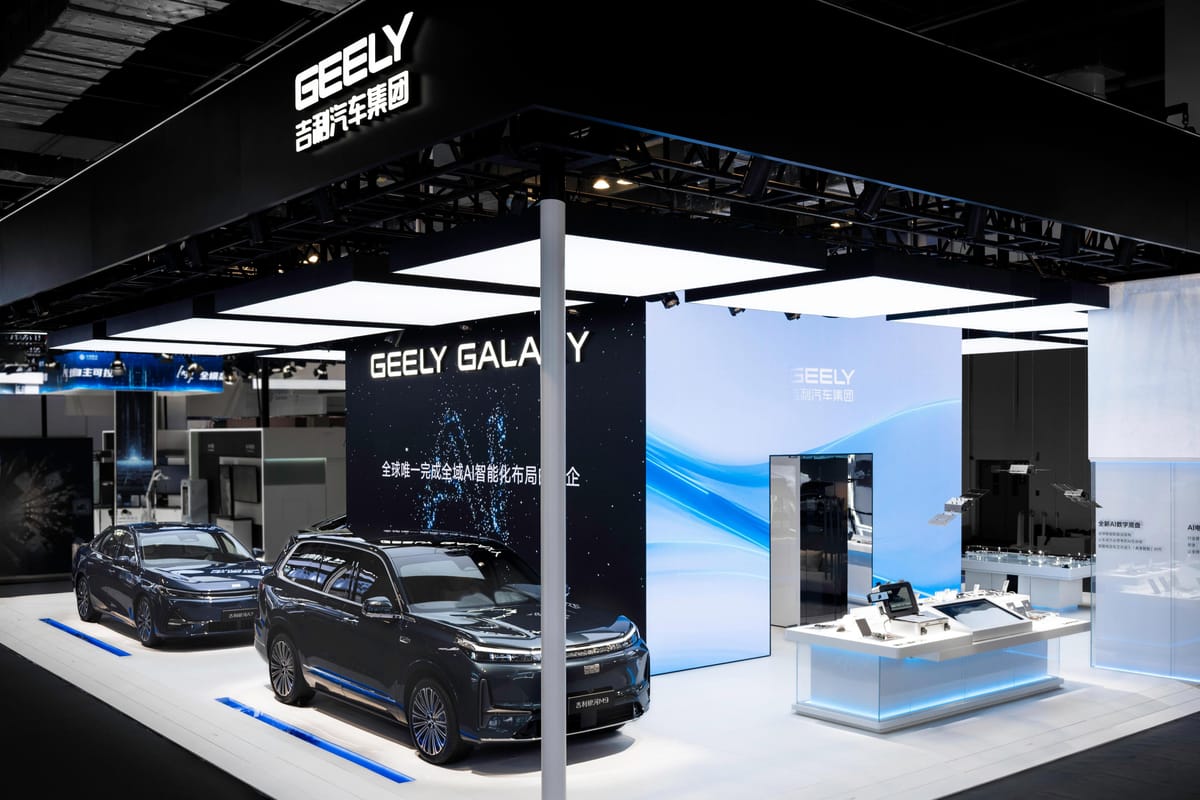
Against a backdrop of near-universal profit pressure, Geely stands out as the only major listed automaker to deliver clean growth across both revenue and profit. H1 revenue rose 14.67% to RMB 173.6 billion (US$24.11 billion); reported attributable net profit dipped a marginal 1.79% to RMB 9.09 billion (US$1.26 billion), but core attributable net profit — excluding one-time items — surged 46% to RMB 9.68 billion (US$1.34 billion). Sales volume reached 1.423 million units, up 1% year-on-year.
The Geely outperformance is not accidental. Two structural levers drove it: the ramping of Zeekr and other premium-segment vehicles, which shifted the product mix toward higher average selling prices and fatter margins; and a 158% year-on-year surge in exports to 474,000 units — exceeding Geely's entire full-year 2025 export volume in a single half-year. Gross margin held at 17.90%, among the stronger readings in the peer group.
Chery also demonstrated export-driven resilience: H1 revenue grew 1.19% to RMB 143.28 billion (US$19.90 billion), gross margin expanded from 13.0% to 16.1%, and gross profit rose 25.1% to RMB 23.04 billion (US$3.20 billion). Exports of 939,000 units — up 71% year-on-year — accounted for 74% of total sales volume, with overseas revenue of RMB 98.97 billion (US$13.75 billion) rising 51.0%.
Great Wall's Revenue Milestone Masks a Profit Collapse
Great Wall Motor crossed a symbolic threshold in H1 2026, with revenue surpassing RMB 100 billion for the first time in a first-half period, reaching RMB 102.10 billion (US$14.18 billion), up 10.58%. Overseas sales of 289,000 units exceeded domestic sales of 286,700 units — the first time international volume has outpaced home-market volume in the company's history, with overseas revenue contributing approximately 55% of total revenue.
The revenue achievement, however, obscures a severe profit deterioration. Attributable net profit collapsed 61.11% to RMB 2.47 billion (US$343 million), gross margin at 18.37%. Chairman Wei Jianjun attributed the earnings decline explicitly to delayed receipt of overseas tax subsidies and violent foreign-exchange swings — the same currency headwind that distorted results across the sector. Excluding FX effects, Great Wall's underlying profitability picture is materially different.
Changan Automobile reported a sharper operational deterioration: revenue fell 9.71% to RMB 65.63 billion (US$9.12 billion), and attributable net profit dropped 64.32% to RMB 817 million (US$113 million), gross margin 14.50%. The core problem is structural: the Changan Ford joint venture, which once contributed approximately 90% of Changan's total net profit at its peak, saw its earnings decline a further 65.2% year-on-year in H1 2026 to just RMB 262 million (US$36 million). Adjusted for FX impact, Changan's net profit would have grown 12% — a figure that illustrates how currency translation is distorting the sector's reported scorecard.
SERES' Impairment Shock Signals L3 Autonomy Transition Costs
The most surprising reversal in the H1 filing season belongs to SERES. Having turned profitable in 2024 on the back of the Huawei-co-developed AITO brand — generating RMB 5.9 billion (US$819 million) in net profit across 2024 and early 2025 — SERES swung to a net loss of RMB 1.72 billion (US$239 million) in H1 2026, on revenue of RMB 57.49 billion (US$7.99 billion), down 7.87%.
Management attributed the loss to two factors: product-cycle transition costs as AITO refreshes its lineup, and asset impairment charges on inventory and equipment with limited compatibility with Level 3 autonomous driving systems — a forward-looking write-down triggered by the imminent large-scale commercialization of L3 autonomy in China. Critically, SERES' gross margin remained 23.3%, the highest in the peer group, suggesting the underlying business model remains sound. The loss is, in management's framing, a deliberate front-loading of negative information — a technique that Li Auto employed to similar effect in a prior period, clearing the balance sheet for a cleaner earnings trajectory in H2.
Li Auto itself reported H1 revenue of RMB 48.65 billion (US$6.76 billion), down 13.39%, with a net loss of RMB 3.98 billion (US$553 million) and a gross margin that compressed to 9.54%. However, Q2 sequential data offered a recovery signal: deliveries of 98,330 units rose 3.4% quarter-on-quarter; Q2 revenue of RMB 25.7 billion (US$3.57 billion) grew 11.7% quarter-on-quarter; and gross margin recovered to 11.0%, up 3.1 percentage points from Q1. Free cash flow improved materially in Q2, providing a liquidity cushion that partially offsets the headline loss.
XPENG and NIO Narrow Losses, While GAC Bleeds Cash at Negative Gross Margin
NIO achieved the most dramatic loss reduction in the cohort: H1 net loss narrowed to RMB 1.22 billion (US$169 million) from RMB 12.03 billion (US$1.67 billion) a year earlier — a 90% reduction — on revenue growth of 85.77% to RMB 57.67 billion (US$8.01 billion). Volume of 191,100 deliveries rose 67.4% year-on-year, driven by the high-margin ES9 and ES8 models. Gross margin reached 18.4%. NIO Chairman Li Bin disclosed on the H1 earnings call that per-vehicle costs rose approximately RMB 14,000 (US$1,944) versus late 2025 levels, with a further RMB 2,000 (US$278) increase projected for H2 — a cost trajectory that will test the durability of the margin recovery.
XPENG reported H1 revenue of RMB 32.77 billion (US$4.55 billion), down 3.8%, with net losses widening to RMB 3.12 billion (US$433 million). Its blended gross margin of 20.7% ranks among the sector's highest — but that figure includes software and technology services revenue, which inflates the blended rate; vehicle-only gross margin stood at 12.1%, a more modest reading that investors should weight carefully.
Guangzhou Automobile Group (GAC) posted the sector's most alarming financials: H1 net loss of RMB 4.47 billion (US$621 million), a 75.98% deterioration from a RMB 2.54 billion (US$353 million) loss a year earlier, on revenue of RMB 46.12 billion (US$6.41 billion) that actually grew 9.38%. The company is the only automaker in the cohort to report a negative gross margin of -2.51% — meaning it is selling vehicles below the cost of making them. Pressure from declining GAC Honda and GAC Toyota joint-venture volumes is the primary driver, though the Aion brand's i60 model is showing early signs of a volume recovery.
Leapmotor's 530% Profit Surge Validates the Price-for-Volume Playbook — With Caveats
Leapmotor is the H1 season's headline winner among new-energy vehicle pure-plays: attributable net profit of RMB 210 million (US$29 million) represents a 530.97% year-on-year increase, making it the only new-force automaker to achieve profitability in the period. Deliveries of 356,500 units rose 60.8%; revenue grew 57.14% to RMB 38.11 billion (US$5.29 billion). Monthly sales in July crossed 100,000 units — approaching Great Wall Motor's monthly volume — a milestone that underscores how rapidly Leapmotor has scaled.
The caveats are material. A gross margin of 11.70% is among the lowest in the peer group, reflecting a business model built on aggressive value pricing. Leapmotor's path to sustainable profitability runs through its partnership with Stellantis NV, which is accelerating the brand's international distribution — a channel that carries meaningfully higher per-unit economics than the domestic Chinese market.
Two Structural Headwinds Explain Where the Profits Went
Across the cohort, two factors account for the bulk of the year-on-year profit erosion.
Raw material cost inflation was the first. Lithium carbonate, memory chips, copper, and aluminum prices all rose materially in H1 2026, directly compressing vehicle bill-of-materials costs. NIO's Li Bin quantified the impact explicitly: RMB 14,000 per vehicle in H1, with more to come. For scale players like BYD and SAIC, procurement leverage and vertical integration provided partial insulation. For smaller-volume new-energy vehicle makers, the impact was proportionally more severe.
Foreign-exchange volatility was the second, and its distortive effect on reported earnings cannot be overstated. Chery's export exposure exceeds 70% of volume; Great Wall's overseas share has crossed 50% for the first time; BYD, Changan, SAIC, and Geely all carry export ratios above 30-40%. When SAIC strips out FX and impairment effects, its core net profit grows 72%. When Changan adjusts for FX, net profit grows 12%. When Geely excludes one-time items, core net profit grows 46%. The pattern is consistent: currency translation is making China's auto sector look considerably weaker than its operating fundamentals warrant — a distinction that will matter as the renminbi's trajectory evolves in H2 2026.
Overseas Expansion Reshapes the Growth Calculus
The H1 data crystallizes a structural shift that has been building for two years: international markets have become the primary engine of incremental revenue and margin improvement for China's leading automakers, and the domestic market — facing demand softness, intensifying price competition, and AI hardware cost inflation flagged by SAIC — can no longer be relied upon as the growth anchor.
BYD's overseas revenue reached RMB 181.27 billion (US$25.18 billion) in H1 2026, up 33.9% year-on-year and representing more than 50% of group revenue. Export volume of 792,300 new-energy vehicles rose 67.8%, accounting for 43.81% of total deliveries. Analysts have modeled that if BYD achieves its full-year export target of 1.5 million units, and assuming overseas per-vehicle net profit of approximately RMB 20,000 (US$2,778), the international business alone could contribute RMB 30 billion (US$4.17 billion) in net profit — a figure that would transform the group's earnings profile.
CAAM Deputy Secretary-General Wei Wenqing struck a cautionary note, warning that export volume growth may be entering a "platform adjustment cycle" and that pursuing aggressive short-term export expansion could damage both the international competitive environment and the health of China's domestic auto industry. The comment reflects a growing consensus among policymakers that the next phase of internationalization must be built on technology, ecosystem, and brand localization — not simply product export at scale.
Impact Assessment: What H1 2026 Means for Investors and the Supply Chain
The H1 2026 results carry three direct implications for market participants.
First, the "volume equals value" thesis is definitively broken. SAIC sold more cars than BYD in H1 yet generated less than half BYD's net profit. GAC grew revenue 9.38% while its losses expanded by 76%. Investors pricing Chinese auto stocks on volume multiples are using the wrong framework.
Second, gross margin — not net margin — is now the most reliable indicator of competitive positioning. SERES at 23.3%, XPENG at 20.7% blended, BYD at 18.85%, and NIO at 18.4% represent the upper tier; GAC at -2.51% and Leapmotor at 11.70% represent the structural vulnerabilities. The gap between gross and net margin across the sector reflects the enormous R&D and SG&A investment required to compete in autonomous driving and smart-cabin technology — costs that will not compress quickly.
Third, the asset impairment cycle triggered by L3 autonomy commercialization is only beginning. SERES' write-downs in H1 2026 are a leading indicator: as Level 3 autonomous driving systems become standard, automakers carrying inventory and production equipment calibrated to earlier-generation architectures will face recurring impairment charges. This is a supply-chain disruption event as much as a financial reporting one, with implications for Tier 1 and Tier 2 suppliers whose product roadmaps are tied to legacy sensor and compute configurations.
Related Coverage:
Leapmotor Tops 100,000 Again as China’s EV Upstarts Enter a Q4 Reset
BYD’s Overseas Sales Hit 43% as Global Expansion Becomes Its Profit Engine