
BYD’s Overseas Sales Hit 43% as Global Expansion Becomes Its Profit Engine
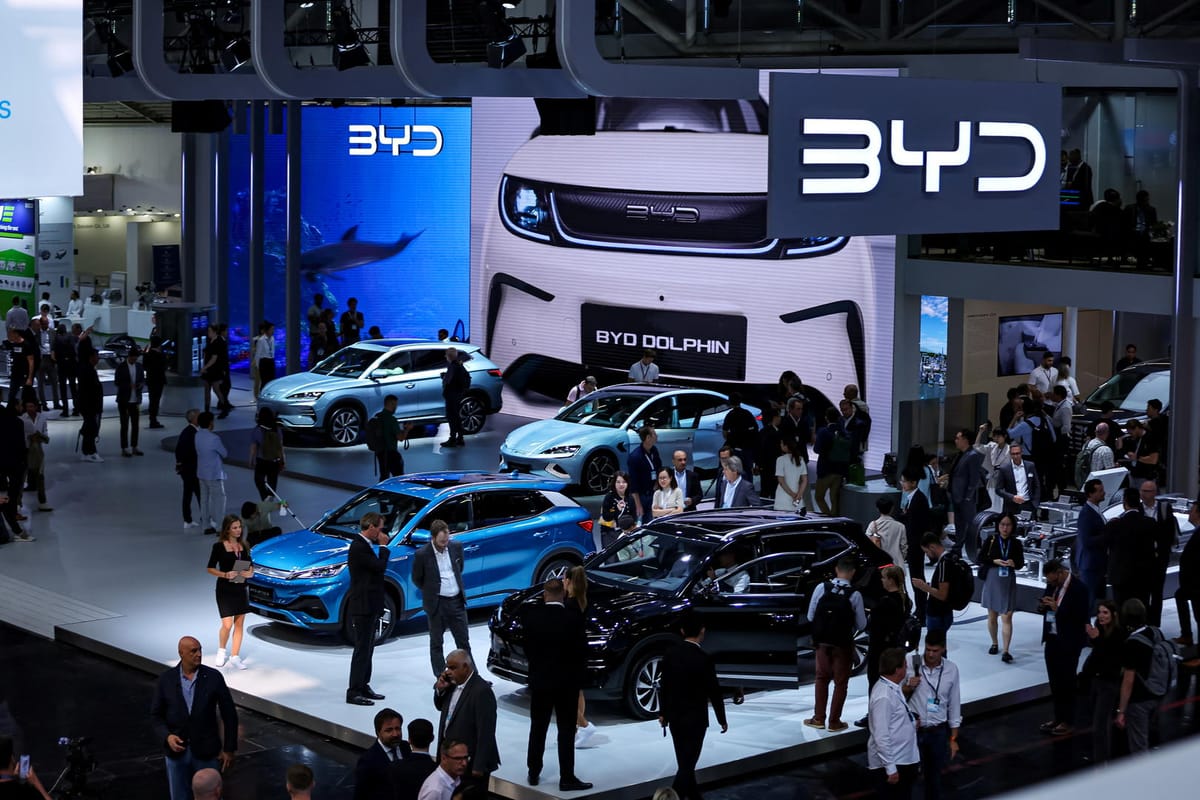
Surging international sales now account for 43% of Q2 volume and carry margins nearly four times higher than domestic vehicles, making global expansion the single most critical variable in BYD's 2026 earnings trajectory.
BYD reported Q2 2026 net profit attributable to shareholders of approximately RMB 8.24 billion (US$1.14 billion), rising roughly 30% year-on-year even as total revenue slipped 3% to RMB 194.6 billion (US$27.0 billion) — missing the RMB 199.5 billion consensus by roughly 2.5%. The earnings beat on the bottom line while missing on the top line encapsulates the central tension in BYD's current business model: a domestic market grinding down average selling prices, offset by an overseas operation that is rapidly evolving from a volume driver into a structural profit anchor.
The results, released after Hong Kong market close on August 29, 2026, prompted immediate analytical debate over whether the company's domestic franchise is in managed retreat or temporary trough — a question with direct implications for the stock's re-rating potential on the Hong Kong exchange (1211.HK).
Domestic ASP Collapses Under Three Simultaneous Pressures
The headline miss traces directly to vehicle average selling price (ASP), which fell to RMB 136,000 (US$18,889) in Q2 — a sequential drop of RMB 24,000 (US$3,333), and RMB 8,000 below the RMB 144,000 market consensus.
Three distinct forces drove the compression simultaneously, and understanding their interaction matters for forecasting whether Q3 marks a recovery inflection or a structural floor.
First, the export mix dilution effect reversed course. After exports reached 46.6% of total sales in Q1 2026, domestic volumes surged 69% quarter-on-quarter to approximately 640,000 units in Q2, pulling the export share down 3.3 percentage points to 43.3%. Since overseas vehicles carry materially higher ASPs, any reduction in their proportional weight mechanically depresses the blended average.
Second, BYD's highest-ASP product line — flash-charging vehicles priced predominantly at RMB 150,000–250,000 — remained capacity-constrained throughout the quarter. Following the March 5 launch of the second-generation Blade Battery and megawatt-level flash-charging technology, order intake surged, but second-generation Blade Battery production reached only below 100,000 units per month by June, with a monthly ramp rate of merely 20,000–30,000 units. These vehicles, which could have pulled the blended ASP meaningfully higher, remained a negligible fraction of total deliveries.
Third, the company deliberately accelerated clearance of legacy model inventory ahead of new product introductions, applying discounts that temporarily elevated the share of lower-priced older units in the sales mix.
The policy environment compounds the domestic challenge. Revised government subsidy rules now tilt benefits toward vehicles priced above RMB 167,000 — a threshold that sits above the RMB 100,000–150,000 sweet spot where BYD concentrates its highest-volume models. Analysts at Dolphin Research project full-year 2026 domestic sales of approximately 2.85 million units, a 20% year-on-year decline, with the first half already down 40% to roughly 1.02 million units.
Cost Engineering Defends Gross Margin Against Consensus Fears
The market had priced in a more severe margin deterioration. Consensus expected automotive gross margin to fall 1.2 percentage points sequentially to 22.2%, driven by upstream raw material cost inflation. The actual outcome — 23.0%, down only 0.4 percentage points — represents a meaningful positive surprise and reflects the depth of BYD's in-house cost engineering capability.
Per-vehicle cost fell approximately RMB 18,000 sequentially to RMB 105,000 (US$14,583), driven by two compounding effects.
Scale leverage was substantial: total Q2 deliveries reached approximately 1.11 million units, up 58% from Q1's roughly 700,000 units. The surge absorbed fixed costs — depreciation, amortization, factory overhead — across a significantly larger base, mechanically reducing per-unit burden.
Technology-driven bill-of-materials reduction added a structural layer. The second-generation Blade Battery, incorporating silicon-carbon anode substitution and manganese-enriched cathode chemistry, cuts energy consumption on equivalent-range configurations. BYD's Sealion 06 EV, for instance, achieves the same 605km CLTC range with 69 kWh versus the prior generation's 79 kWh — a 10 kWh reduction translating to approximately RMB 7,000 in raw material savings per unit (net of new flash-charging components, estimated at approximately RMB 4,000).
Capital expenditure also moderated sharply: Q2 capex fell to RMB 22.6 billion (US$3.14 billion), roughly half the Q4 2025 peak. If BYD's global factory investment cycle has indeed crested — with the Brazil plant already operational at 150,000 units annual capacity and the Hungary facility targeting H2 2026 commissioning at a further 150,000 units — future depreciation pressure should ease incrementally, providing a modest but durable tailwind to margins.
Per-Vehicle Profit Climbs Even as Gross Margin Dips
The divergence between gross margin direction and per-vehicle net profit trajectory is analytically significant. Per-vehicle net profit rose approximately RMB 1,400 sequentially to roughly RMB 7,200 (US$1,000) despite the gross margin compression — a result of operating leverage and disciplined expense management below the gross line.
R&D expenditure of RMB 12.0 billion (US$1.67 billion) came in 18% below the RMB 14.7 billion consensus, and 22% below the year-ago peak of RMB 15.4 billion. The moderation reflects the completion of major development cycles for the second-generation Blade Battery and the Xuanji A3 autonomous driving chip, rather than a strategic retrenchment. Selling expenses rose approximately RMB 800 million sequentially to RMB 6.7 billion (US$931 million), tracking volume growth through BYD's dealer-commission model.
The most telling profitability metric — core operating profit per vehicle, stripping out foreign exchange and other non-operating items — reached approximately RMB 9,000 in Q2 2026, versus roughly RMB 3,000 in Q2 2025. The year-on-year tripling reflects the severity of last year's trough: in Q2 2025, BYD simultaneously cut prices on smart-driving variants, missed volume targets, and sustained peak R&D spending, compressing automotive gross margin to a historical low of 18.7%.
Overseas Business Graduates From Growth Engine to Profit Anchor
The structural importance of BYD's international business has crossed a qualitative threshold. At 470,000 units in Q2 2026 — up 46% quarter-on-quarter and representing 43.3% of total deliveries — overseas sales are no longer a supplementary revenue line. They are the primary driver of unit economics.
The ASP differential is stark. Domestic vehicles average approximately RMB 100,000–110,000 per unit with per-vehicle net profit estimated at roughly RMB 3,500. Overseas vehicles carry estimated per-vehicle net profit of RMB 13,000–14,000 (US$1,806–1,944), reflecting premium pricing in developed markets, a richer product mix skewed toward higher-specification variants, and the absence of the domestic price war dynamic.
BYD has revised its full-year 2026 export target upward for the second time, from the original 1.5 million units to 1.7–1.8 million, with management signaling a stretch target approaching 1.9 million. Through July 2026, cumulative exports reached 970,000 units, placing the revised target well within reach. Dolphin Research's base-case estimate stands at 1.8 million units, implying 74% year-on-year growth.
The localization strategy underpinning this expansion is designed to reduce tariff exposure and shorten supply chains. Beyond the Brazil and Hungary plants, BYD is advancing manufacturing presence in Indonesia and Turkey. By end-2026, the company targets overseas localized capacity exceeding 700,000 units annually across an eight-country, eight-factory network. European dealer network expansion — from approximately 1,000 outlets at end-2025 to a target 2,000 by end-2026 — is intended to convert production capacity into retail throughput.
Plug-in hybrid vehicles are playing an increasingly important role in the overseas mix. In May 2026, PHEVs accounted for 40.6% of BYD's new energy vehicle exports, up 6.7 percentage points year-on-year — a reflection of infrastructure constraints in developing markets where pure-electric charging networks remain underdeveloped.
Technology Roadmap Targets Domestic Share Recovery in H2
BYD's Q2 domestic market share recovered to 22.7% from a Q1 trough of 19.8%, still well below the 36% peak reached in Q2 2024. Management's response is a two-pronged technology deployment strategy rather than renewed price aggression — a deliberate shift toward margin preservation over share maximization.
On electrification, the "Flash Charge China" infrastructure program targets 20,000 fast-charging stations by end-2026, including 2,000 highway locations. Critically, the 6C-level flash-charging technology — previously confined to vehicles above RMB 200,000 — is being cascaded to the RMB 150,000–200,000 mainstream tier, including the Song Ultra EV and the Haiseal 06 EV. This directly contests Geely and Xpeng in the 800V fast-charging segment at lower price points.
On autonomous driving, BYD's May 28 intelligence strategy event introduced the Xuanji A3 chip — China's first 4nm automotive-grade autonomous driving processor, delivering 700 TOPS per unit and over 2,100 TOPS in a three-chip cluster configuration, supporting L3/L4 autonomy. The accompanying DiPilot 5.0 software stack employs reinforcement learning with end-to-end architecture and world-model simulation. Crucially, BYD is cascading driver-assistance capability down to the Dolphin EV, priced from RMB 68,900 (US$9,569) — a deliberate democratization play targeting the mass market.
The DM 6.0 plug-in hybrid platform, expected to achieve thermal efficiency above 48% and fuel consumption as low as 1.8–2.79L/100km versus the current DM 5.0's 2.9L/100km, is unlikely to launch before H2 2026, limiting its near-term contribution to PHEV sales volumes.
Valuation Ceiling Remains Tied to Overseas Execution
Dolphin Research's base-case model projects full-year 2026 total deliveries of approximately 4.65 million units — a 1% year-on-year increase — with domestic volumes declining 20% to 2.85 million and overseas volumes rising 74% to 1.8 million. The blended per-vehicle net profit of approximately RMB 3,500 domestically and RMB 13,000–14,000 internationally implies that overseas operations, representing roughly 39% of projected full-year volume, will contribute a disproportionate share of total earnings.
The investment case for BYD at current valuations therefore rests almost entirely on two variables: the pace of overseas localized production capacity coming online, and whether international per-vehicle profitability can be sustained or expanded as volume scales and local competition intensifies. Neither is fully visible in current financials, which is precisely why the market continues to assign a discount to the stock's intrinsic earnings power.
Related Coverage:
BYD Brings Flash Charging to the Mass Market, Raising the Stakes in China's EV Price War