
Morgan Stanley Warns China’s Memory Expansion Could Trigger a 2028 Supply Glut
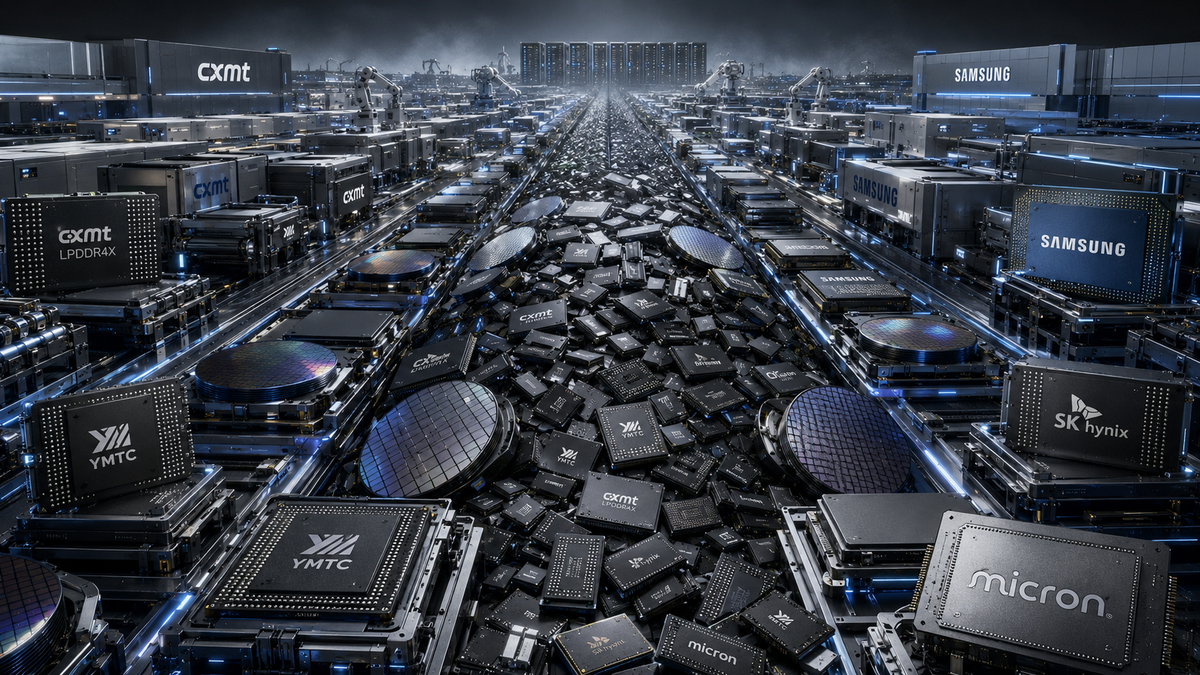
Morgan Stanley’s latest memory-industry research, released in late August 2026, puts a date on a risk the global semiconductor market has largely chosen to defer: 2028.
For the next two years, the AI infrastructure boom may absorb a substantial wave of new Chinese memory output. But Morgan Stanley argues that the expansion plans of China’s leading memory producers—combined with capacity additions by established overseas suppliers—could turn today’s scarcity into a far more uncomfortable surplus once the cycle turns.
The report matters because it reframes China’s memory drive. This is no longer simply a story of technological catch-up or low-cost substitution. It is increasingly a capacity story—and capacity, once built, has a habit of changing markets whether incumbents welcome it or not.
From Mainstream Memory to Higher-Value Segments
Morgan Stanley sees ChangXin Memory Technologies, Inc. (长鑫科技), commonly known as CXMT, and Yangtze Memory Technologies Co., Ltd. (长江存储), or YMTC, following a deliberate route into the global supply chain.
The strategy is not to immediately challenge established suppliers in every leading-edge category. Instead, the two companies are first building positions in mainstream memory products, then moving gradually into higher-margin areas including high-bandwidth memory, advanced server DRAM and enterprise solid-state drives.
That sequencing is significant. It lets Chinese manufacturers build scale and supply-chain relevance before attempting a broader push into premium products. In a memory market historically dominated by overseas giants, production scale itself can become a competitive weapon.
Morgan Stanley’s core conclusion is blunt: China’s expanding output could eventually “shake and reshape” the global supply structure. The question is not merely whether Chinese suppliers can win share. It is whether the industry can absorb the capacity being planned.
CXMT’s DRAM Scale-Up Could Redraw Rankings
In DRAM, Morgan Stanley forecasts that CXMT’s monthly wafer capacity will rise from 180,000 wafers in 2025 to 300,000 wafers in 2026. At that level, the company would account for 13% of global DRAM wafer capacity and about 11% of global bit shipments.
The ramp does not stop there. Morgan Stanley expects CXMT’s monthly output capacity to reach 500,000 wafers by 2028 and 800,000 wafers by 2031.
If those plans are executed, the bank estimates that CXMT could approach a 15% share of global DRAM bit shipments by 2030. More strikingly, its manufacturing scale could enable it to overtake Micron around 2028 and become the world’s third-largest DRAM supplier.
That would mark a meaningful break from the long-standing three-player structure that has defined the DRAM market. Whether such a shift translates directly into pricing power is another matter. In memory, scale can strengthen a supplier’s position—but it can also accelerate the industry’s descent into oversupply.
For now, Morgan Stanley believes the cycle remains supportive. AI computing demand is driving tightness in advanced memory, and demand through 2026 and 2027 should broadly absorb incremental Chinese capacity. That is the constructive case.
The less comfortable case begins when both demand growth and supply discipline weaken at the same time.
NAND’s Outcome Hinges on AI SSD Demand
In NAND flash, the balance appears even more conditional. Morgan Stanley identifies two variables that will determine the market’s direction: the growth rate of AI-related SSD demand and the pace at which YMTC brings capacity online.
Under one scenario, YMTC keeps monthly wafer capacity at 310,000 wafers in 2028 while AI SSD demand continues to grow rapidly. In that case, the NAND market would likely remain relatively tight.
Under the other scenario, YMTC expands monthly capacity to nearly 470,000 wafers while AI SSD demand growth slows. The result, Morgan Stanley warns, could be a rapid break in the supply-demand balance and a shift toward clear oversupply.
This is the familiar arithmetic of the memory cycle, amplified by a new source of capacity. AI demand may have changed the near-term narrative, but it has not repealed the industry’s underlying economics. When production additions arrive just as demand normalizes, shortages can disappear with surprising speed.
2028: The Market’s Real Stress Test
Morgan Stanley identifies 2028 as the key inflection point. By then, Chinese output will be rising further, while capacity expansion programs from established international memory producers are also expected to come online. If the demand cycle simultaneously loses momentum, the market could face a severe test of its supply structure.
For the next two years, AI provides Chinese memory companies with a valuable window to scale, improve product mix and secure a larger role in global supply chains. After that, the test becomes more unforgiving.
The global memory market is not yet facing a supply glut. But Morgan Stanley’s warning is that the ingredients are being assembled now—and by 2028, the industry may discover that today’s AI-driven tightness was merely the calm before the next capacity storm.
Related Coverage:
Memory Chip Costs Surge 180%, EV Price Wars Give Way to Industry Consolidation