
China's Automakers Launch Branded Batteries, Reshaping EV Supply Chain Beyond CATL's Shadow
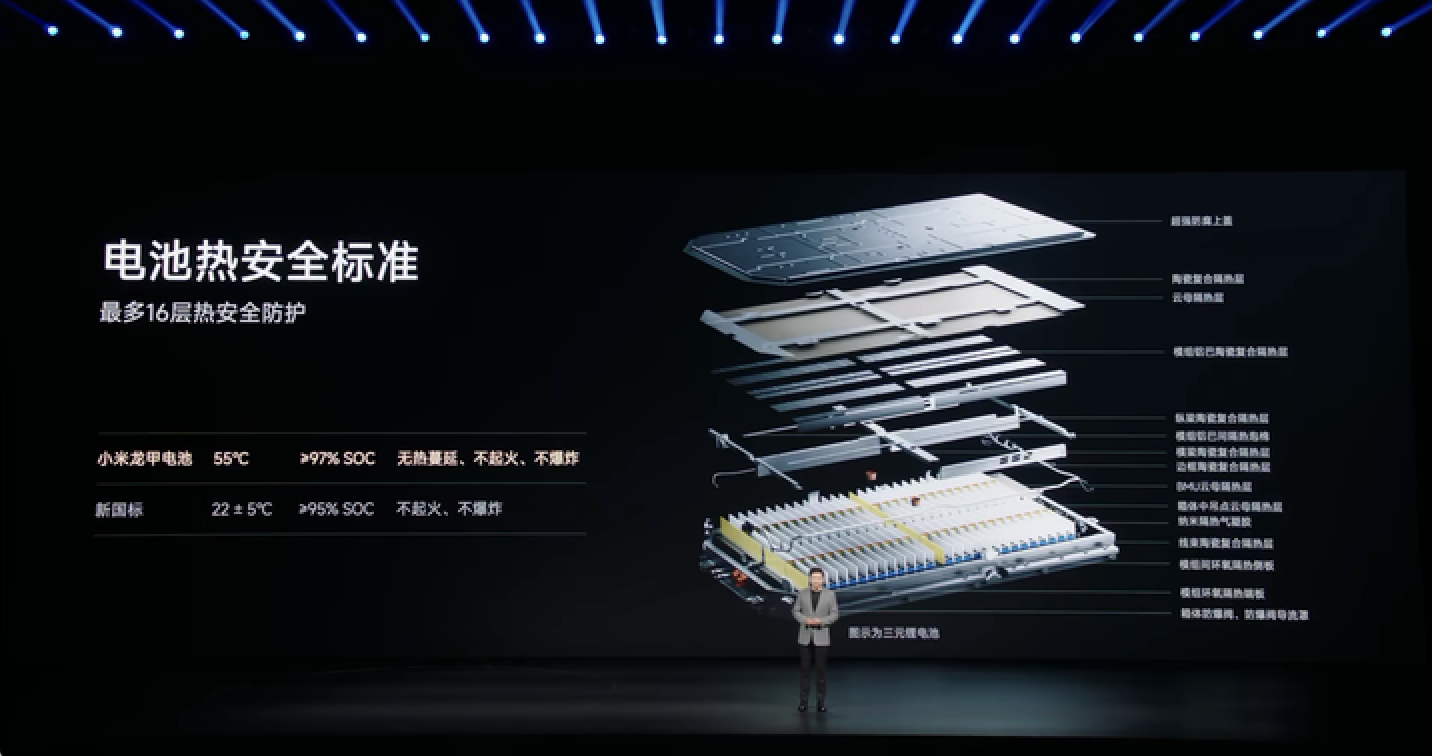
Xiaomi, Li Auto and Huawei's Aito are deploying proprietary battery systems with full-stack process control, directly challenging the "Intel Inside" dominance of Contemporary Amperex Technology (CATL) and forcing second-tier cell makers into an ODM-style subordinate role.
The shift crystallized on July 30, 2026, when Xiaomi Chairman Lei Jun unveiled the Longjiia battery at a technology event — the latest in a string of automaker-branded power systems that now includes Li Auto's proprietary pack and Huawei-backed Aito's Jujing battery. Each launch signals that China's electric-vehicle makers are no longer content to treat the battery — a component that accounts for roughly 30% of vehicle bill-of-materials cost — as a black box supplied by a single dominant vendor.
Industry sources familiar with the matter told 36Kr that consumer brand loyalty to CATL remains formidable: even after Li Auto offered buyers of its i6 model two additional years of warranty on Sunwoda cells, more than half of purchasers still opted for the CATL-equipped variant. That data point illustrates precisely why automakers are investing heavily in proprietary battery branding — not merely to cut costs, but to reclaim consumer mindshare that CATL has cultivated through an aggressive "Choose EVs by battery; trust CATL" advertising campaign visible across China's airports, high-speed rail stations and shopping malls.
Automakers Seize Full-Stack Control to Break CATL's "Gray Box" Lock-In
The structural grievance driving the trend is transparency — or the lack of it. When automakers source complete battery packs from CATL, they receive what industry insiders describe as a "gray box": basic cell discharge data such as capacity, voltage and internal resistance, but little visibility into cell chemistry, material formulations or factory-floor process controls. A Nio engineer cited by 36Kr put it bluntly: "CATL gives us almost nothing."
Automaker-branded batteries invert that arrangement entirely. Li Auto reportedly deployed more than 300 personnel on its battery program as of 2025, with the company's own cell-development and materials engineers effectively directing Sunwoda as a contract manufacturer. "Essentially Li Auto is calling all the shots; Sunwoda is cooperating," one source close to the company said. Xiaomi's battery team numbered over 100 staff in 2025, the majority focused on battery management system (BMS) algorithms, with active recruitment underway for industrialization and cell-capability roles.
Huawei's involvement in the Jujing battery goes further up the chemistry stack. Sources close to Aito say Huawei participates across the chemical system, raw materials, process design and end-of-line inspection — setting thermal-runaway standards that industry veterans describe as among the most stringent commercially deployed. The Jujing specification requires that a battery pack at approximately 100% state of charge, inside a fully heated vehicle in a high-ambient-temperature environment, must not explode following a thermal-runaway event — a bar that "very few" industry benchmarks exceed, according to engineers surveyed by 36Kr.
Xiaomi's Longjia battery similarly exceeds national standards: its 500-joule bottom-impact tolerance compares with a 150-joule national-standard threshold for non-leakage, non-ignition and non-explosion.
Production Consistency Remains CATL's Durable Competitive Moat
Despite the strategic momentum behind automaker batteries, multiple battery-industry engineers interviewed by 36Kr converge on a single conclusion: CATL's most defensible advantage is not chemistry or product specification, but manufacturing consistency — the ability to produce millions of cells with near-zero inter-cell variance in voltage, internal resistance and dimensional tolerance.
"CATL is the only domestic cell maker that doesn't sort cells into grades, because they're all the same," one industry veteran said. That uniformity is not incidental. Achieving it requires mastery of every production variable — ambient humidity, temperature, particulate contamination and raw-material selection — across enormous production volumes. "You need sufficient scale to conduct effective screening and trial-and-error," a second source noted. Neither automaker-owned lines nor second- and third-tier cell suppliers can replicate that scale in the near term.
The financial stakes of inconsistency are concrete. Industry sources explained the mechanism: in a 100-kWh pack, a single cell capable of only 98 kWh of effective capacity forces the BMS passive-balancing algorithm to dissipate the surplus energy of every other cell as heat, reducing usable pack capacity below design specification. Active-balancing BMS architectures can address this "valley-filling" problem but cost roughly RMB 20,000 (US$2,780) per commercial-vehicle unit — a premium that makes the technology economically unviable for passenger cars at current price points. The implication: cell-level inconsistency translates directly into range degradation and, in severe cases, elevated fire risk through chronic overcharge-discharge cycling.
Automakers Deploy Intensified Inspection Regimes to Narrow the Gap
Automaker battery programs are not passively accepting the consistency disadvantage. One engineer at a self-developed battery project described doubling or quadrupling standard industry inspection steps: ceramic-removal processes to eliminate metallic contaminants from raw materials increased from two passes to four; voltage-decay screening tests increased from two or three cycles to four. X-ray inspection — already adopted by CATL, Envision AESC and Sunwoda to detect electrode misalignment and winding defects — is being deployed at higher sampling rates on automaker-directed lines.
Crucially, automaker programs are extending quality governance deep into the sub-tier supply chain, setting material-selection standards for cathode and anode suppliers and dispatching engineers to assist second- and third-tier vendors with production-line upgrades and personnel training. "This is something the industry has rarely done before," one source said.
The BMS layer represents a second structural advantage for automakers. Because vehicle OEMs understand the full control-unit interaction architecture of their platforms, their BMS application-layer software "may actually be better than what battery makers produce," multiple engineers noted — a claim that Li Auto's internal after-sales data appears to support. Sources close to the company say that Li Auto-branded battery failure rates are comparable to CATL's, with some months recording lower failure rates than the CATL-supplied equivalent.
Industry Bifurcation Accelerates, Pressuring CATL to Open Its Ecosystem
The competitive dynamics now unfolding point toward a structural bifurcation of China's EV battery supply chain. On one side, CATL continues to offer high-integration system solutions — its Kirin and Shenxing products remain the benchmark for flagship-segment vehicles. On the other, a growing cohort of second- and third-tier cell makers — including Sunwoda and potentially others — are being repositioned as ODM-style manufacturers operating under automaker-defined standards, with limited autonomous product authority.
The medium-term pressure on CATL is therefore not primarily about market-share loss in the near term. Rather, it is about the terms of engagement: as automakers demonstrate that full-stack-controlled batteries can match or approach CATL's failure rates, the negotiating leverage that CATL's opacity has historically conferred will erode. The logical response — greater openness, deeper co-development and integration into automaker technical standards — is, paradoxically, precisely the outcome that the automaker-battery movement was designed to catalyze.
Whether that convergence materializes before second-tier cell consistency catches up to CATL's manufacturing benchmark will define the next phase of China's EV battery competitive landscape.
Related Coverage:
CATL’s Nvidia Moment: How China’s Battery Giant Is Trading Margins for Ecosystem Control