
China's Battery Makers Tighten Global Stranglehold as Korean Rivals Hemorrhage Share
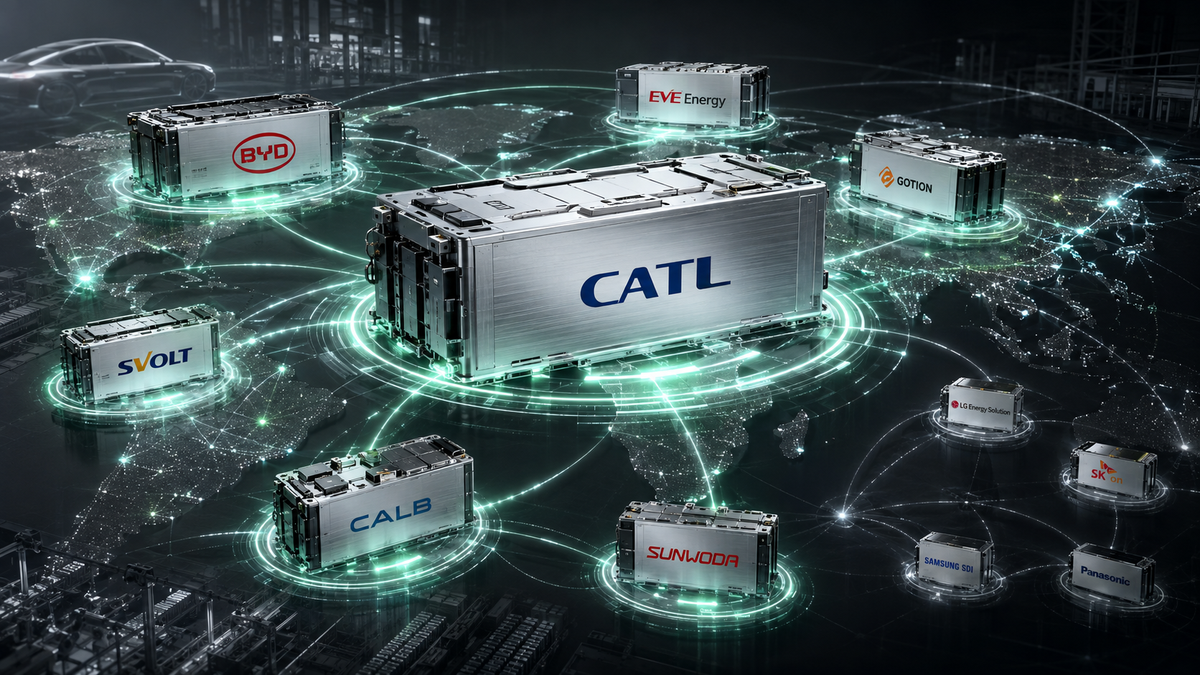
Seven Chinese firms now command 72.4% of worldwide EV battery installations in H1 2026, with CATL alone approaching 40% — a structural shift that is rendering Korean competitors strategically marginal.
Global EV battery installations reached 608.5 gigawatt-hours in the first half of 2026, a 20% year-on-year gain, according to data released August 5 by Seoul-based SNE Research. The headline growth figure, however, obscures a more consequential story: the competitive gap between Chinese manufacturers and their Japanese and Korean peers widened materially, raising questions about whether the latter can arrest a multi-year market-share erosion before the next technology cycle arrives.
The data landed without triggering immediate equity moves in Hong Kong or Shenzhen, as markets were closed for a public holiday. Analysts tracking the sector, however, noted that CATL's near-40% global share milestone represents a threshold that will likely intensify procurement pressure on automakers still holding dual-sourcing strategies with Korean suppliers.
CATL Accelerates Away From the Pack, Closing in on 40% Milestone
Contemporary Amperex Technology (CATL) — recorded 242.7 GWh of global installations in H1 2026, a 25.3% increase that outpaced the broader market by more than five percentage points. Its global share rose 1.7 percentage points to 39.9%, meaning roughly four in every ten EV battery cells installed worldwide now originate from a single Chinese manufacturer.
The growth engine is a deliberate dual-customer architecture. SNE Research's analysis notes that CATL has systematically deepened supply relationships with Tesla, BMW, Mercedes-Benz, Toyota, and Kia while simultaneously serving Chinese automakers expanding overseas. In markets outside China, CATL's installations surged 41.7% to 90.5 GWh, lifting its ex-China share from 30.0% to 33.6% — a figure that underscores the company's ability to compete on cost and product breadth even where trade barriers exist.
The competitive moat rests on lithium iron phosphate chemistry. LFP's lower raw-material cost and improving energy density have eroded the performance premium that once justified nickel-manganese-cobalt cells favored by Korean producers. CATL's product matrix now spans LFP, high-nickel NMC, and nascent solid-state development programs, giving it coverage across vehicle segments and regulatory environments.
BYD's Domestic Headwinds Mask a Credible Overseas Pivot
BYD retained second place with 87.7 GWh globally, but its 1.6% overall growth rate — against a market expanding at 20% — compressed its worldwide share from 17.0% to 14.4%. The divergence between CATL and BYD in the global ranking is partly structural: BYD's battery business is captive to its own vehicle brand, limiting third-party supply optionality.
The more instructive metric is BYD's ex-China performance. In markets outside China, BYD posted 28.2 GWh of installations, a 67.9% year-on-year surge, with share expanding 2.6 percentage points. The Blade Battery's combination of cost efficiency and thermal safety credentials is resonating with buyers in Europe, Southeast Asia, and Latin America. BYD is simultaneously building out overseas assembly capacity and dealership networks in those regions, a strategy that should sustain ex-China battery volume growth independent of domestic demand cycles.
The domestic context matters here. China's new-energy vehicle sales fell 13.4% year-on-year to 5.09 million units in H1 2026, according to the China Association of Automobile Manufacturers, as 2025's subsidy-front-loaded demand normalized. Yet domestic battery installations still grew 12.0% to 335.6 GWh — a counterintuitive outcome explained by a 34.0% year-on-year jump in average battery capacity per vehicle to 69.1 kWh, driven by extended-range and plug-in hybrid models entering what the industry calls the "large-battery era." That per-vehicle densification effect fully offset the unit-sales decline, insulating battery makers from what would otherwise have been a severe volume shock.
Second-Tier Chinese Makers Post Triple-Digit Gains Outside China, Reshaping Supplier Hierarchies
The most consequential competitive development for global automakers may not be CATL's dominance but the explosive growth of China's second tier. In ex-China markets:
- EVE Energy: 5.1 GWh, +171.5% YoY — the fastest growth rate among all tracked manufacturers
- Gotion High-Tech: 9.9 GWh, +141.5% YoY
- SVOLT Energy Technology: 8.4 GWh, +106.0% YoY
- CALB — China Aviation Lithium Battery: 6.3 GWh, +80.5% YoY
These growth rates reflect a structural shift in how European and Asian OEMs manage battery supply risk. Faced with concentration risk from over-reliance on CATL, and unable to find cost-competitive alternatives among Korean or Japanese suppliers, procurement teams are increasingly qualifying Chinese second-tier vendors. Localized production agreements, joint ventures, and LFP licensing arrangements are accelerating that qualification process.
For investors, the implication is a potential re-rating of these mid-cap Chinese battery names, several of which trade at significant discounts to CATL despite superior near-term growth trajectories.
Korean Trio Faces Structural Erosion, Not a Cyclical Dip
The H1 2026 data should extinguish any remaining argument that Korean battery makers face a temporary headwind. The evidence points to structural displacement.
LG Energy Solution posted 52.6 GWh, a 8.4% increase that lagged the market by nearly 12 percentage points. Share fell from 9.6% to 8.6%. LG's client roster — Tesla, Hyundai Motor Group, General Motors, Volkswagen — is blue-chip, but several of those customers are themselves losing EV market share in key regions, capping the upside.
SK On recorded a rare outright volume decline: 19.0 GWh, down 6.7% YoY, with share contracting from 4.0% to 3.1%. North American and European customers including Ford and Mercedes-Benz adjusted production schedules downward, directly suppressing SK On's utilization rates. The company's heavy geographic concentration in North America is a liability given that the region's EV market contracted 20.5% in H1 2026 — the steepest decline among major markets tracked by SNE Research.
Samsung SDI suffered the most severe deterioration, falling out of the global top ten entirely. In the ex-China market — where Samsung has negligible presence domestically — it recorded 10.5 GWh, a 29.0% year-on-year collapse, the largest decline among any top-tier manufacturer. Its ex-China share shrank from 7.0% to 3.9%. The proximate cause: Rivian Automotive's weak sales in North America and softening demand for legacy EV models among European clients including BMW and Audi. New model ramp-ups have been insufficient to compensate.
Sunwoda Electronic displaced Samsung SDI to claim the tenth global ranking with 14.5 GWh — a symbolic but consequential data point. Sunwoda had dropped out of the top ten in 2025; its return signals that even the lower boundary of the global top tier is now a Chinese preserve.
Panasonic Holds Position but Loses Ground, Anchored to Tesla's North American Footprint
Panasonic ranked sixth globally with 22.7 GWh, up 10.2% YoY — positive growth, but well below the market average, compressing share from 4.1% to 3.7%. Panasonic's strategic position is defined almost entirely by its Tesla relationship at the Gigafactory Nevada facility. Tesla's global deliveries grew 16.3% in H1 2026, but outside North America, Tesla increasingly sources from CATL and LG Energy Solution. Panasonic's geographic and client concentration leaves it structurally exposed to any Tesla demand variability in the U.S. market.
Solid-State Battery Narrative Offers Limited Near-Term Relief for Incumbents
Western European, American, Japanese, and Korean automakers have periodically cited solid-state battery commercialization as the technological reset that could neutralize Chinese cost advantages. The H1 2026 data reinforces skepticism about that thesis as a near-term catalyst.
Chinese battery manufacturers and state-backed research institutions have materially increased solid-state R&D investment. Current development timelines suggest that if a solid-state transition does occur at commercial scale, Chinese producers are positioned to participate in — rather than be disrupted by — that shift. The competitive architecture of the current lithium-ion generation, characterized by Chinese dominance across cost, scale, and product breadth, is unlikely to be overturned before the next technology cycle matures.
For global automakers still maintaining Korean or Japanese battery supply as a strategic hedge, the H1 2026 data sharpens a difficult question: at what point does that hedge become a cost burden rather than a risk management tool?
Related Coverage:
China's EV Battery Output Hits 192GWh in May as Installation Rate Slides to Record Low 38%