
China's Chip Battle: Path to Self-Sufficiency

The WeChat public account Industry Navigation released an in-depth report on the state of China's semiconductor and integrated circuit sector. The analysis, framed as an examination of a national "breakthrough battle," provides a comprehensive overview of China's strategy to navigate escalating geopolitical pressures and build a more resilient domestic chip industry. It covers the entire supply chain, from upstream materials and equipment to downstream packaging and testing.
The report is particularly noteworthy as it offers a Chinese domestic perspective on its industrial strategy amidst intensifying technology restrictions from the United States and its allies. It argues that China's objective in 2025 is not a direct, "symmetric" confrontation with global leaders across all fronts. Instead, the focus is on achieving "asymmetric" advantages through targeted breakthroughs in key areas, while leveraging the country's vast domestic market as a strategic buffer to reshape the competitive landscape.
Full Report Translation
In 2025, when we examine China's semiconductor and integrated circuit industry, what we see is not just an industry cross-section, but a strategic high ground at the epicenter of a global geopolitical storm, bearing the profound weight of national will. Since the China-US trade friction began in 2018, and especially with the implementation and deepening of the US CHIPS and Science Act and a series of export control measures by its allies (such as the Netherlands and Japan), the narrative of "cooperation and mutual benefit" in the global semiconductor supply chain has been overshadowed by the realist clouds of "decoupling and supply chain disruption."
For China, this is both an unprecedented challenge and an opportunity to force industrial upgrading and achieve self-sufficiency and control. In the past, we were accustomed to playing the role of "trading market for technology" or "downstream application integration" within the globalized system. However, when the floodgates of external supply were mercilessly shut, nearly every critical node—from upstream EDA (Electronic Design Automation) software, semiconductor materials, and core equipment to midstream advanced-process wafer fabrication—became a painful "chokehold."
Therefore, the core narrative of China's semiconductor industry in 2025 has evolved from simple "catch-up" to a multi-dimensional, all-encompassing "breakthrough battle." The goal of this battle is not to engage in a "symmetric," head-on confrontation with the world's strongest players in all areas. Rather, it is to concentrate resources in certain key fields to achieve "point breakthroughs" and use China's vast domestic market as strategic depth, leveraging "asymmetric" advantages to pry open an evolution in the industrial landscape. This article will proceed from a macro perspective of the industrial chain to deeply analyze the panoramic view, challenges, opportunities, and the key forces forging the nation's technological capabilities in 2025.
I. Full Industry Chain Analysis — Dissecting the Path to Self-Reliance
The semiconductor industry chain is like a towering tree with lush branches, its roots deeply embedded in basic science, its trunk running through design, manufacturing, and packaging, and its leaves extending to thousands of applications. To understand China's "breakthrough battle," one must first dissect its full anatomy.
A. Upstream: The Foundation and the Toughest "Long March"
The upstream segment has the highest technological barriers, the longest investment cycles, and is currently China's weakest link. It determines how high and how far the entire industry can go.
1. EDA (Electronic Design Automation) Software: The 'Mother of Chips,' an Intangible 'Lithography Machine'
EDA is the cornerstone of chip design. Without EDA software, the design, verification, and layout of hundreds of millions of transistors would be impossible. The global market has long been dominated by the American firms Synopsys and Cadence, and Germany's Mentor Graphics (now part of Siemens), a trio that collectively holds over 75% of the market share.
In recent years, US export controls on high-end EDA software, particularly tools for advanced processes like GAA (Gate-All-Around), have placed immense pressure on Chinese chip design companies. Against this backdrop, domestic EDA vendors have found a window of opportunity for "domestic substitution." Local companies, led by Empyrean Technology (华大九天), have achieved a degree of competitiveness in point tools for analog circuit design and flat-panel display circuit design and have successfully listed on the capital market. However, building a full-flow digital chip design toolchain that can support 7nm and below advanced processes remains a formidable task. In 2025, the goal for domestic EDA is to achieve a higher percentage of domestic coverage in mature process nodes (e.g., 28nm and above) while arduously advancing toward more advanced nodes. This is a protracted war of code, algorithms, and ecosystems.
2. Semiconductor Materials: The Industry's 'Lifeblood' and 'Nourishment'
Semiconductor materials are diverse and have extremely high technical thresholds, including silicon wafers, photoresists, electronic specialty gases, wet electronic chemicals, and targets.
- Silicon Wafers: These are the substrate for chip manufacturing. 12-inch (300mm) large silicon wafers are the mainstream, but the global market is highly monopolized by five major vendors, including Japan's Shin-Etsu Chemical and SUMCO. Chinese companies such as National Silicon Industry Group (沪硅产业, NSIG) and TCL Zhonghuan (中环股份) have achieved mass production of 12-inch wafers, but their capacity, yield, and technological maturity still lag behind international giants. The goal for 2025 is to further enhance the supply capacity and market share of prime wafers to meet the growing demand from domestic fabs.
- Photoresist: Hailed as the "pearl on the crown of semiconductor materials," its quality directly determines the precision of the lithography process. Especially in high-end ArF and extreme ultraviolet (EUV) photoresists, the market is almost entirely controlled by Japanese companies like JSR, Tokyo Ohka Kogyo, and Shin-Etsu Chemical. Chinese companies like Nata Opto-electronic Material (南大光电), Shanghai Sinyang Semiconductor Materials (上海新阳), and Jingrui Electronic Material (晶瑞电材) have made breakthroughs in mid-to-low-end photoresists like KrF and i-line, but ArF photoresist is still in the validation and limited supply stage, while EUV photoresist remains in the early stages of R&D. This is one of the most severe material "chokeholds."
- Electronic Specialty Gases: These are numerous, with high purity being the key. Domestic companies like Huate Gas (华特气体) and Jinhong Gas (金宏气体) have achieved import substitution for some mid-to-low-end gases but still need breakthroughs in some critical etching and deposition gases.
3. Semiconductor Equipment: The Nation's Heavy Armor, The Foundation of Manufacturing
Equipment is the physical basis for wafer fabrication and packaging & testing, accounting for over 70% of a fab's total investment. Lithography machines, etching machines, and thin-film deposition equipment are the three core types of equipment.
- Lithography Machines: The core of the core. The Netherlands' ASML holds an absolute monopoly in high-end EUV and DUV lithography. Limited by the Wassenaar Arrangement and US bans, China cannot obtain the most advanced EUV lithography machines and even faces strict restrictions on the import of immersion DUV lithography machines. Shanghai Micro Electronics Equipment (Group) Co., Ltd. (上海微电子装备, SMEE) represents China's hope for a breakthrough in lithography. It can already stably produce ArF dry lithography machines applicable to the 90nm process. The market widely anticipates its breakthrough in immersion DUV lithography for 28nm and more advanced nodes, which is undoubtedly the most challenging task in the entire industry chain. In 2025, every step of SMEE's progress will be a focal point for the industry.
- Etching & Deposition Machines: This is a segment where China's semiconductor equipment industry has a relative advantage. The dielectric etchers from Advanced Micro-Fabrication Equipment Inc. China (中微公司, AMEC) have entered validation in world-leading 5nm production lines, and its technology is competitive on a global scale. NAURA Technology Group Co., Ltd. (北方华创, NAURA) is a platform-type equipment leader with a product line covering etching, PVD, CVD, cleaning, and thermal processing, achieving domestic substitution in multiple areas. In 2025, these two companies will continue to act as the "standard-bearers" for domestic equipment, striving for higher technical specifications and broader market coverage.
B. Midstream: The 'Core' of the Industry, A Game of Manufacturing and Design
The midstream is the central link where chip blueprints become reality, encompassing chip design and wafer fabrication.
1. Chip Design (Fabless): From 'Application-Driven' to 'Architecture Innovation'
China has the world's largest cohort of chip design companies, but it still has shortcomings in the high-end segment.
- Mobile SoC: Once, Huawei HiSilicon's (华为海思) Kirin chips reached the pinnacle of the world, forming a triumvirate with Qualcomm and Apple. However, after its manufacturing was restricted, its development stagnated. Unisoc (紫光展锐) has been making steady progress in the low-to-mid-range market and is currently the most important mobile chip supplier in mainland China's open market.
- AI/Server Chips: With the explosion in demand from artificial intelligence and data centers, this is a fiercely contested area. Companies like Huawei Ascend (华为昇腾), Cambricon Technologies (寒武纪), Biren Technology (壁仞科技), and Moore Threads (摩尔线程) are all deploying in this field. However, high-end AI chips also face manufacturing bottlenecks at advanced process nodes. Therefore, maximizing performance under existing process constraints through architectural innovation (like Chiplets) and software ecosystem optimization has become an important strategy for 2025.
- Other Areas: In consumer electronics (Will Semiconductor (韦尔股份) is a global leader in CIS image sensors), the Internet of Things (GigaDevice Semiconductor's (兆易创新) MCUs and NOR Flash), and power semiconductors, Chinese design companies have already established strong global competitiveness.
2. Wafer Fabrication (Foundry): The 'High Ground' That Determines the Industry's Fate
Wafer fabrication is the most capital- and technology-intensive segment and the focal point of geopolitical rivalry. The global market is dominated by a duopoly of TSMC and Samsung in advanced processes.
- Mainland China's "Duo": Semiconductor Manufacturing International Corporation (中芯国际, SMIC) and Hua Hong Semiconductor (华虹半导体) are the flagships of China's wafer foundry industry.
- SMIC: As mainland China's most technologically advanced and largest wafer foundry, every move by SMIC is closely watched. Although it cannot obtain EUV lithography machines, it is widely believed in the market that it has achieved risk production of 7nm process technology using existing DUV equipment through techniques like multiple patterning. This is a major step forward for China in advanced processes. In 2025, SMIC's strategic focus will be on increasing the capacity and profitability of mature processes (28nm and above) while optimizing technology and improving yields for advanced processes (14/7nm) to provide limited but precious capacity support for domestic high-end chip design companies.
- Hua Hong Semiconductor: Focusing on specialty processes such as embedded non-volatile memory, power devices, and analog & power management, it holds a significant position in the global specialty process foundry market. Its prudent business strategy and differentiated competitive route make it an indispensable part of the industry chain.
C. Downstream: Outsourced Semiconductor Assembly and Test (OSAT), from 'Follower' to 'Leader'
OSAT is the final link in the industry chain and the segment where mainland China has the most global competitiveness.
- Traditional Strengths and Advanced Layout: Through years of development and overseas acquisitions, mainland China's JCET Group (长电科技), TF Microelectronics (通富微电), and Huatian Technology (华天科技) have firmly established themselves in the global top ten OSAT rankings.
- Strategic Opportunity in Advanced Packaging: In the "post-Moore's Law era," with the rise of Chiplet technology, the importance of advanced packaging (such as 2.5D/3D packaging) is increasingly prominent. It can enhance the overall performance of a chip through heterogeneous integration without relying on the most advanced process nodes. This provides a strategic opportunity for China's semiconductor industry to "overtake on the curve." In 2025, Chinese OSAT vendors will increase investment and R&D in advanced packaging technologies like Fan-Out, SiP (System-in-Package), and 2.5D, which are seen as an "asymmetric" weapon to break through the blockade on advanced processes.
II. Key Battles — Breakthroughs and Challenges in Core Technology Areas (2025 Focus)
For China's semiconductor industry in 2025, the outcomes of several key battles will directly impact the success of the "breakthrough."
A. Advanced Processes vs. Mature Processes: The Wisdom of Walking on Two Legs
- Advanced Processes (≤14nm): This is the technological high ground, crucial for core areas like high-performance computing, AI, and high-end smartphones. China's path to breakthrough is fraught with thorns. SMIC's 7nm is considered a "chip of national pride" (争气芯), but the realities are high costs, a difficult yield ramp, and limited capacity. In 2025, we will not see China competing head-on with TSMC at 3nm or 2nm. The strategic goal is to deeply optimize the 7nm/5nm technology nodes and explore non-ASML technological paths (such as nanoimprint, though still in its infancy).
- Mature Processes (>28nm): This is the "base" and strategic depth of China's semiconductor industry. There is massive demand for mature processes in fields like automotive electronics, the Internet of Things, industrial control, and power semiconductors. In 2025, China will continue to massively expand its mature process capacity. This can, on one hand, meet huge domestic market demand and ensure supply chain security; on the other hand, through economies of scale, it may trigger a "price war" in the global mature process market, reshaping the competitive landscape in this area. "Trading market for time, and using mature [processes] to secure advanced [ones]" is the core strategy for China's wafer manufacturing industry in 2025.
B. Memory Chips: A "Nourishment" Industry Concerning National Information Security
DRAM and NAND Flash are the two pillars of memory chips and were once among the largest categories of integrated circuits imported by China annually.
- Yangtze Memory Technologies Corp. (长江存储, YMTC): Focused on 3D NAND flash memory. It has successfully mass-produced 232-layer NAND chips, placing it in the world's top tier technologically. Despite being placed on the US "Entity List" and facing restrictions on equipment imports, YMTC is still arduously advancing its technology and maintaining production. Its status in 2025 will be an important window for observing the resilience of China's semiconductor industry.
- ChangXin Memory Technologies (长鑫存储, CXMT): Focused on DRAM memory. It has achieved mass production of DDR4 using a 19nm process and is moving towards the more advanced DDR5 and 17nm processes. Compared to the three giants—Samsung, SK Hynix, and Micron—there is still a gap in technology and scale, but it has achieved a major breakthrough from 0 to 1.
The survival and development of YMTC and CXMT are of immeasurable strategic significance for ensuring China's data security and the stability of its information industry.
C. Third-Generation Semiconductors: A New Track with Potential for "Track-Changing Overtaking"
Third-generation semiconductors, represented by Silicon Carbide (SiC) and Gallium Nitride (GaN), have excellent performance in high voltage, high frequency, and high efficiency. They are the core materials for emerging fields like new energy vehicles (NEVs), 5G communications, and photovoltaic energy storage.
- China's Opportunity: Compared to first-generation (silicon) semiconductors, the global third-generation semiconductor industry is still in its early stages of development, and giants have not yet formed an absolute monopoly. China has an early start in this field, possessing a complete industry chain from substrate and epitaxy to devices and applications, and is closely integrated with downstream advantageous industries like NEVs.
- Key Players: Companies like Sanan Optoelectronics (三安光电), Wingtech Technology (闻泰科技) (through its acquisition of Nexperia), and CRRC Times Electric (时代电气) have deep deployments in the SiC and GaN fields. In 2025, as the penetration rate of domestic NEVs continues to rise and with the large-scale construction of charging piles, China's third-generation semiconductor market is expected to experience explosive growth, potentially becoming a breakthrough point for China's semiconductor industry to achieve a leading position globally.
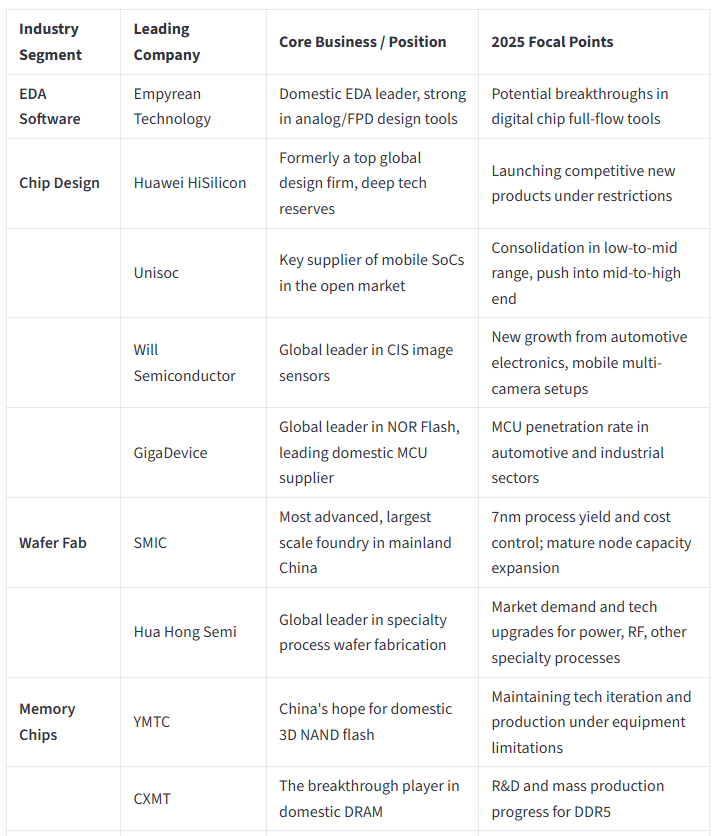
III. Forging the Nation's Capabilities — A Roster of Key Companies on the Industry Chain (2025 Watchlist)
The grand narrative of the "breakthrough battle" ultimately comes down to individual companies. The following are the key forces that warrant close attention in 2025 as they forge capabilities for the nation across various segments of the industry chain.

Looking Ahead to 2025
The landscape of China's semiconductor industry in 2025 is complex and full of tension.
Three Core Challenges Ahead:
- Persistence and Precision of External Blockades: US-led technology blockades are not expected to ease and may become even more precise in targeting China's weak links and emerging breakthroughs.
- Difficulty of Breaking Through Endogenous Technology Bottlenecks: Overcoming the "hardest hurdles" like lithography machines, high-end photoresists, and full-flow EDA tools requires time and patience, not an overnight success.
- Massive Talent Gap: The talent shortage across the entire industry chain, from top scientists and architects to front-line process engineers, is a deep-seated factor constraining development.
Three Strategic Opportunities Within Reach:
- Strategic Depth of the Vast Domestic Market: China is the world's largest consumer of chips, and its huge internal market provides a valuable ground for domestic chips to be tested, iterated, and grown.
- Exploration Space for "Asymmetric" Technology Routes: New tracks like Chiplets and third-generation semiconductors offer China possibilities to bypass traditional paths and achieve "track-changing overtaking."
- Steadfast Support of the National Will: Long-term, stable capital investment, represented by the third phase of the "National IC Fund," and supporting policies from local governments provide a powerful driving force for industrial development.
In 2025, China's semiconductor industry will not stage a sudden "come-from-behind" miracle. It is more akin to a grueling "Battle of Triangle Hill"—a high-stakes campaign of attrition involving repeated struggles over key positions. We will likely see China's influence in the global market for mature processes further strengthen, driven by capacity expansion and cost advantages. In advanced packaging and third-generation semiconductors, it is poised to achieve "point" global leadership. And in the most difficult areas of equipment, materials, and advanced process manufacturing, every small step forward will be a solid move toward breaking the blockade.
The ultimate victory in this "breakthrough battle" requires not only technological breakthroughs but also long-term synergy and perseverance in the nation's scientific research, education, finance, and industrial policy. For every company and individual involved, this is both a challenge of the times and an opportunity to make history.
This analysis is the culmination of months of in-depth industry research, cross-analysis of hundreds of public financial reports and technical documents, and anonymous interviews with dozens of front-line practitioners and senior analysts. It aims to provide a cognitive depth that surpasses the market average.
Information is power, and cognition determines wealth. In this "breakthrough battle" that concerns the fate of the nation, let us walk with the times from the most professional perspective.