
China's Chip Industry Revenue Surges 89.4% to RMB 1.58 Trillion, Driven by AI Demand Supercycle
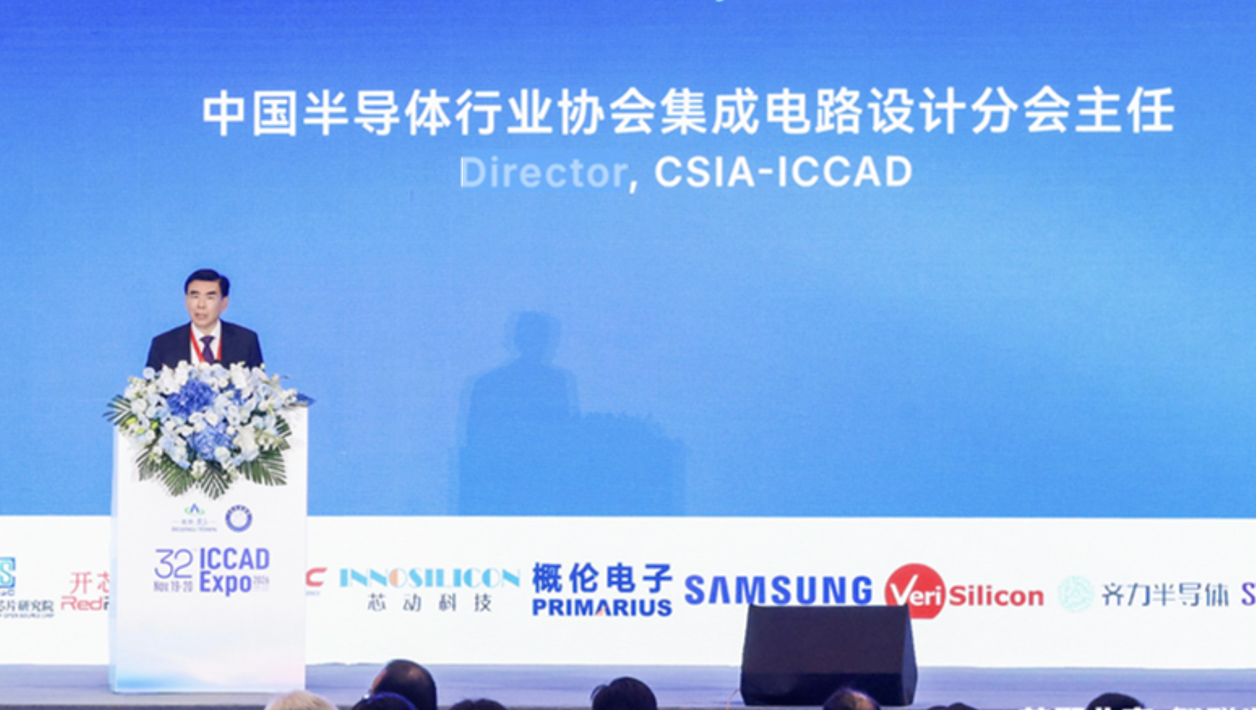
Wei Shaojun's keynote at ICCAD-Expo 2026 reveals a structural acceleration in domestic semiconductor design, with AI-driven compute demand reshaping regional growth dynamics and forcing a fundamental rethink of chip architecture methodology.
China's integrated circuit design industry posted full-year sales of RMB 1,582.03 billion (US$219.7 billion) in 2026, surging 89.4% year-on-year — a pace that far outstrips global semiconductor benchmarks and signals a demand inflection point driven almost entirely by artificial intelligence infrastructure buildout.
The figures, disclosed by Wei Shaojun, director of the IC Design Branch of the China Semiconductor Industry Association and professor at Tsinghua University, were presented during his keynote address titled "Embracing the Wave of Intelligence" at the 2026 Integrated Circuit Development Forum (ICCAD-Expo 2026) held November 19–20 in Beijing's Yizhuang district. The dataset covers approximately 4,320 enterprises across 20 cities — the broadest statistical footprint the annual survey has captured — and all 20 cities recorded positive growth, a first in recent survey history.
AI Redefines Chip Architecture, Upending Traditional Design Logic
Wei argued that the revenue surge is not a cyclical rebound but a structural shift rooted in AI's insatiable compute appetite. Large language model training, he noted, requires chips to deliver sustained, massive parallelism over extended periods — a demand profile fundamentally incompatible with traditional linear chip design flows built around manual tuning and sequential optimization.
The new paradigm demands high throughput, ultra-low latency, and adaptive processing across heterogeneous workloads, forcing designers to reconfigure approaches to compute density, memory bandwidth, and on-chip interconnect architecture simultaneously. "AI is driving a paradigm shift in chip design methodology," Wei stated, framing the transition as systemic rather than incremental — not a single-chip or single-IP upgrade, but a full reconstruction of the product stack.
This has direct capital allocation implications: companies that have invested early in AI-native architecture — particularly in the compute, memory, and interconnect triad Wei identified as the industry's strategic priority chain — are disproportionately capturing the revenue upside.
Regional Bifurcation Sharpens as Yangtze River Delta Consolidates Dominance
The geographic distribution of that RMB 1.58 trillion in sales reveals a deepening regional hierarchy with significant policy and investment implications.
The Yangtze River Delta retained its commanding lead at approximately RMB 970 billion (US$134.7 billion), accounting for roughly 61% of national IC design revenue. The Greater Bay Area (Pearl River Delta) contributed RMB 304.4 billion (US$42.3 billion), up 28% — solid but trailing the national average. The Beijing-Tianjin-Hebei corridor generated RMB 216.8 billion (US$30.1 billion), growing 38.4%.
The most striking data point for investors tracking China's industrial policy execution is the Central and Western region's performance: RMB 273 billion (US$37.9 billion), with an 80% growth rate that places it second nationally in expansion velocity. This aligns with Beijing's sustained push to develop inland semiconductor clusters as a supply chain resilience strategy.
At the city level, the divergences are even more pronounced. Hefei topped the growth ranking with a staggering 2,546.7% increase — a figure reflecting its transformation from a minor player into a state-backed semiconductor hub anchored by significant government-guided fund investment. Wuhan ranked second at 218.2% growth, followed by Chongqing at 66.7% and Beijing at 45.1%. The concentration of hyper-growth in second- and third-tier cities suggests that China's chip geography is still in active formation, with policy capital continuing to reshape the competitive map.
Scale-Up in Profitable Firms Masks Widening Intra-Industry Stratification
A deeper reading of Wei's data reveals a bifurcated industry structure that is both a strength and a vulnerability. The number of IC design firms with annual revenues exceeding RMB 100 million (US$13.9 million) is projected to reach 947 in 2026, up from 831 in 2025 — a 14% increase representing 116 new entrants to that threshold.
More telling is the concentration at the top: the revenue aggregate of leading chip design enterprises approaches RMB 800 billion (US$111.1 billion), growing at a rate significantly above the sector average of 89.4%. This implies that headline growth is substantially powered by a relatively small cohort of scaled players, while the broader base of startups — which continue to proliferate in the Yangtze River Delta and Central-Western regions — faces an intensifying capability gap.
For venture investors, this creates a bifurcated risk profile: the tailwind is real, but the addressable opportunity increasingly concentrates in companies that can compete on system-level AI silicon, not discrete component plays.
Wei Maps Five Strategic Imperatives as External Pressure Mounts
Closing his address, Wei outlined five priorities that read as much as a policy roadmap as an industry call-to-action — a signal of where state and industry expectations are converging.
First, he urged long-term strategic confidence, explicitly cautioning against evaluating technology development cycles through the lens of short-term secondary market logic — a pointed message aimed at both speculative capital and policymakers susceptible to quarterly metrics.
Second, he identified the critical gaps requiring sustained investment: advanced manufacturing processes, core equipment, materials, and talent — the same chokepoints that U.S. export controls have targeted most aggressively since 2022.
Third, on innovation strategy, Wei rejected wholesale adoption of foreign development roadmaps, calling instead for China-rooted R&D that converts research output into product competitiveness. The AI transition, he argued, creates a "lane-change opportunity" for domestic players precisely because legacy architectural paradigms are being disrupted globally.
Fourth, he endorsed advanced packaging — including heterogeneous integration — as a viable parallel technology path alongside leading-edge process development. This positions packaging not as a fallback but as a co-equal strategic vector, a framing consistent with the trajectory of players such as JCET Group and Tongfu Microelectronics.
Fifth, Wei invoked "baseline thinking" — placing supply chain security above pure performance benchmarks, a principle that underscores how China's semiconductor strategy operates under a dual mandate of technological ambition and systemic risk management.
Impact Assessment: What the Numbers Mean for the Broader Market
The 89.4% growth rate is extraordinary by any measure, but context is essential. China's IC design revenue base entering 2025 was significantly compressed relative to its structural potential, partly due to inventory digestion cycles in consumer electronics and the ramp-up lag in AI infrastructure spending. The 2026 surge reflects both a low base effect and a genuine demand acceleration — meaning the absolute growth trajectory into 2027 will likely moderate, though Wei's data on startup formation and city-level expansion suggests the structural buildout phase is far from complete.
For global semiconductor supply chains, the data confirms that China is developing a parallel, increasingly self-sufficient IC design ecosystem at scale. The Yangtze River Delta's RMB 970 billion cluster alone rivals the combined output of several mid-sized national semiconductor industries. As that ecosystem matures from design into more integrated chipmaking capability — a transition still constrained by equipment and materials access — the competitive dynamics for fabless players globally will shift materially.
Related Coverage:
Chinese Chip-Tool Power Supplier Shenzhou Semiconductor Clears STAR IPO Review
New Chips, 200MP Cameras to Define China's 2025 Flagship Phones