
China's Commercial Space Race Accelerates as Orbital Resource Scramble Triggers Historic Market Rally
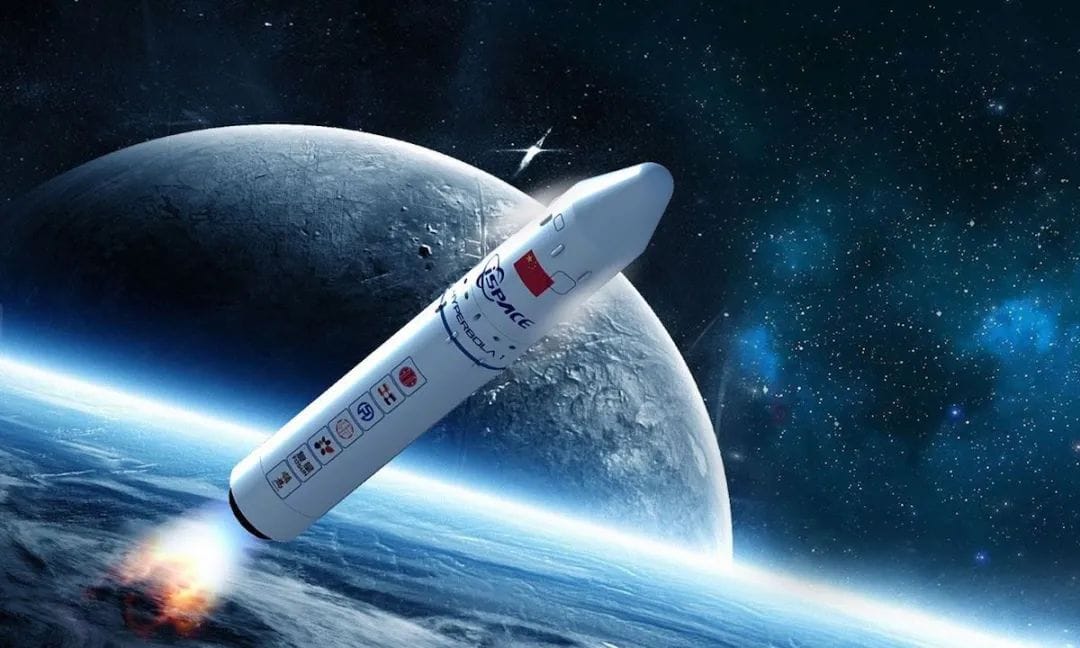
China has formally notified the International Telecommunication Union of plans to deploy 203,000 new satellites across 14 constellations, marking its largest single orbital frequency filing and propelling domestic aerospace equities to unprecedented valuations. The move, submitted between December 25-31, 2025, arrives as reusable rocket technology breakthroughs converge with explicit policy architecture designed to close the gap with SpaceX's operational dominance in low Earth orbit.
Reusable Launch Systems Break Through Technical Barriers
The market surge stems from tangible engineering milestones rather than speculative positioning. LandSpace's Zhuque-3 rocket achieved China's first vertical landing attempt during second-stage orbital insertion on December 3, 2025, followed by China Aerospace Science and Technology Corporation's Long March 12A demonstrating an alternative recovery pathway on December 23. While neither mission recovered its booster intact, both flights validated critical subsystems—attitude control during atmospheric reentry, engine restart capability, and thermal protection integrity—that SpaceX spent years perfecting between 2013-2015.
The technical parallel matters because launch cost economics dictate satellite constellation feasibility. SpaceX reduced per-kilogram launch costs from approximately 10,000tounder10,000tounder1,500 through Falcon 9 reusability, enabling its Starlink network to reach 9,300 operational satellites and 9 million subscribers by year-end 2025. China's GW constellation, G60 Starlink, and Honghu-3 projects collectively target over 50,000 satellites, but execution hinges on achieving comparable launch cadence—SpaceX conducted 170 missions in 2025 alone—which requires proven reusable systems.
Policy Infrastructure Shifts From Oversight to Industrial Catalysis
Regulatory changes now explicitly treat orbital access as strategic infrastructure rather than experimental ventures. The National Space Administration's establishment of a dedicated Commercial Space Bureau in November 2025 created centralized coordination previously fragmented across military and civilian agencies. The three-year action plan released simultaneously set quantifiable deployment targets and procurement frameworks, transitioning commercial aerospace from policy experiment to baseline national capability.
The Shanghai Stock Exchange's December 26 rule change allowing pre-revenue rocket manufacturers to list under Chart 5 criteria removed the primary capital formation bottleneck. LandSpace's IPO filing—seeking ¥7.5 billion with ¥2.77 billion earmarked for production scaling—illustrates how the new framework permits technology validation milestones to substitute for profitability metrics. The regulation explicitly requires successful orbital insertion using reusable technology, linking public market access directly to engineering achievement rather than revenue recognition.
Valuation Disconnects Expose Execution Risks Ahead
The Shenwan Aerospace Equipment II index gained 37% in 2026's first nine trading days following a 146% surge in 2025, yet underlying fundamentals reveal sector-wide pre-commercialization exposure. China Satellite's market capitalization reached ¥137.9 billion against nine-month net income of ¥15 million, implying a 2,400x trailing PE ratio. Aerospace Development reported consecutive quarterly losses totaling ¥489 million through Q3 2025 even as its January 12 trading volume hit ¥22.2 billion—second only to BlueFocus across all A-shares.
Such disconnects reflect positioning for anticipated rather than realized cash flows. Lin Yankun, whose firm backed LandSpace in 2020, frames the valuation logic around anticipated procurement cycles: successful high-frequency launch capability triggers constellation deployment contracts, which generate application-layer revenues that fund reinvestment. The model assumes China replicates SpaceX's "launch-deploy-monetize-reinvest" flywheel, yet orbital mechanics impose constraints—near-Earth capacity accommodates roughly 60,000 satellites under current ITU coordination frameworks, and China's 203,000-unit filing includes allocations the newly formed Radio Innovation Institute must activate through actual deployments to defend.
Space-Based Computing Emerges as Secondary Demand Vector
Beyond communications infrastructure, domestic planning now incorporates orbital data centers as "15th Five-Year Plan" priority projects. Lin's analysis suggests cost parity between space-based and terrestrial hyperscale compute facilities could arrive within the planning period, driven by launch cost reductions and thermal management advantages in vacuum environments. The concept positions satellite networks as dual-use platforms—communication nodes that simultaneously provide distributed processing capacity for latency-insensitive AI training workloads.
This application layer remains speculative but carries implications for component manufacturers and satellite bus providers. Ground station networks, inter-satellite laser links, and radiation-hardened processors become critical path items if orbital computing progresses from whitepaper to procurement. SpaceX's anticipated H2 2026 IPO at $800 billion valuation provides a benchmark for integrated space infrastructure operators, though its Starship V3 test flight and operational history dwarf Chinese commercial entities' demonstrated capabilities.
Near-term sector performance hinges on whether subsequent LandSpace and Long March recovery attempts achieve full booster reuse, validating the technical foundation for cost parity with established competitors. The ITU's "first-come, first-served" principle transforms launch tempo into geopolitical currency—orbital slots claimed through active satellites cannot be displaced by paper filings. China's 203,000-unit notification secures regulatory placeholders, but converting those reservations into operational assets depends entirely on closing the reusability execution gap SpaceX bridged nearly a decade ago.
By ChinaBiz Insider Analysis Desk