
China's Embodied AI IPO Wave: Real Technology, Unresolved Gaps
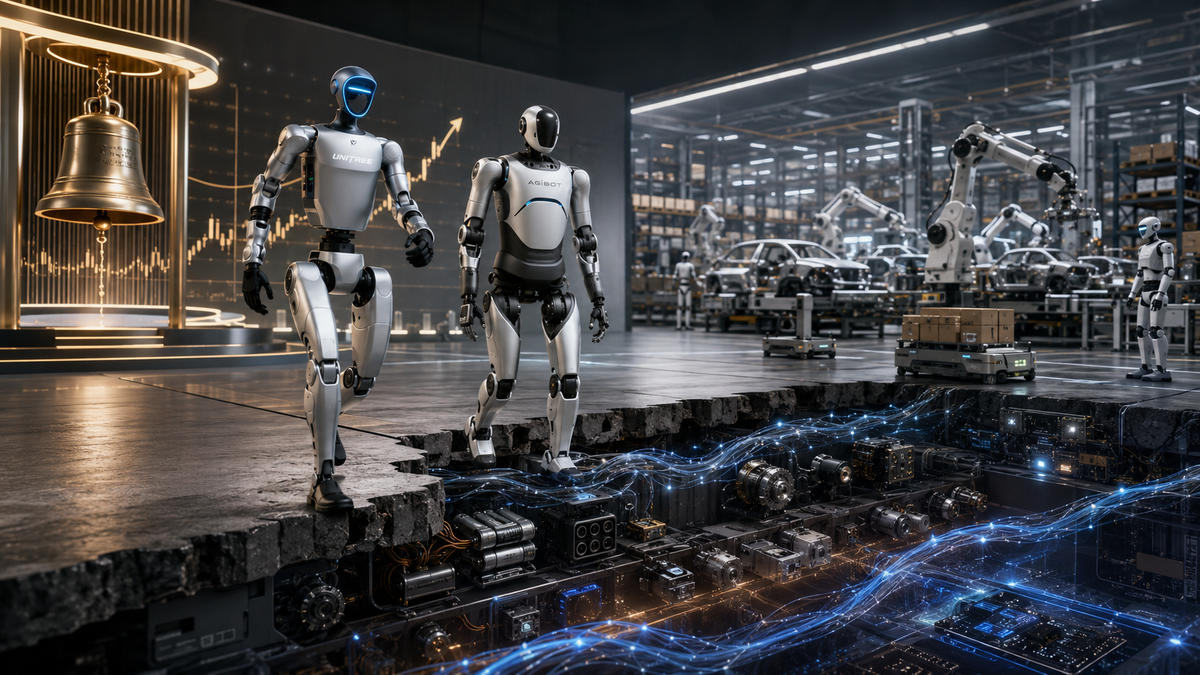
Why the listings of Unitree and AgiBot tell us more about capital cycles than commercial readiness
What Is "Embodied AI" — and Why Is It Suddenly Everywhere?
Embodied AI refers to artificial intelligence systems that interact with and operate within the physical world through a body — whether a humanoid robot, a quadruped, or a wheeled platform. Unlike software AI, which processes information in digital space, embodied AI must perceive, decide, and act in real environments subject to the laws of physics.
The term has moved from research papers into financial headlines because two of China's most prominent embodied AI companies — Unitree Robotics and AgiBot — are now pursuing public listings. Unitree has landed on Shanghai's STAR Market; AgiBot is preparing a Hong Kong IPO. Their combined valuations run into the tens of billions of renminbi.
The timing has triggered a familiar question in emerging technology markets: are these IPOs a signal that the technology has matured, or that early investors need an exit?
What Has Actually Changed Technologically?
The honest answer is: quite a lot — but not enough to declare commercial victory.
On the intelligence side, the emergence of large language models and vision-language-action (VLA) models has given robots something resembling a cognitive layer. Traditional industrial robots execute pre-programmed, deterministic movements. Embodied AI systems can now interpret natural language instructions, process multi-modal sensory inputs, and make context-dependent decisions. The "body" is beginning to catch up to a more human-like "brain."
On the hardware side, domestic supply chains in China have driven meaningful cost compression. Core components — servo motors, harmonic reducers, torque sensors — that were largely imported just a few years ago are now manufactured domestically at a fraction of the previous cost. One leading domestic joint module supplier now prices a harmonic drive joint assembly for a humanoid arm at roughly ¥1,000 — a price point at which, two years earlier, a standalone reducer alone would have cost more. Unitree has pushed the retail price of a humanoid robot below ¥99,000, a threshold that would have been considered impossible in 2022.
These are genuine advances. They are not, however, the same as commercial scalability.
Why Are These Companies Going Public Now?
Two structural forces are converging simultaneously, and understanding both is essential to reading the IPO wave correctly.
Force 1: Capital intensity demands public markets. Embodied AI is among the most cash-consumptive sectors in deep tech. Algorithm training, compute infrastructure, hardware iteration, and supply chain development all require sustained capital deployment. Private funding rounds — even large ones — have finite runways. Public markets provide a more durable and scalable financing mechanism.
Force 2: Early investors are approaching their holding limits. Many institutional investors entered the leading embodied AI companies three to four years ago, at valuations that have since expanded dramatically on the expectation of future commercialization. With large-scale revenue still not materializing at the pace originally projected, the pressure to provide liquidity — through an IPO — has become structural rather than opportunistic. An IPO is simultaneously a fundraising event for the company and an exit mechanism for early capital.
Critically, listing on a public exchange does not mean a company is profitable. It means the company has secured a new stage of financing and accepted a new level of scrutiny. The two should not be conflated.
Where Does the Gap Between Demo and Deployment Actually Lie?
This is the section that most investor presentations omit. Three structural gaps separate today's embodied AI from genuine industrial or consumer deployment.
The Teleoperation-to-Autonomy Gap
A significant portion of the impressive robot demonstrations circulating on social media involve teleoperation — a human operator wearing motion-capture equipment remotely controls the robot's movements, while the robot's sensors record the interaction to generate training data. The robot appears autonomous; it is not.
True commercial deployment requires unsupervised, autonomous operation across variable real-world conditions. Current embodied AI systems remain brittle in generalization: change the viewing angle, substitute a different object, alter the ambient lighting, and model performance degrades sharply. A robot that can reliably pour water in a controlled lab environment may fail when the cup is placed two inches to the left.
The Industrial Economics Gap
Humanoid robots are being positioned as candidates for factory work — assembly, fastening, materials handling. The competitive reality is that conventional industrial robots (articulated arms, SCARA systems, cobots) are cheaper, more precise, faster, and more reliable for structured manufacturing tasks. Humanoid robots offer "flexibility" in handling non-standard tasks, but industrial buyers evaluate capital equipment on return on investment. Until humanoid systems demonstrably outperform or meaningfully undercut traditional automation on a total-cost basis, factory deployment will remain at the pilot and co-development stage rather than volume procurement.
The Hardware Durability Gap
Cost reduction is not the same as reliability improvement. Under high-dynamic operating conditions — the kind of continuous, repetitive motion that industrial deployment demands — joint wear, battery cycle degradation, and thermal management become critical constraints. Laboratory environments allow for frequent maintenance and controlled conditions. Real-world deployment does not. The gap between current demonstrated durability and industrial-grade or consumer-grade reliability standards remains substantial.
Is "Humanoid" the Right Frame for Embodied AI?
One of the most persistent misunderstandings in current market discourse is treating "humanoid robot" and "embodied AI" as synonyms. They are not.
Humanoid form is one design choice among many. The underlying technology — an intelligent agent that perceives and acts in physical space — can be instantiated in radically different hardware configurations depending on the deployment environment. Unitree's parallel development of quadruped robots and humanoids reflects this logic. AgiBot's emphasis on integrating large embodied models with its "Expedition" hardware platform points in the same direction.
The commercially viable form factor will be determined by scene-hardware fit, not by anthropomorphic aesthetics:
- In logistics and warehousing: wheeled AMRs with articulated arms
- In hazardous inspection or search-and-rescue: quadrupeds
- In flexible manufacturing: task-specific manipulators on mobile bases
- In consumer or eldercare settings: potentially humanoid, but only when reliability standards are met
Investors and analysts who evaluate embodied AI companies primarily on the visual impressiveness of their humanoid demonstrations are measuring the wrong variable. The right question is whether a company can solve a specific, high-value problem reliably enough to generate repeatable commercial orders.
Who Are the Key Players and What Differentiates Them?
Unitree Robotics has built its position on motion control algorithms — its quadruped robots set benchmarks for dynamic locomotion — while simultaneously expanding into humanoid platforms. The sub-¥99,000 humanoid price point reflects both hardware cost discipline and a deliberate strategy to accelerate deployment volume and data collection.
AgiBot has emphasized the integration of large embodied foundation models with its hardware, positioning itself as an AI-first rather than hardware-first company. Its Hong Kong listing path suggests a different investor base and capital market strategy than Unitree's STAR Market route.
Both companies face the same structural constraint: the data flywheel. Embodied AI improves through real-world interaction data. More deployments generate more data, which improves model performance, which enables more deployments. Companies that achieve early deployment scale — even in narrow, high-value use cases — will compound their technical advantage faster than those optimizing for demo quality.
What Should Investors and Observers Actually Watch?
The embodied AI sector will produce both significant long-term value and significant near-term capital destruction. Distinguishing between the two requires looking past the obvious metrics.
Watch the data flywheel, not the demo reel. The most durable competitive advantage in embodied AI is proprietary real-world interaction data at scale. Ask whether a company's deployed units are generating training data continuously, and whether that data is translating into measurable model improvement.
Watch gross margin trajectory, not revenue growth alone. Early-stage hardware companies can grow revenue by selling below cost. The transition from "shipping units" to "generating margin" is the critical inflection point. Post-IPO financial disclosures will make this visible for the first time for many of these companies.
Watch for "cash cow" use cases. The companies most likely to survive the current cycle are those that identify narrow, high-value deployment scenarios — industrial inspection, specialized logistics, educational robotics, defense-adjacent applications — where the economics work today, and use those revenues to fund broader platform development.
Watch component supply chain independence. China's embodied AI sector has made significant progress on domestic component sourcing, but dependencies remain. Companies with stronger vertical integration or domestic supply chain lock-in carry lower geopolitical and operational risk.
What Comes Next?
The near-term trajectory of China's embodied AI sector will likely follow a pattern familiar from previous deep-tech cycles: an IPO-driven valuation expansion phase, followed by a period of pressure as public market investors apply earnings-based scrutiny that private markets did not.
The companies that navigate this transition successfully will be those that treat the IPO not as a validation of their current position, but as financing for the next phase of a genuinely long development cycle. Physical-world AI operates under constraints — materials science, mechanical engineering, thermodynamics — that software does not. Iteration cycles are measured in months and years, not days and weeks.
The long-term case for embodied AI remains structurally sound: aging workforces, labor cost pressures, the need for flexible automation in non-standardized environments, and the convergence of foundation model capabilities with improving hardware. None of that has changed.
What has changed is that the sector is now subject to public market accountability. That is, on balance, a healthy development — provided investors, operators, and policymakers maintain realistic expectations about the distance between today's demonstrations and tomorrow's deployments.
Related Coverage:
Unitree vs. AgiBot: Two Competing Paths to China's Humanoid Robot Future