
Unitree vs. AgiBot: Two Competing Paths to China's Humanoid Robot Future
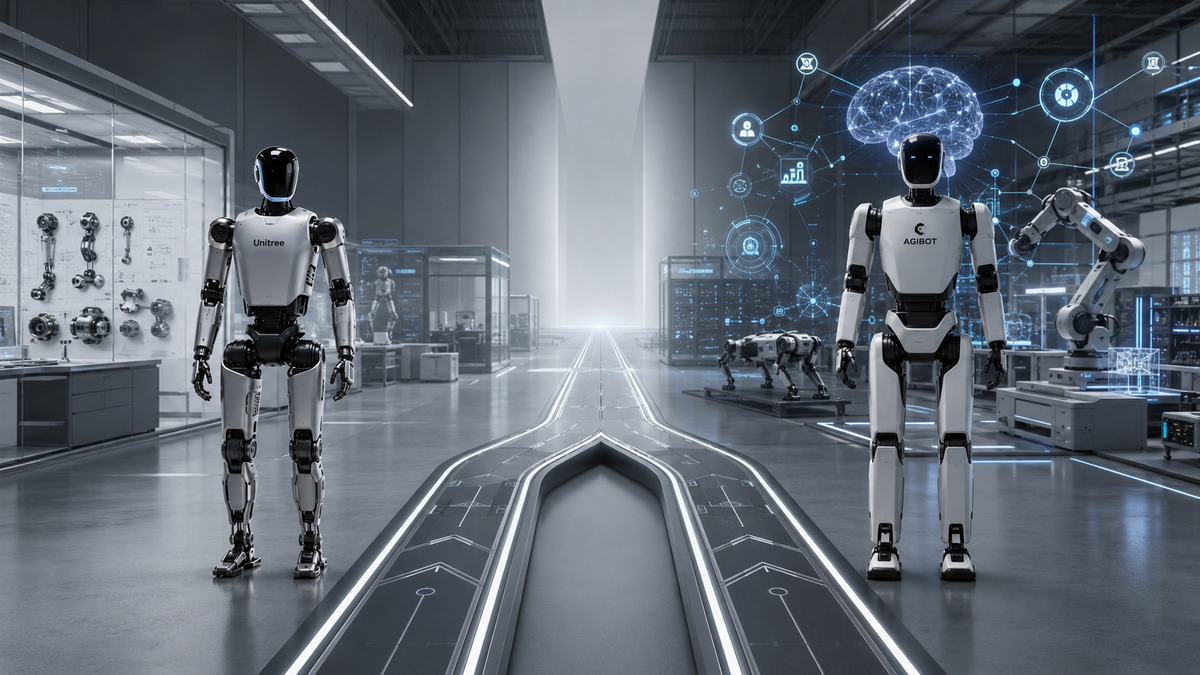
How Unitree and AgiBot are making opposite bets on embodied AI — and why both strategies may be necessary
What Is This About?
China's embodied AI industry has produced two companies that, by mid-2026, have emerged as the clearest benchmarks for what a commercial humanoid robot company can look like. Unitree Robotics listed on Shanghai's STAR Market in August 2026. AgiBot announced plans to pursue a Hong Kong IPO under the city's 18C framework for pre-profit technology companies, with a rumored target valuation of HK$40–50 billion.
The two companies are roughly comparable in scale — yet they have built fundamentally different organizations, chosen different capital markets, and are answering the same question in opposite ways: What form should a robot take to enter everyday human life?
Understanding the structural logic behind each approach is more useful than tracking their stock prices. The contrast between them maps the entire strategic landscape of China's embodied AI sector.
Why This Moment Matters
Embodied AI — the integration of physical robots with large AI models capable of perception, reasoning, and autonomous action — has moved from a research concept to a commercial race. But the industry is still in an early, unstable phase.
Three structural tensions define the current moment:
- Hardware versus intelligence. A robot's body (motion control, actuators, form factor) and its "brain" (foundation models, training data, task generalization) are still largely separate engineering disciplines. No company has convincingly unified them.
- Proven niches versus mass deployment. Commercial use cases remain narrow: trade show demonstrations, retail foot traffic, data collection, and limited industrial tasks. The kind of general-purpose deployment that justifies billion-dollar valuations has not yet arrived.
- Speed versus sustainability. The companies growing fastest are often burning cash. The companies that are profitable are growing more slowly. Investors in different markets are pricing these trade-offs very differently.
Unitree and AgiBot sit on opposite sides of each of these tensions.
The Product Purist: How Unitree Is Built
Unitree's founder Wang Xinxing holds roughly 65% of voting rights through a dual-class share structure and simultaneously serves as chairman, CEO, and CTO. The company's core R&D team numbers just three people at the top level, with a total R&D headcount of 175 — about 40% of all employees.
This concentration of authority and focus is deliberate. Unitree's long-term technical priority has been motion control: making robots move better, faster, and more efficiently than competitors. The results are measurable. Its H1 model completed the world's first full-size electrically-driven humanoid backflip. Its G1 performed the first electrically-driven side flip. Its Go1 quadruped set a speed record for consumer-grade four-legged robots at 4.7 meters per second.
The product strategy follows the same logic. Unitree's lineup is narrow and clearly tiered:
- Quadruped robots (Go series): consumer price range, entry-level
- G1 humanoid: launched at RMB 99,000, subsequently reduced to approximately RMB 85,000
- R1 humanoid: priced below RMB 30,000, targeting broader commercial adoption
Aggressive pricing is paired with aggressive marketing. Unitree appeared on China's CCTV Spring Festival Gala for two consecutive years, converting humanoid robots from laboratory curiosities into a mainstream consumer symbol. In the robot rental market — one of the few commercially active channels — Unitree is consistently the first recommendation from rental operators, primarily for retail and event traffic attraction.
The financial profile is that of a mature product company. Revenue grew from RMB 159 million in 2023 to RMB 1.699 billion in 2025, a compound annual growth rate of 226.78%. Gross margin expanded from 44.22% to 60.13%. The company turned profitable on a non-GAAP basis in 2025, reporting RMB 591 million in adjusted net income. For the first half of 2026, Unitree projected revenue of RMB 1.152 billion — up 48.54% year-on-year — though adjusted net profit declined 19.34% as R&D spending accelerated.
The analogy most commonly drawn in Chinese industry circles is to Li Auto: a founder-driven company that dominated a specific segment with a focused product line before expanding.
The Platform Builder: How AgiBot Is Built
AgiBot was founded in 2023 by Deng Taihua, former president of Huawei's Ascend computing business, and Peng Zhihui (known online as "Zhihui Jun"), a Huawei "genius youth" hire who became one of China's most prominent technology content creators. Four of the company's nine founding partners have Huawei backgrounds.
The Huawei DNA is visible in the organizational architecture. Where Unitree consolidates, AgiBot distributes. The parent company sits at the center of a structure that has spun out five independent subsidiaries, each with its own funding and development trajectory:
|
Subsidiary |
Focus |
|
AGILINK |
Dexterous
hands and end-effectors |
|
Maniformer |
Embodied
AI data collection |
|
BOTSHARE |
Robot
leasing, operating in 13 countries |
|
AGIQUAD |
Quadruped
robots |
|
Zhiding
Robot |
Commercial
cleaning (already profitable) |
Beyond these subsidiaries, AgiBot has co-established an industry investment fund with Hillhouse Capital and holds 52 investment positions across the full supply chain — motors, actuators, vision systems, controllers, and specialized robot categories.
On the AI side, AgiBot has invested heavily and early. By late 2024, it had open-sourced one million real robot motion data points. In March 2025, it released its first foundation model, GO-1, followed by GO-2 in April 2026. Founder Deng Taihua stated at the company's 2026 partner conference that "large and small brain AI R&D accounts for three-quarters of our headcount and three-quarters of our R&D budget."
The financial profile is that of a high-growth, pre-profit platform company. Revenue was RMB 300,000 in 2023, RMB 60 million in 2024, and RMB 1.05 billion in 2025. In Q1 2026 alone, quarterly revenue exceeded RMB 1 billion, with a full-year target of approximately RMB 4 billion. The company remains loss-making at the consolidated level.
This is why AgiBot is pursuing a Hong Kong listing under the 18C chapter, which permits unprofitable advanced technology companies to access public markets — a framework that prices future potential rather than current earnings.
The analogy most commonly drawn is to NIO: a company that built charging infrastructure, user communities, multi-brand architecture, and ecosystem partnerships alongside the core product.
The Convergence Problem
The more interesting story is that both strategies are beginning to look incomplete — and both companies are quietly moving toward the other's territory.
AgiBot is discovering that "brain" investment does not substitute for "body" performance. In conversations with robot rental operators, the most valued attribute of AgiBot's humanoid robots is still their motion capability — specifically, their ability to perform choreographed routines. The sophisticated AI architecture matters less to end customers than whether the robot can execute reliably in front of an audience. AgiBot's humanoid shipments reached 8,400 units in the first half of 2026, representing 44% of global volume, but the dominant use cases remain entertainment, data collection, and guided tours — not the autonomous industrial deployment that would justify the platform investment.
Unitree is discovering that motion control leadership has a ceiling. Of the RMB 4.2 billion in IPO proceeds earmarked for specific projects, nearly half — RMB 2.022 billion — is allocated to intelligent robot model development. (Actual total proceeds were approximately RMB 6.1 billion at the final issue price.) Unitree has open-sourced a World Model Architecture (WMA) and a Vision-Language-Action (VLA) model, and has tested autonomous complex tasks — such as unsupervised meeting room organization — on the G1. Wang Xinxing has publicly projected that embodied AI's "ChatGPT moment" will arrive within three to five years.
But entering foundation model development means entering a competition where the structural advantage belongs to large technology companies with proprietary data at scale. As one industry participant noted: "The top researchers working on foundation models are all elite talent — technical differences between organizations are small. The real differentiator is the dataset. Large companies have the advantage because they can acquire reliable training data more easily."
The Shared Challenges Neither Company Has Solved
1. The scene gap. Outside of exhibitions, laboratories, and entertainment venues, commercially viable deployment scenarios for humanoid robots remain thin. The distribution of current use cases shows a stark gap: research and science applications are active; industrial and consumer applications are not yet at scale. This mirrors the early trajectory of electric vehicles — a long climb from laboratory demonstration to factory deployment, with the mainstream adoption curve still ahead.
2. The brain-body integration problem. Foundation models for embodied AI have not converged on a dominant architecture. The integration of high-level reasoning ("large brain") with real-time motor control ("small brain") remains an unsolved engineering challenge. Until this integration matures, neither a pure product company nor a pure platform company has a decisive advantage.
3. Talent instability. The industry is in a period of significant personnel flux. Unitree's two rounds of equity incentive grants covered 23 individuals, of whom 9 have since left the company. AgiBot's founding chief scientist, a Berkeley PhD and former Google DeepMind researcher who had led technical collaboration with Physical Intelligence, has been removed from the company's official partner list. Across the broader industry, founders and senior engineers are moving between companies at high frequency — and talent from adjacent industries (autonomous driving at Li Auto, Huawei, NIO, and Xiaomi) is flowing in.
What to Watch Going Forward
Several variables will determine which strategic model proves more durable:
The timing of the "ChatGPT moment." If general-purpose embodied AI capability emerges within the next three to five years, companies with strong foundation model positions and integrated data assets will have a structural advantage. If the timeline extends further, companies with profitable product businesses and strong balance sheets will have more runway.
Industrial deployment at scale. The transition from entertainment and data collection to manufacturing and logistics is the critical commercial threshold. The first company to demonstrate reliable, cost-effective deployment in a real industrial environment will set the benchmark for the entire sector.
Data as the new moat. As foundation model architectures converge, proprietary robot action data — the kind that AgiBot has been systematically collecting and that Unitree is now investing to acquire — becomes the primary differentiator. How this data is accumulated, licensed, and protected will shape competitive dynamics more than hardware specifications.
Capital market signals. Unitree's STAR Market listing and AgiBot's planned 18C IPO will produce public financial disclosures that allow direct comparison of unit economics, R&D productivity, and capital efficiency across the two models. This transparency will accelerate the industry's ability to evaluate which structural approach is working.
The Underlying Question
The Unitree-AgiBot comparison is ultimately a proxy for a question the entire robotics industry is trying to answer: in a sector where the technology is not yet mature and the market is not yet defined, does it make more sense to do one thing exceptionally well, or to build the infrastructure for an entire ecosystem?
The electric vehicle industry went through the same debate. It produced both focused product companies and sprawling platform builders. The market eventually rewarded both — at different stages, for different reasons.
For now, neither model has been validated at the scale that would settle the argument. The product company has profitability but limited AI capability. The platform company has ecosystem breadth but no clear path to consolidated profitability. Both are moving toward each other.
The race is not yet decided. But the structure of the competition is now visible.
Related Coverage:
Unitree Robotics IPO: What China's First Humanoid Robot Stock Tells Us About the Industry
AgiBot Overtakes Unitree in H1 Humanoid Robot Shipments, But the Lead Remains Fragile