
Pop Mart Revenue Rises 24% as Overseas Growth Reverses and Inventory Piles Up
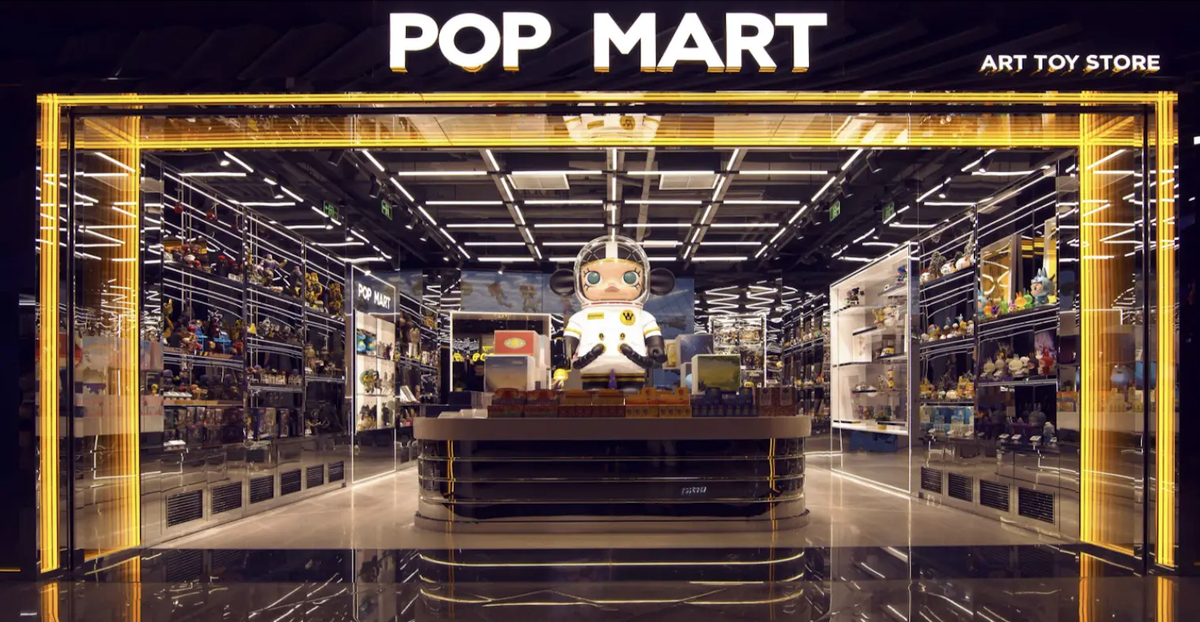
Pop Mart International Group delivered RMB 17.17 billion (US$2.38 billion) in first-half 2026 revenue — a 23.8% year-on-year gain that flatters a far more troubled picture beneath: overseas sales contracted 10.7%, the Americas business lost nearly half its official-channel revenue, and CEO Wang Ning has already conceded the company will miss its full-year 20% growth target.
The results, released August 20, mark a decisive inflection point for the Hong Kong-listed designer toy powerhouse. After riding a viral LABUBU-driven wave to global celebrity in 2025, Pop Mart is now confronting the structural fragility of hype-dependent international expansion. Net profit for the six months ended June 30 rose just 8.9% to RMB 5.1 billion (US$708 million) — a sharp deceleration from revenue growth — with a RMB 720 million (US$100 million) foreign-exchange loss, versus a RMB 120 million gain in the prior-year period, compressing margins materially.
Market reaction was swift. Analysts flagged the divergence between domestic momentum and overseas deterioration as a structural concern rather than a cyclical blip, particularly given that inventory days ballooned from 123 days at end-2025 to 201 days by June 30, 2026 — a 63% surge that signals aggressive pre-positioning for international growth that has yet to materialize.
Six IPs Clear RMB 1 Billion, but the Portfolio Is Reshuffling Fast
Pop Mart's IP engine remains formidable on paper. Eleven IPs generated over RMB 1 billion in first-half revenue, and the company's total toy-segment revenue now trails only Lego globally, surpassing Bandai, Hasbro, and Mattel — a competitive positioning that would have seemed implausible three years ago.
The headline story within the IP matrix is the meteoric rise of Xingxingren. The character posted RMB 2.65 billion (US$368 million) in revenue, a 580.6% year-on-year surge, vaulting it to the No. 2 position in Pop Mart's entire portfolio. That ascent is as much a warning as a triumph: it underscores how rapidly consumer preference rotates within the collectibles category, and how dependent the company's earnings trajectory is on successfully identifying — and industrializing — the next breakout character.
THE MONSTERS, home to LABUBU, retained the top slot with RMB 4.45 billion (US$618 million), but revenue fell 7.5% year-on-year and declined far more steeply from the second half of 2025. Pop Mart's marketing push — including a FIFA World Cup co-branding campaign launched in April and LABUBU appearances at both the tournament's opening and closing ceremonies — failed to arrest the deceleration, suggesting the IP has crossed its cultural-moment peak in key markets.
MOLLY, once Pop Mart's flagship character, fell out of the top five for the first time, generating RMB 901 million (US$125 million), down 33.7%. CRYBABY, DIMOO, SKULLPANDA, and HIRONO occupied positions three through six, posting growth of 34%, 46.6%, 27.1%, and 38.5% respectively. The SKULLPANDA x My Little Pony collaboration — a licensed tie-up with Hasbro's animation IP — generated over RMB 600 million (US$83 million) and ranked as the single best-selling product of the half.
Plush Dominance Redraws the Product Mix, Squeezing Legacy Blind Box Margins
The product-category shift is as significant as the IP rotation. Plush products generated RMB 9.83 billion (US$1.36 billion), up 60% year-on-year, and now account for 57.2% of total revenue — a category that barely registered two years ago. Traditional art toys (figurines) contributed RMB 5.19 billion (US$721 million), essentially flat at +0.3%, with their revenue share compressing to 30.2%. Derivatives and other products fell 15.8% to RMB 2.16 billion (US$300 million).
This structural shift carries margin implications. Plush manufacturing is more commoditized than resin figurines, and the rapid scaling of the category — across both flagship IPs and newer characters including Nyota, Zsiga, and Peach Riot — increases exposure to raw-material and logistics cost volatility. Management cited rising input costs and freight expenses as the primary driver of the slight gross-margin compression reported for the period, and outlined plans to accelerate overseas supply chain construction and consolidate global logistics.
Domestic Channels Firing on All Cylinders, Led by Blind Box Machines and Douyin
China remains Pop Mart's engine room. Domestic revenue grew 47.3% year-on-year, driven by a combination of new product launches, theme park expansion, and an accelerating shift toward higher-frequency digital touchpoints.
Offline China revenue reached RMB 6.87 billion (US$954 million), up 35.1%, with retail stores growing 38.2% and robotic vending machines up 14.8%. The mainland store count reached 419 as of June 30, a net addition of 10 units in the half. Theme park attendance surged, with the LABUBU and DIMOO zones at Pop Mart's urban entertainment parks reporting more than double the visitor flow quarter-on-quarter following new area openings.
Online China revenue of RMB 4.78 billion (US$664 million) grew 62.7%, with Pop Mart's proprietary blind-box vending machine app leading at RMB 2.06 billion (US$286 million), up 83.3% — the fastest-growing channel in the entire business. Douyin overtook Tmall as the second-largest online platform, generating RMB 976 million versus Tmall's RMB 885 million, reflecting the broader migration of Chinese discretionary spending toward short-video commerce. Registered members on the mainland reached 82.44 million, with a member repurchase rate of 51.6% and members accounting for 92.9% of domestic sales — metrics that indicate deep loyalty but also concentration risk.
Americas Expansion Accelerates Physically While Collapsing Digitally
The international picture is where Pop Mart's growth thesis faces its most serious stress test. Aggregate overseas revenue declined 10.67%, with the pattern consistent across all three geographic segments: physical stores growing, online channels collapsing.
In the Americas — Pop Mart's most strategically important international market — the company added a net 22 stores in the first half, a 30% increase in physical footprint, bringing the total to 86 locations. Yet overall Americas revenue fell 16.5%. The official online channel saw revenue drop 44.6%, and other e-commerce platforms fell approximately 80%. Wang Ning acknowledged at the earnings call that last year's international breakout carried an element of "luck," a rare admission from a Chinese consumer company executive that implicitly reframes 2025's overseas performance as an outlier rather than a baseline.
Asia-Pacific, Pop Mart's most mature overseas region with 90 stores, saw offline revenue grow 16.2% but online fall 39.8% and wholesale decline 38%. Europe and other markets showed the most extreme online contraction at -59%, though offline grew 49.8% and the region added nine net stores to reach 45 locations. Management characterized the shifts as deliberate channel rationalization — Asia-Pacific moving from "scale expansion" to "refined operations," Europe building out localized digital infrastructure — but the magnitude of online declines across all regions simultaneously suggests demand normalization is the dominant force, not strategic channel pruning.
Inventory Overhang and High Base Effects Define the Second-Half Challenge
The 201-day inventory figure is the single most important number in Pop Mart's H1 2026 results for investors to monitor. At current revenue run rates, the company is carrying roughly two quarters of global stock — a level that will require either a meaningful demand reacceleration in H2 or material markdowns that further compress margins.
The base-period problem compounds the challenge. Pop Mart's H2 2025 was the strongest half in company history, driven by the peak of LABUBU's global cultural moment. Wang Ning explicitly warned that H2 2026 will face greater earnings pressure, and that the full-year 20% growth guidance issued at the start of 2026 is "most likely unachievable." For a stock that has historically traded on growth-premium multiples, a formal guidance miss would test investor tolerance.
Pop Mart is also navigating the transition from a viral-IP company to a diversified entertainment platform — launching POP BAKERY dessert pop-ups across Chinese cities, expanding POPOP accessories revenue, and exploring small home appliances as adjacent categories. The company separately announced it is leading the drafting of China's first national industry standard for the designer toy sector, a regulatory positioning move that could confer long-term competitive advantages in procurement, quality certification, and retail licensing.
Globally, Pop Mart operates 676 stores and 2,827 robotic vending machines as of June 30, 2026. The question for the second half is whether its IP pipeline — and specifically whether Xingxingren can replicate LABUBU's cross-cultural appeal — can offset the structural hangover from 2025's exceptional performance.
Related Coverage:
Pop Mart Q1 2026 Preview: Overseas Markets Face Sequential Decline