
AgiBot Overtakes Unitree in H1 Humanoid Robot Shipments, But the Lead Remains Fragile
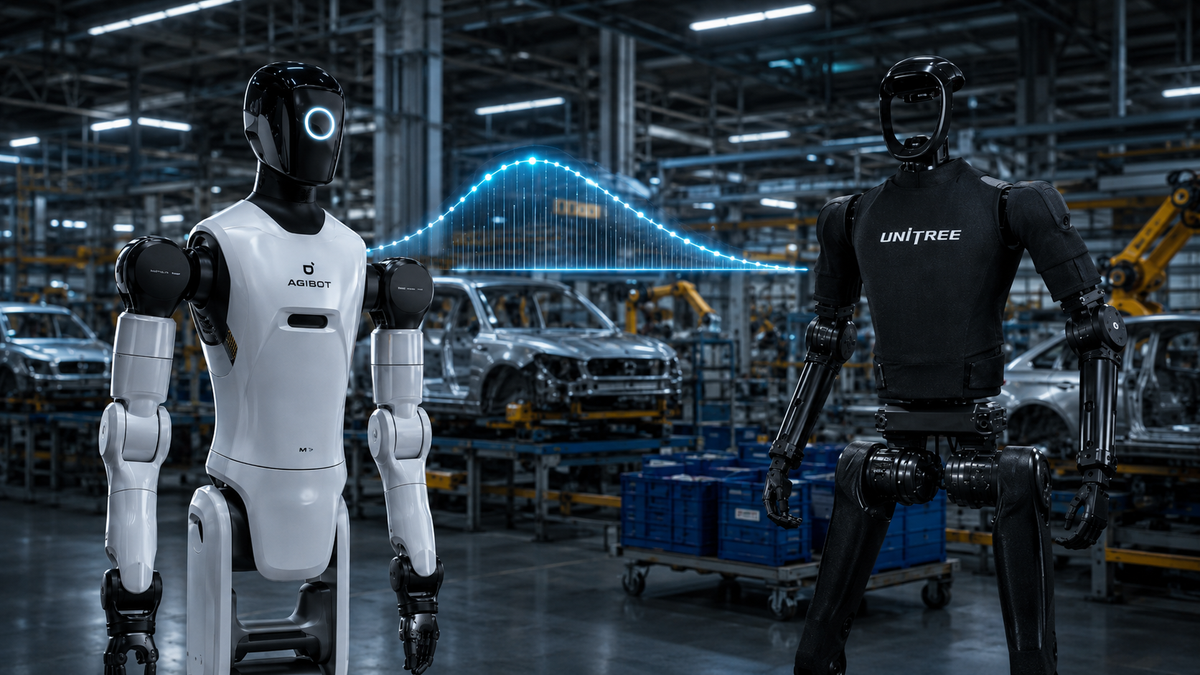
China's humanoid robot market is reshuffling at speed: AgiBot displaced Unitree Robotics as the world's top humanoid robot shipper in the first half of 2026, driven by a decisive pivot toward industrial and commercial deployment — yet the margin of victory reveals as much about methodology as it does about competitive moat.
According to a mid-year market report published by U.S.-based research firm SAG, global humanoid robot shipments surged to approximately 19,100 units in H1 2026, a 272% year-on-year increase from roughly 5,100 units in the same period of 2025. Chinese manufacturers collectively accounted for more than 97% of global shipments, underscoring the country's near-total dominance of a sector that is rapidly transitioning from proof-of-concept to revenue-generating deployment. SAG projects full-year 2026 global shipments will approach 60,000 units, with the figure potentially exceeding 500,000 by 2030.
The headline number that rattled the industry: AgiBot posted 8,400 units shipped in H1 2026, a 562% year-on-year jump, capturing a 44% market share and claiming the global No. 1 position. Unitree, which held the top spot in the same period last year with 2,200 units, shipped 5,900 units in H1 2026 — a still-robust 170% increase — but fell to second place with a 31% share. The gap between the two stands at 2,500 units.
The reaction from industry observers was immediate and divided.
Competing Methodologies Cloud the Ranking's Credibility
The "AgiBot No. 1" headline cannot be read in isolation. The humanoid robot industry currently operates without a universally accepted shipment classification standard, and the identity of the market leader changes depending on which ruler is used.
Four research institutions command the most industry credibility: IDC, SAG, CCID Research Institute, and Omdia. All four measure shipment volume rather than technical capability, but their scope definitions diverge sharply. CCID employs the narrowest definition, counting only fully bipedal humanoids — under which Unitree led the full-year 2025 rankings with 5,500-plus units to AgiBot's 4,000-plus. Omdia's broader "dual-arm wheeled humanoid" classification flipped the order: AgiBot topped at 5,168 units versus Unitree's approximately 4,200 in 2025.
SAG's methodology is the most expansive: it counts full-size bipedal, half-size bipedal, wheeled, and ultra-biomimetic robots, while explicitly excluding "non-functional embodied humanoids" — units incapable of performing defined tasks in structured industrial or commercial environments. Under this framework, all three of AgiBot's active product lines (Yuanzheng, Lingxi, and Jingling) qualify, as do all four of Unitree's humanoid models (H1, H2, G1, R1). The classification does not disadvantage Unitree in rule design, but a wider aperture structurally favors the company with the more diversified product portfolio — in this case, AgiBot.
Critically, Unitree's quadruped lineup — Go1, Go2 (consumer), B1, B2, A2 (industrial) — falls entirely outside SAG's humanoid count. Unitree's prospectus filings indicate that despite humanoid revenue surpassing 50% of total sales in the first three quarters of 2025, quadrupeds remain a material revenue pillar. That volume simply does not register in any humanoid-specific ranking.
Industrial Deployment Shift Explains the Reversal
The more analytically significant story is not which firm tops a given league table, but why the gap opened so quickly. The answer lies in where the incremental demand materialized.
SAG data shows that of the approximately 14,000 additional units shipped in H1 2026 versus the year-earlier period, roughly 10,800 — or about 77% — went to industrial and commercial settings such as factories, warehouses, and retail environments. The share of industrial and commercial deployments in total humanoid shipments rose from approximately 50% in H1 2025 to over 70% in H1 2026.
AgiBot's product architecture was pre-positioned for precisely this shift. Its Yuanzheng line targets industrial manufacturing, Lingxi addresses commercial services and guided retail, and Jingling is designed for warehouse logistics. All three product lines are purpose-built for structured, high-repeatability environments.
Unitree's humanoid revenue profile, by contrast, reflects a different strategic bet. According to the company's exchange query responses filed with the Shanghai Stock Exchange, of the RMB 595 million (approximately US$82.6 million) in humanoid revenue generated in the first three quarters of 2025, 73.6% came from research and education customers, 17.4% from commercial and consumer applications, and just 9.01% from industrial use cases. The G1 model's RMB 99,000 (approximately US$13,750) entry-level price point was explicitly designed to serve university labs and developer communities — a deliberate channel strategy that drove volume but anchored Unitree's customer base away from the industrial segment that is now generating the bulk of industry growth.
In April 2026, AgiBot also completed a structural separation, spinning off its quadruped robotics operations into a wholly owned subsidiary, AGIQUAD, further concentrating its reported humanoid shipment figures.
Three Metrics Will Determine Whether AgiBot Holds the Lead
Manufacturing scale provides a near-term advantage that competitors can close.
AgiBot's three concurrent production lines, combined with a high domestic component sourcing rate, enabled cumulative production of 15,000 units through June 2026. This throughput capacity aligns with the batch-delivery requirements of factory and retail chain customers, who prioritize supply reliability over marginal performance gains. Unitree's H-series industrial production ramp has been comparatively slower, and its wheeled humanoid footprint remains limited.
However, this is the most replicable of the three competitive dimensions. Unitree has already demonstrated supply chain and mass production competency through its quadruped business. A strategic reallocation of production capacity toward H-series and wheeled humanoid platforms could narrow the delivery gap within two to three product cycles.
Scene penetration is harder to replicate than production lines.
AgiBot's installed base in factories and distribution centers generates customer relationships, on-site calibration expertise, and procurement familiarity that cannot be duplicated by switching a production line. Unitree's H1-2 bipedal platform can carry 21 kilograms and, equipped with dexterous hands, meets basic industrial task requirements; its B2 and H2 series have also logged efficiency data in power grid inspection and warehouse sorting pilots. The technical foundation for an industrial push exists. But converting pilot data into recurring commercial contracts requires channel development and operational embedding that takes time to build.
Data loop maturity represents the most durable and least transferable advantage.
SAG's report identifies the widening gap between "demonstration-grade" and "task-grade" humanoid robots as the central bottleneck constraining industry scaling. Hardware capacity is expanding rapidly; AI model generalization and closed-loop training pipelines are not keeping pace. Most current industrial deployments remain confined to fixed routes and repetitive tasks. Unscripted or novel environments continue to expose the limits of current embodied AI.
In April 2026, AgiBot's Jingling G2 unit completed an eight-hour continuous operation live demonstration at Longcheer Technology's Nanchang factory, achieving a 99.5% task success rate. High-quality real-world operational data from deployments at this scale feeds back into AgiBot's embodied large model training, establishing a nascent but functional data flywheel. Unitree's G1, with cumulative production of approximately 11,000 units through June 2026, has generated substantial real-robot data — but the operational profile skews toward motion control demonstrations and developer-modified tasks rather than closed-loop industrial workflow execution.
This gap is the most difficult for Unitree to close in the near term. It is also, notably, the most contingent on factors outside either company's control: if Vision-Language-Action (VLA) models or world model architectures achieve a generalization breakthrough, the rules of the data competition will be rewritten, and accumulated task-specific datasets may become less decisive than the ability to rapidly integrate new training paradigms.
Mid-Tier Players Signal Market Is Still Fluid
Below the top two, the rankings remain unsettled. Galaxy General Robotics shipped approximately 900 units in H1 2026, edging past UBTECH Robotics at 700 units. Leju Robotics placed fifth with 600 units, counting only its KUAVO Kuafu industrial series and excluding education-focused Aelos and Roban models. The gap between third and fifth place is measured in hundreds of units — suggesting the mid-tier competitive order could shift materially within a single half-year reporting period.
The Strategic Verdict: Orders Are Not a Moat
AgiBot's H1 2026 leadership is analytically coherent: it reflects a deliberate product-market fit decision made years earlier, now validated by the industry's structural shift toward industrial deployment. The 562% shipment growth is not a statistical artifact — it represents real units operating in real facilities.
But the lead is narrow in moat terms. Unitree retains superior profitability metrics, a mature quadruped supply chain, and deep penetration of the research and developer ecosystem that will matter when the next hardware generation requires rapid iteration. Under CCID's narrow bipedal classification, Unitree likely still leads. The two companies have made different strategic bets on which customer segment scales fastest, and the H1 2026 data confirms that industrial deployment is currently the faster-growing vector.
The longer-term competition will not be decided by who ships 10,000 units first. It will be decided by who first delivers a robot that can execute complex, unstructured tasks reliably at industrial scale — a problem that remains unsolved across the entire industry.
Related Coverage:
Unitree's RMB 60.99B IPO Rewrites the Valuation Rules for China's Humanoid Robot Race