
China's Robotics Price War Has Already Begun. Unitree Needs a Second Act.
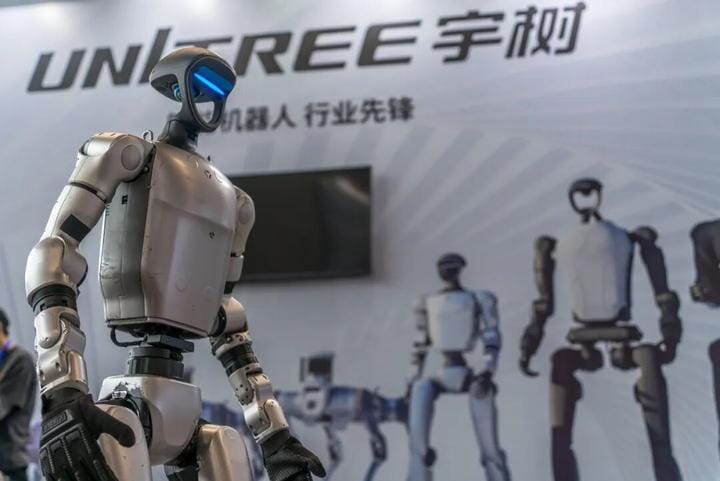
A RMB 61 billion valuation on RMB 1.7 billion in revenue forces a single question: can China's most aggressive robotics price-cutter convert supply-chain dominance into a defensible software moat before rivals commoditize its only edge?
Unitree Robotics, the Hangzhou-based humanoid and quadruped robot maker, is seeking a public listing at a valuation of RMB 61 billion (US$8.47 billion)—implying a price-to-sales multiple of 36x and a price-to-earnings ratio of 219x on parent-attributable net income. Those numbers place Unitree in the company of frontier AI platforms, not hardware manufacturers. Yet its prospectus tells a more grounded story: FY2025 revenue of RMB 1.708 billion (US$237 million), with the bulk of sales flowing to universities, research institutes, and developer teams at major technology corporations.
The valuation gap is not lost on institutional observers. What keeps the bull case alive is a financial signature that is genuinely unusual for a hardware business: gross margins that expand as prices fall—a combination that signals Unitree is cutting costs faster than it is cutting prices, and that its supply-chain architecture may be more structurally advantaged than the headline numbers suggest.
Falling Prices Mask a Rising-Margin Machine
Unitree's pricing trajectory is aggressive by any measure. Its G1 humanoid robot, launched in May 2024 at RMB 99,000 (US$13,750), now retails at approximately RMB 85,000 (US$11,800) in its base configuration. In November 2025, the company pushed the entry-level threshold further with the R1-Air at RMB 29,900 (US$4,150)—less than one-third of the G1's original list price.
The prospectus data on average selling prices tells an even sharper story. Average revenue per humanoid unit collapsed from RMB 593,400 (US$82,400) to RMB 260,400 (US$36,200) and then to RMB 166,400 (US$23,100) across the three reported fiscal years. Quadruped prices declined more modestly, from RMB 38,300 to RMB 30,300 (US$4,200) over the same period.
Counterintuitively, consolidated gross margin on core operations moved in the opposite direction: from 44.22% to 56.74% and then to 60.13%. Quadruped gross margin rose from 43.71% in FY2023 to 56.72% in FY2025. Humanoid gross margin did compress—from 87.67% to 63.18%—but remained above the company-wide average throughout, reflecting the still-premium nature of bipedal units even as volumes scaled.
For context, Apple Inc.'s hardware products carried a gross margin of approximately 36.8% in its FY2025 results. Among direct Chinese peers, Dobot reported a gross margin of 46.49% and UBTECH Robotics 37.67% for the same period—roughly 14 and 23 percentage points below Unitree, respectively.
"A 60% gross margin in hardware is already high-end territory," one robotics industry practitioner told 36Kr-affiliated outlet YouJie UnKnown. "Part of it is scale, but the structural cost position is real."
Vertical Integration Drives the Cost Wedge
The mechanism behind Unitree's margin expansion is visible in its cost structure. Of RMB 668 million (US$92.8 million) in FY2025 cost of goods sold, direct materials accounted for more than 80%. Within that materials base, mechanical components—machined parts, die castings, fasteners, and plastic components—represented approximately 48%, while electronic components including PCBs, chips, resistors, capacitors, and antennas accounted for roughly 25%.
The strategically significant detail is what is absent from the procurement list: finished motors, reducers, and other high-value robotic actuator assemblies. Unitree does not buy these components off the shelf. Instead, it develops and manufactures motors, reducers, and encoders in-house, sourcing only the commodity raw materials—steel, aluminum, copper, thermal pads—that feed its internal production lines.
This two-layer model generates cost advantages at both ends. Externally, Unitree buys standardized, price-transparent commodity inputs at scale, accumulating procurement leverage. Internally, it controls the design, material selection, and component reuse strategies for the highest-value parts, bypassing the brand premiums embedded in third-party actuator pricing.
The prospectus does not fully disclose the supplier network. Of the named primary raw-material suppliers, only Shanghai Yaoli Electronic Technology appears with an explicit name; the remainder are anonymized as "Supplier B," "Supplier I," and "Supplier AB." The opacity limits external due diligence on individual vendor pricing dynamics, but the directional cost-reduction logic is coherent.
Supply-Chain Moats Erode—History Offers a Warning
Unitree's hardware advantage is real. The question investors must answer is whether it is durable.
Chinese technology history provides two instructive precedents. In 2011, Samsung Electronics' Galaxy S II retailed at RMB 4,999 (US$694). Xiaomi entered at RMB 1,999 (US$278) with its first smartphone. Within two years, Xiaomi's Redmi sub-brand reached RMB 799 (US$111) by leveraging a mature Qualcomm chip ecosystem and a standardized contract-manufacturing supply chain. Within six months of the Redmi launch, Huawei's Honor 3C matched it at RMB 798—and the Android price war was fully ignited.
The autonomous driving sector followed a similar arc. As lidar and intelligent-driving chip supply chains matured, the barrier to assembling a functional ADAS stack dropped sharply, even as top-tier companies retained algorithmic leads.
Unitree's current position maps closely onto those early-mover moments. Its supply-chain integration helped it break the price ceiling for humanoid robotics. That same supply chain, as it standardizes and scales across the industry, will lower the barrier for every competitor that follows.
The risk is not theoretical. China's manufacturing base—the same ecosystem that commoditized smartphones and solar panels—is already being activated across the robotics component stack. Once actuator and sensor supply chains reach the maturity that PCB and display supply chains have, the cost differential that Unitree currently enjoys will compress.
Software Ecosystem Becomes the Only Sustainable Moat
Unitree's management appears to understand the hardware ceiling. The prospectus outlines planned R&D investment of approximately RMB 2.022 billion (US$280.8 million), with nearly 80% allocated to personnel, computing infrastructure, data assets, and technical services—and only roughly 20% to physical equipment.
The architecture being built is layered: at the base, software development kits (SDKs), Robot Operating System (ROS) integration, simulation environments, and reinforcement learning tools to lower developer onboarding costs; in the middle, data collection and model training pipelines; at the top, Vision-Language-Action (VLA) models and world models for embodied intelligence.
The strategic template is explicit—replicate the NVIDIA CUDA ecosystem dynamic, where developer lock-in to a programming environment creates switching costs that outlast any hardware generation.
The execution challenge, however, is structurally harder than CUDA. GPU software stacks are hardware-agnostic at the application layer; a developer can swap chips while preserving code. Embodied AI models are deeply coupled to physical robot morphology—different joint configurations, weight distributions, and actuator responses can require full retraining even within the same product line. Building cross-platform stickiness in that environment is a materially more complex problem.
The Xiaomi Parallel—and Its Limits
The symbolic weight of Unitree's IPO narrative was crystallized in a meeting that reportedly took place in March 2026, just before the company filed its initial prospectus. Xiaomi founder Lei Jun told Unitree CEO Wang Xingxing that he was grateful for the opportunity to invest in the company.
The parallel is deliberate. Lei Jun used Xiaomi to make Android smartphones a mass-market commodity in China; Wang Xingxing is attempting the same transformation for robotics. Both strategies center on supply-chain integration, scale-driven cost reduction, and price aggression as the primary market-entry weapon.
But Xiaomi's eventual durability came not from phone hardware, but from MIUI, its app ecosystem, and its connected-device platform—assets built over years of developer and consumer engagement. Unitree's IPO valuation implicitly prices in a similar software transition. Whether that transition can be executed before lower-cost competitors arrive with comparable hardware is the central investment thesis—and the central risk.
At RMB 61 billion on RMB 1.708 billion in revenue, the market is not paying for what Unitree is. It is paying for what Unitree must become.
Related Coverage:
Unitree's RMB 60.99B IPO Rewrites the Valuation Rules for China's Humanoid Robot Race