
China's Smart Driving Tech Eyes Europe: What's Changing and Why It Matters
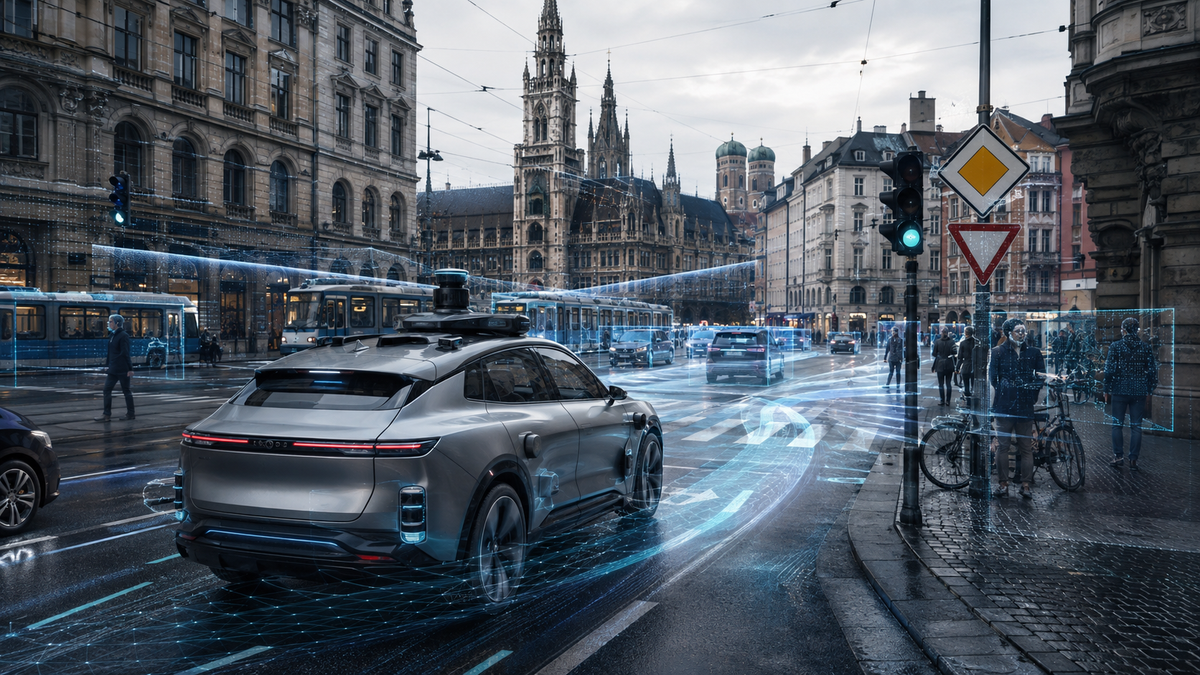
How a regulatory shift is giving Chinese ADAS companies their first real opening in the European automotive market
What Is This About?
For years, China's edge in the global auto industry was primarily about electric vehicles — batteries, powertrains, and cost-efficient manufacturing. But a quieter, more technically complex race is now underway: exporting Chinese-developed intelligent driving systems to Europe.
Companies like Momenta, Xpeng, and Horizon Robotics are no longer just following Chinese-brand vehicles into overseas markets. They are actively testing their systems on European roads, engaging with European automakers, and positioning themselves as potential suppliers to the continent's own car industry.
This is not a story about one company or one product launch. It is about a structural shift in where advanced driver-assistance technology gets developed, deployed — and ultimately sourced.
Why Europe, and Why Now?
The regulatory unlock that changed everything
Europe has long been cautious about intelligent driving. Legacy automakers — BMW, Mercedes-Benz, Volkswagen — invested heavily in ADAS and autonomous driving for years, yet real-world deployment remained confined largely to highways and controlled environments. Urban driving, the most commercially valuable and technically demanding scenario, had no clear regulatory pathway.
That began to change in late 2024, when the R171 regulation established the first comprehensive certification framework for driver-assistance systems in Europe. But even then, urban use cases were largely excluded.
The decisive turning point came in June 2026, when the United Nations World Forum for Harmonization of Vehicle Regulations passed the R171 Series 02 amendment. For the first time, this opened the door to urban NOA (Navigate on Autopilot) — city-level intelligent driving — under a recognized legal framework.
In practical terms: Europe only created a viable path for urban smart driving in 2026. This explains why Chinese companies are arriving in force right now, rather than three years ago.
The business case beyond regulation
Regulatory access alone does not justify the investment. Europe also offers structural commercial advantages:
- Market scale: Europe is one of the world's largest auto markets, with consumers who can absorb the hardware and R&D costs associated with high-end intelligent driving systems.
- Unified certification: A single system certified under European standards can enter multiple national markets simultaneously, avoiding the country-by-country approval burden seen elsewhere.
- Competitive vacuum: European OEMs have spent years and significant capital on intelligent driving, yet none has established a clear leadership position in urban scenarios. The field is genuinely open.
Together, these factors make Europe a plausible candidate to become the third major market — after China and the United States — where high-level intelligent driving reaches commercial scale.
How Advanced Are Chinese Systems, Really?
Core capability: stronger than expected
Testing conducted in Munich in summer 2026 — including rides in Momenta's R7 World Model test vehicle and Xpeng's systems — revealed something important: the fundamental driving capability transfers surprisingly well.
Despite being trained predominantly on Chinese road data, the systems handled core European driving tasks with reasonable fluency: following traffic, navigating unprotected intersections, merging, and maneuvering around obstacles. The base model's generalization ability held up across a different road environment.
This matters because it suggests Chinese companies do not need to rebuild their systems from scratch for Europe. The architectural foundation is portable.
Where the gaps appear: cultural logic, not raw capability
The more revealing finding is where the systems struggled — and it was not with complex maneuvers, but with socially encoded driving behavior.
Several examples from Munich testing illustrate this:
- Aggressive merging: A system forced its way into a lane with oncoming straight-moving traffic. In dense Chinese urban traffic, this assertive style is often necessary and expected. In European traffic culture, it reads as a violation of right-of-way norms.
- Queue-cutting at intersections: During congestion, a system bypassed the back of a queue to insert itself further forward — again, a behavior not uncommon in Chinese cities, but inconsistent with European traffic etiquette.
- Failure to yield for reversing: On a narrow street where local convention expects following vehicles to reverse and make space, the test vehicle simply blocked the reversing car's path until the other driver gave up and drove away.
- Unfamiliar road signs: Europe's yellow-diamond priority road sign — indicating right-of-way at upcoming unsignaled intersections — is absent from Chinese roads. Systems trained on Chinese data have no learned association with it.
- Double traffic light sequences: In older parts of Munich, intersections are spaced just meters apart, causing two sets of traffic lights to appear simultaneously in the vehicle's field of view. Systems showed hesitation about which signal to obey.
None of these failures indicate that the system "cannot drive" in Europe. They indicate that the system's learned model of how traffic participants interact does not yet match European defaults.
The Technical Challenge: Why This Is Harder to Fix Than It Sounds
From rule-based to neural: a double-edged shift
The previous generation of intelligent driving systems operated on explicit rules: engineers wrote conditional logic covering specific scenarios. Fixing a behavioral error meant finding the relevant rule and rewriting it.
Modern systems — including those deployed by Momenta, Xpeng, and Horizon — use neural network models that learn driving behavior by processing vast volumes of real-world video data. This approach produces far stronger generalization: a system trained on millions of hours of Chinese road footage can still navigate a Munich intersection it has never seen, because it has learned underlying spatial and motion relationships rather than memorized specific scenarios.
But this same architecture makes targeted behavioral correction much harder. The "knowledge" that a system should merge assertively, or that queues should not be jumped, is not stored in a single accessible parameter. It is distributed across billions of weights throughout the model. Engineers cannot simply locate and rewrite a rule.
The two-track localization strategy
Chinese companies are converging on a common approach to this problem:
- Maximize base model generalization: Build and maintain a single foundational model capable of operating across diverse road environments, reducing the need to develop separate systems for each market.
- Local fine-tuning through post-training: Collect local road data in each target market, then use it to fine-tune the base model — adjusting the system's behavioral tendencies to match local traffic norms, road signs, and right-of-way conventions.
This architecture, if it works reliably, has compounding value. Each new market entered adds local data and fine-tuning experience. Improvements to the base model in China propagate automatically to overseas versions. The marginal cost of entering the fifth or tenth market is substantially lower than entering the first.
Who Are the Main Players and What Are Their Positions?
Momenta
Momenta is pursuing a B2B model, targeting European OEM partnerships rather than selling directly to consumers. Its R7 World Model is designed as a scalable foundation for multiple vehicle platforms. The Munich testing represents early-stage localization work rather than a commercial launch.
Xpeng
Xpeng occupies a dual position: it is both a Chinese EV brand selling cars in Europe and a technology developer. Its second-generation VLA (Vision-Language-Action) model is designed with cross-domain model reuse in mind — the same base architecture intended to serve different markets with local adaptation. Xpeng's consumer brand presence in Europe gives it a channel for direct deployment that pure-play tech suppliers lack.
Horizon Robotics
Horizon focuses on the chip and compute layer — supplying the hardware that intelligent driving software runs on. Its presence in Munich signals an ambition to become a hardware platform provider for European OEMs, not just a software or systems company. This positions it differently from Momenta and Xpeng, competing more directly with established automotive chip suppliers.
What Are the Real Constraints?
Road testing ≠ commercial deployment
Demonstrating that a system can drive in Munich is a necessary condition for market entry, not a sufficient one. The path from test vehicle to production vehicle involves:
- Formal R171 Series 02 certification: A rigorous process with no guaranteed timeline
- OEM integration: European automakers have existing supplier relationships, procurement cycles, and internal development programs that do not reorganize quickly around new entrants
- Liability and insurance frameworks: Urban intelligent driving raises unresolved questions about who bears responsibility in the event of an incident — questions that regulators and insurers are still working through
- Data sovereignty: Collecting and processing European road data for model training may face restrictions under GDPR and emerging automotive data regulations
Geopolitical headwinds
The same tariff and market-access tensions that have complicated Chinese EV sales in Europe apply, in different forms, to software and technology suppliers. European policymakers are increasingly attentive to supply-chain dependencies on Chinese technology in safety-critical automotive systems. This is not a barrier that can be solved through better engineering.
Local data accumulation takes time
The fine-tuning strategy depends on collecting sufficient local road data. In China, companies benefit from enormous fleets of consumer vehicles generating continuous real-world data. In Europe, starting from near zero, building a comparable data asset takes years — unless OEM partnerships provide access to European fleet data at scale.
What Comes Next?
The near-term trajectory has three plausible outcomes, which are not mutually exclusive:
Scenario 1 — Technology supplier to European OEMs: If Chinese companies can complete R171 Series 02 certification and demonstrate reliable urban performance, they become candidates for the supplier shortlists of European automakers looking to close the gap with Chinese competitors in intelligent driving. This would represent the deepest form of market penetration — not following Chinese brands into Europe, but supplying European brands.
Scenario 2 — Bundled with Chinese EV exports: The more immediate path is supplying intelligent driving capability to Chinese EV brands already selling in Europe. This is lower-risk commercially but positions Chinese smart driving as an accessory to Chinese vehicles rather than a standalone technology export.
Scenario 3 — Extended localization timeline: Regulatory complexity, data constraints, and OEM procurement cycles combine to delay meaningful commercial deployment beyond 2027–2028. Companies maintain a presence and continue testing, but revenue impact remains limited.
The structural logic favors eventual penetration. China's intelligent driving industry has a genuine capability lead in urban scenarios, a regulatory window has opened, and European OEMs face real pressure to close their own technology gap. But the automotive industry moves slowly, and the distance between a successful road test and a production contract is measured in years, not months.
The Bigger Picture
China's automotive export story has, until now, been primarily about hardware: electric vehicles, batteries, and manufacturing efficiency. Intelligent driving represents a different kind of export — one based on software, data, and algorithmic capability developed through years of deployment in the world's most complex urban traffic environments.
If Chinese smart driving systems succeed in Europe, the implications extend beyond market share. They would establish Chinese companies as core technology providers within the European automotive supply chain — a structural position with durability that pure vehicle sales do not provide.
That outcome is not guaranteed. But the conditions for it to happen are, for the first time, genuinely in place.
Related Coverage:
Volkswagen Taps Horizon Robotics in White-Box AI Deal, Targeting L3 Autonomy by Late 2027Momenta Hong Kong IPO Anchors Physical AI Valuation With HK$6.8B Debut