
China’s EV Challengers Close in on Tesla’s Model Y Dominance as SUV War Intensifies
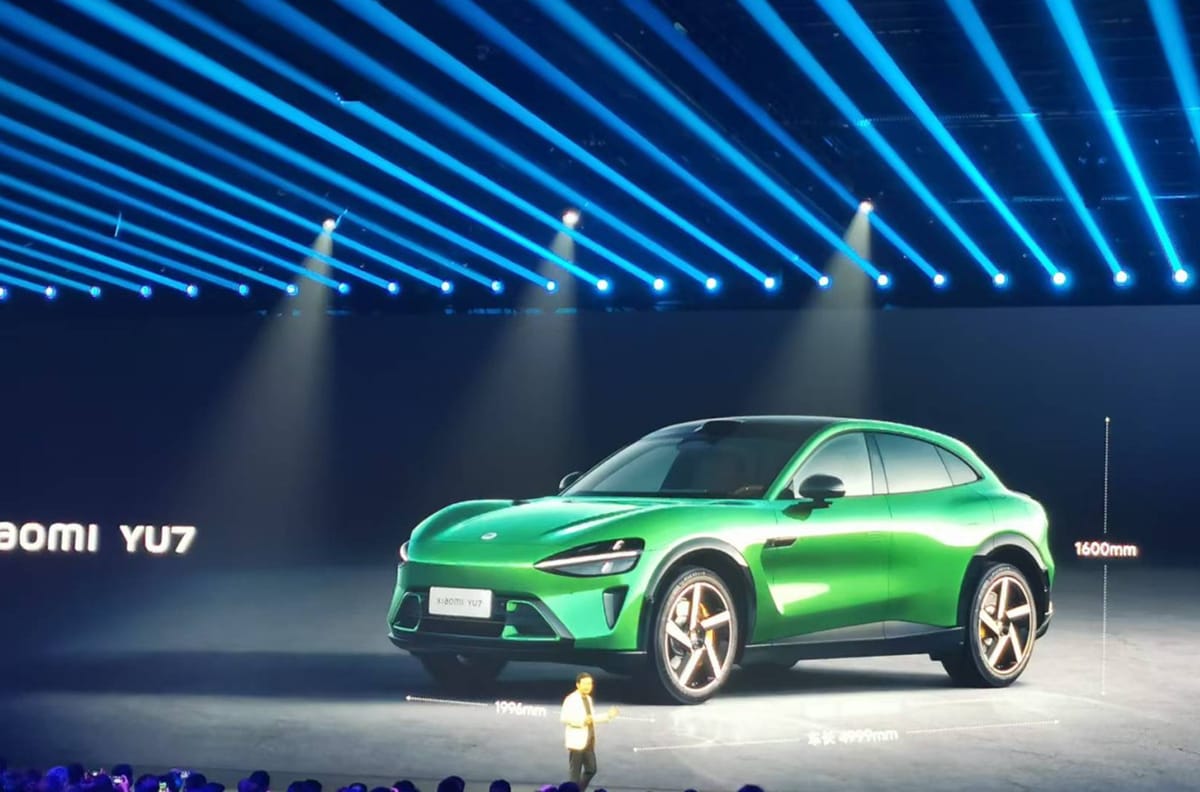
Competition in China’s mid-to-large SUV market reached a fever pitch in November 2025, with domestic challengers aggressively encroaching on Tesla Inc.’s long-standing dominance. Data reveals that new models from technology giant Xiaomi and electric vehicle leader BYD have rapidly scaled up, effectively matching or surpassing the sales volume of major established foreign competitors in key segments.
In a direct confrontation for the five-seater crossover throne, Xiaomi saw its YU7 model deliver 33,572 units in November, virtually tying with the five-seater version of the Tesla Model Y, which recorded 33,939 sales. This dead-heat signals a potential fracturing of Tesla’s stronghold, as Chinese consumers increasingly opt for domestic tech-integrated alternatives, leaving the market split between the two technology heavyweights.
Meanwhile, a broader battle is unfolding across the RMB 150,000 to RMB 350,000 (US$20,600 to US$48,100) price spectrum, where companies like BYD and Huawei-backed AITO are fragmenting the market with diversified powertrains.The aggressive ramp-up of hybrid and extended-range electric vehicles (EREVs) suggests that the segment is transitioning from a Tesla-led monopoly to a crowded field of highly competitive, volume-driven rivals.
Retail data released by the China Passenger Car Association (CPCA) highlights a distinct shift in consumer preference fueled by these new launches. The following breakdown analyzes the contrasting performance of key market players as they vie for share in this critical automotive segment heading into the end of 2025.
The Head-to-Head: Tesla vs. Xiaomi
Tesla’s SUV lineup remains formidable, posting a combined volume of nearly 47,000 units in November. This total is comprised of 33,939 units of the standard Model Y and 12,844 units of the larger Model Y L. However, the benchmark five-seat segment is now effectively a deadlock.
Xiaomi’s YU7, with 33,572 deliveries, has pulled even with the standard Model Y. Market currents suggest that sales volumes for these two specific models will likely continue to oscillate and overlap in the coming months. Contrastingly, the Model Y L is carving out a separate niche, positioning itself to compete primarily against six-seater rivals rather than the five-seat YU7.
Hybrid Wars: AITO vs. Li Auto
In the hybrid and extended-range sector, the rivalry between AITO—the brand developed by Huawei and Seres—and Li Auto has intensified. AITO’s updated M7 model demonstrated exceptional order-gathering capability, surging to roughly 25,000 units in November. Of these, the EREV version accounted for the vast majority at 22,014 units, confirming extended-range technology as the current scale driver, while the battery electric (BEV) version remains a supplementary product at 3,164 units.
Conversely, Li Auto is balancing its portfolio between its "L" series EREVs and significant orders for its i6 model. The i6 recorded 6,768 sales, effectively complementing the L6 (9,210 units) and L7 (4,556 units). While the L6 and L7 face competitive pressure, the combined product mix provides a buffer. Looking ahead to 2026, the potential release of an AITO M6 suggests a direct, sustained confrontation where AITO’s M6 and M7 will compete squarely against Li Auto’s sales pillars.
Incumbents Scaling Up: BYD and Geely
BYD Co. Ltd. continued to leverage its industrial scale, with the Titan 7 (Titanium 7) standing out by delivering 23,509 units in November. The Sea Lion 06 EV also performed robustly with 17,244 units, significantly outselling its plug-in hybrid counterpart, which moved 7,586 units. Both the Titan 7 and Sea Lion 06 have completed their initial production ramps and have entered a "high plateau" phase, positioning them as key assets for BYD to expand market share in the next stage.
Geely showed steady growth through its sub-brands. The Zeekr 7X maintained a stable upward trajectory in the premium five-seat segment with 6,313 sales. Meanwhile, the Lynk & Co brand achieved new highs with a dual-product strategy: the family-oriented Lynk 08 (5,989 units) and the youth-targeted Lynk 07 (4,926 units) both saw synchronized sales growth.
The Supporting Cast
Outside the top-tier volume leaders, several other challengers are carving out niches in the segment targeting Model Y. The Luxeed R7, another Huawei-backed entry, recovered from a mid-year dip to nearly 10,000 units (9,919) in November, following a "high opening, decline, and repair" sales curve typical of models that regain traction after initial volatility.
NIO Inc.’s sub-brand Onvo saw its L60 model stabilize around 6,000 units (5,992), functioning as a steady "family mainstream" option supported by battery-swapping infrastructure and value pricing. XPeng remains in a consolidation phase, with the platform-stable G6 selling 3,089 units and the G7 undergoing market adjustment at 2,409 units.