
China’s EV Market Reshuffled: Geely and Chery Surge as Li Auto Falters Amid Record Penetration
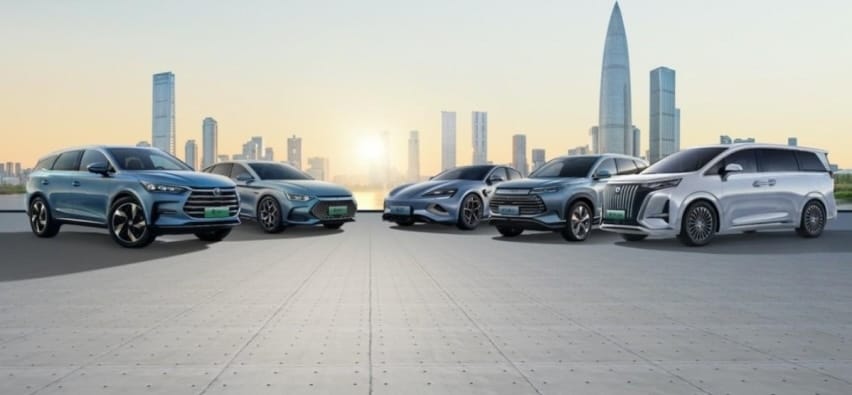
China’s new energy vehicle (NEV) market is undergoing a seismic shift in late 2025, marked by record penetration rates even as traditional sales momentum cools. While the sector’s adoption rate surged to 59.3% in November—positioning it to breach the 60% threshold next month—the established hierarchy of automakers is fracturing. Industry titans like BYD are tapping the brakes on growth, while aggressive challengers including Geely, Chery, and Xiaomi are rapidly rapidly gaining ground.
The latest data reveals a stark divergence in fortunes. BYD, despite maintaining its top position, reported its third consecutive comparable monthly sales decline in November, signaling an end to its era of explosive expansion. Conversely, Geely and Chery have capitalized on the success of their sub-brands—Galaxy and Fulwin, respectively—to pressure the market leader. In the startup arena, Li Auto, once the segment leader, has been ejected from the top 10 rankings following six months of contracting sales.
This volatility underscores a market that is far from stabilized, despite its maturity. The reshuffling comes as automakers brace for significant policy headwinds in 2026. The looming expiration of full purchase tax exemptions is expected to intensify competition, transitioning the industry from a phase of rapid expansion to what executives are describing as a "war of attrition" focused on resource reserves and operational endurance.
Incumbents Under Pressure
BYD remains the dominant force, delivering a record 480,200 vehicles in November when including commercial units. However, this headline figure masks underlying friction. The company recorded a year-on-year sales decline—its third in a row for 2025. This deceleration follows a second-quarter profit drop of 29.9%, the first such quarterly decline in over three years. Faced with inventory levels reaching 3.21 months—well above the industry average of 1.38 months—BYD has shifted its strategy from aggressive expansion to prioritizing price stability and volume retention.
Sensing vulnerability, rivals have intensified their offensives. Geely has emerged as the most formidable challenger, with cumulative NEV sales surpassing 1.5 million units in the first 11 months of 2025. Its penetration rate now exceeds 60%, driven primarily by the Galaxy series, which surged 167% year-on-year. To support this growth, Geely is reportedly acquiring manufacturing capacity from SAIC-GM and Lotus to produce Galaxy models.
Chery is also rapidly climbing the ranks. Powered by its upgraded Fulwin brand, the company entered the top three for NEV sales for the first time. In November, Chery’s NEV sector grew by 54%, mirroring Geely’s trajectory. While Changan Automobile and SAIC-GM-Wuling maintain high volumes, their sales remain heavily skewed toward lower-margin A00-class vehicles, such as the Wuling Hongguang MINI EV, limiting their competitive positioning in higher value segments.
Startup Volatility: The Rise of HIMA and Xiaomi
The landscape for pure-play electric vehicle startups has also been upended in 2025, with "new forces" now accounting for half of the top 10 brands. The year has proven best-in-class for many, but disastrous for others. Li Auto, previously the top performer, has seen sales contract by over 18% cumulatively, falling behind competitors like Leapmotor, XPeng Inc., and Nio Inc.
Taking the lead is the Harmony Intelligent Mobility Alliance (HIMA), backed by Huawei Technologies Co. HIMA delivered a record 81,900 units in November, surpassing all other EV startups. The surge is driven by new models like the Stelato S9T and Luxeed H5. Similarly, Leapmotor has solidified its position as the runner-up, surpassing 500,000 wholesale units for the year and targeting 1 million deliveries in 2026.
Xiaomi Corp. continues to defy expectations in its sophomore year of auto production. With improved capacity, Xiaomi’s monthly deliveries have risen steadily since July, putting the tech giant on track to exceed 400,000 units for 2025. Reports indicate the company aims to expand annual capacity to 1.2 million vehicles by the end of next year. Meanwhile, XPeng has claimed the lead among the legacy startup trio (Nio, XPeng, Li Auto), bolstered by strong demand for its budget-friendly MONA M03 and P7+ models.
Legacy Joint Ventures Struggle to Pivot
International legacy automakers continue to lose ground in the world's largest auto market. While joint ventures like Dongfeng Nissan and GAC Toyota have posted significant percentage growth in NEV sales—Dongfeng Nissan rising from negligible numbers to over 50,000 cumulative units—their absolute market share is shrinking.
The top-performing joint ventures in the NEV space are SAIC-GM and Volvo Cars, though Volvo's numbers rely heavily on exports. Notably, aside from Tesla Inc., the top 20 NEV sales rankings are now almost exclusively occupied by Chinese domestic brands. Last year, entities like SAIC Volkswagen held prominent spots; in 2025, even major players like SAIC-GM are seeing volumes roughly half of what leaders achieved a year prior. While brands including Audi and Cadillac are preparing new models on dedicated EV platforms for late 2025 and 2026, their ability to arrest market share erosion remains uncertain.
Outlook: The End of Subsidies
The barrier to entry for China's automotive elite is rising. In 2024, monthly sales of 20,000 units guaranteed a top 10 spot; in 2025, the threshold has moved to 30,000. This pressure will likely compound in 2026 as China’s decadelong policy of full purchase tax exemption for NEVs concludes.
Starting next year, the policy shifts to a "halved levy," with a maximum reduction capped at RMB 15,000 yuan (US$2,075) per vehicle. While the impact of this withdrawal on total volume is debated, industry leaders agree it will trigger fierce consolidation. William Li, CEO of Nio, characterized the upcoming environment not as a "blitzkrieg" but a sustained "war of attrition," where financial reserves and supply chain resilience will determine survival.