
China's Exoskeleton Boom: Ant, Meituan, and the Race for China's 323 Million Seniors
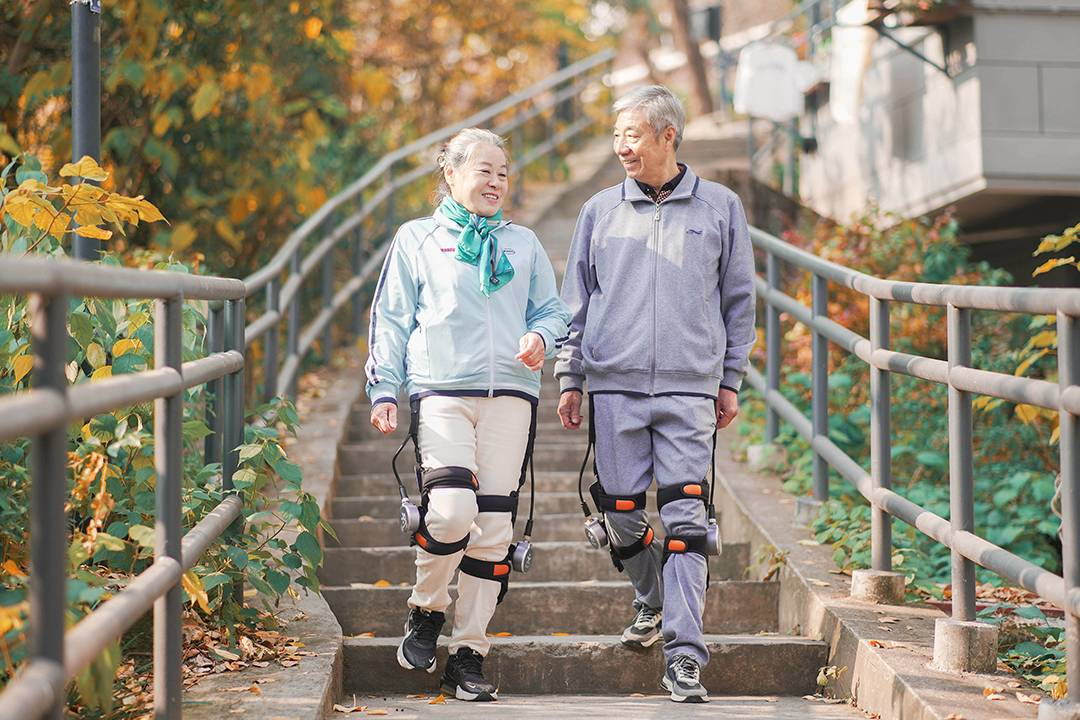
Consumer-grade wearable robotics has vaulted from niche medical hardware to a mass-market category in five years, drawing China's most powerful internet platforms into a race to own the data spine of the country's 323 million elderly.
The inflection point arrived on May 18, 2026, when Jike Technology closed a US$50 million Series B+ round led jointly by Ant Group and Meituan Longzhu — marking the first time internet-platform giants have taken the lead position in an exoskeleton financing. The deal signals a structural shift: what was once a deep-tech wager by specialist VCs is now a strategic land-grab by platforms that collectively touch nearly every dimension of Chinese consumer life. Online retail data released by China's Ministry of Commerce in late May 2026 provided the commercial backdrop — smart mobility exoskeleton sales surged 785.5% year-on-year in the January–April 2026 period, the sharpest four-month spike the category has ever recorded.
Market sizing data from Tou Bao Research Institute underscores the velocity of the shift: China's exoskeleton robotics market stood at RMB 680 million (US$94.4 million) in 2021; by 2025 it had reached approximately RMB 10.56 billion (US$1.47 billion), implying a compound annual growth rate of 98.5% over four years — a 15-fold expansion. Fortune Business Insights projects the global wearable exoskeleton market at US$2.49 billion in 2025, scaling to US$64.23 billion by 2034 at a 43.7% CAGR.
Capital Converges, Crowding Out the Skeptics
Five years ago, Sun Kuan, a product manager at robotics firm DFRobot, registered Juling Shen Technology in Shanghai with a premise that nearly 100 investors rejected outright: build an exoskeleton cheap and light enough for ordinary consumers to order on an e-commerce platform. The question thrown back at him in every pitch meeting — "Why would a normal person need an exoskeleton?" — has since been answered by the market itself.
The financing trail into 2026 reads like a roll call of China's most credible institutional capital. Sequoia China and IDG Capital led Jike Technology's Series A round in 2024. The company subsequently raised US$70 million across its Pre-B and Series B rounds in late 2025 before completing its current B+ financing.
Parallel to Jike's trajectory, ChengTian Technology completed a nine-figure RMB Series B+ round in March 2026, led by Agricultural Bank of China International, with Hangzhou Capital, a local state-owned investment vehicle, participating as a co-investor. In January 2026, Buffalo Robotics secured a Series A investment from Chengdu Science and Technology Venture Capital.
Meanwhile, Fourier Intelligence closed an approximately RMB 800 million (US$111.1 million) Series E round in early 2025, with Shanghai state-backed investors including Guoxin Investment and Pudong Venture Capital serving as lead backers.
The investor mix — sovereign-adjacent state funds, tier-one VCs, internet platforms, and Saudi Arabia's Aramco Prosperity7 — is itself a signal. Each constituency brings a different return thesis, yet all are converging on the same category simultaneously.
Price Collapse Unlocks the Mass Market
The exoskeleton's journey from million-yuan hospital equipment to sub-thousand-yuan consumer product traces a compression curve that mirrors the early smartphone era. As recently as 2023, the global average selling price for an exoskeleton ranged between RMB 600,000 and RMB 1 million (US$83,000–US$139,000), with premium units reaching several million yuan.
The first price break came around 2020, when Fourier Intelligence and Da Ai Robotics pushed rehabilitation-grade units into the RMB 100,000–300,000 (US$13,900–US$41,700) range, enabling broader adoption in rehab centers and nursing homes. Da Ai secured China's first CFDA registration certificate for an exoskeleton; by 2025, Professor Shuai Mei's team disclosed that Da Ai's products had dropped from the million-yuan tier to as low as the ten-thousand-yuan and even thousand-yuan band.
Consumer-grade critical mass arrived in 2024. Jike Technology began global shipments of its Hypershell line, targeting commuting, hiking, and trekking scenarios. Aoshu Intelligent launched its "Meet the Future" consumer exoskeleton series, with prices starting at RMB 6,900 (US$958).
In early 2025, Kenqing Technology partnered with Taishan Cultural Tourism Group to deploy rental exoskeletons at the Mount Tai scenic area — a viral moment that introduced the technology to China's mass internet audience.
Around the same period, ChengTian Technology listed a consumer-grade exoskeleton priced at RMB 2,599 (US$361) on e-commerce platforms, where it sold out in just 15 seconds.
Haier, a Fortune Global 500 company that requires no external capital, entered the category independently. Its W1 AI Sports Exoskeleton sold out on its first day of release in 2025. In May 2026, Haier followed with the launch of the W3, currently the world's lightest AI-powered motion exoskeleton, weighing just 1.75 kilograms.
The enabling technologies are well-understood but their simultaneous maturation is compressing timelines: AI gait algorithms now recognize wearer intent in milliseconds and auto-adjust assist force; carbon fiber and titanium alloy frames have reduced structural weight by an order of magnitude; and volume manufacturing is driving unit economics toward consumer electronics parity.
Ant and Meituan Reveal the Ecosystem Play
Neither Ant Group nor Meituan has publicly explained the strategic rationale behind the Jike co-lead. The logic, however, is traceable through each platform's existing product architecture.
Ant Group operates three services with direct elderly-user touchpoints: Alipay, Ant Insurance, and Ant Afu, a chronic-disease health management platform. An exoskeleton worn daily generates continuous gait data — step count, stride pattern, joint load — that feeds directly into chronic-disease monitoring and insurance risk modeling. The device becomes a hardware data terminal, giving Ant a first-party health data stream from a demographic that is simultaneously its fastest-growing insurance customer segment.
Meituan's logic is structural. In January 2026, Meituan signed an agreement with the Beijing Municipal Civil Affairs Bureau to list elderly care institutions across its platform. In February it launched elder care services in Hong Kong. By March, founder Wang Xing's "boundary theory" — the idea that Meituan's local-life platform has no fixed perimeter — was visibly extending into the silver economy. The company's platform already touches 323 million elderly users in China. Meituan's stake in Jike escalated from co-investor in November 2025 to lead investor by May 2026 — a six-month upgrade from participant to architect. When care institutions, mobility aids, and last-mile delivery networks converge on one platform, the elderly-centric local-life loop closes.
The broader competitive context reinforces the urgency. In June 2025, Tencent upgraded its SSV Silver Technology Partner Program. In December 2025, JD.com committed RMB 1 billion (US$138.9 million) over three years to elder care training. The silver economy is no longer a pilot program for China's internet majors — it is a declared strategic vertical.
Demographic Math Anchors the Long Thesis
The investment rationale ultimately rests on arithmetic. China has more than 300 million citizens aged 60 and above, a cohort that will expand materially through the 2030s. A sub-RMB 3,000 (US$417) exoskeleton that enables independent mobility reduces caregiver labor costs, defers institutionalization, and generates continuous health data — all at a capital-light unit economics profile that traditional elder care infrastructure cannot match.
Category definition remains contested: is a consumer exoskeleton an outdoor sports device, a rehabilitation aid, a consumer electronics product, or a mobility vehicle? Regulatory classification will shape reimbursement pathways and distribution channels. User adoption habits are still forming. Product form factors — Jike and Kenqing targeting outdoor activity, Cheng Tian anchored in medical rehabilitation with its brain-computer interface exoskeleton system already shortlisted in the National AI Medical Device catalog — have not converged on a dominant design.
What has converged is capital conviction. When Sequoia China, IDG Capital, Ant Group, Meituan, Saudi Aramco's Prosperity7 fund, and Haier — a company that writes its own checks — are all positioned in the same category, the debate shifts from whether the market will materialize to when. For China's 323 million elderly, the answer is arriving faster than anyone predicted five years ago.
Related Coverage: