
China's Flash Model Race: Why Efficiency, Not Scale, Now Defines AI Competition
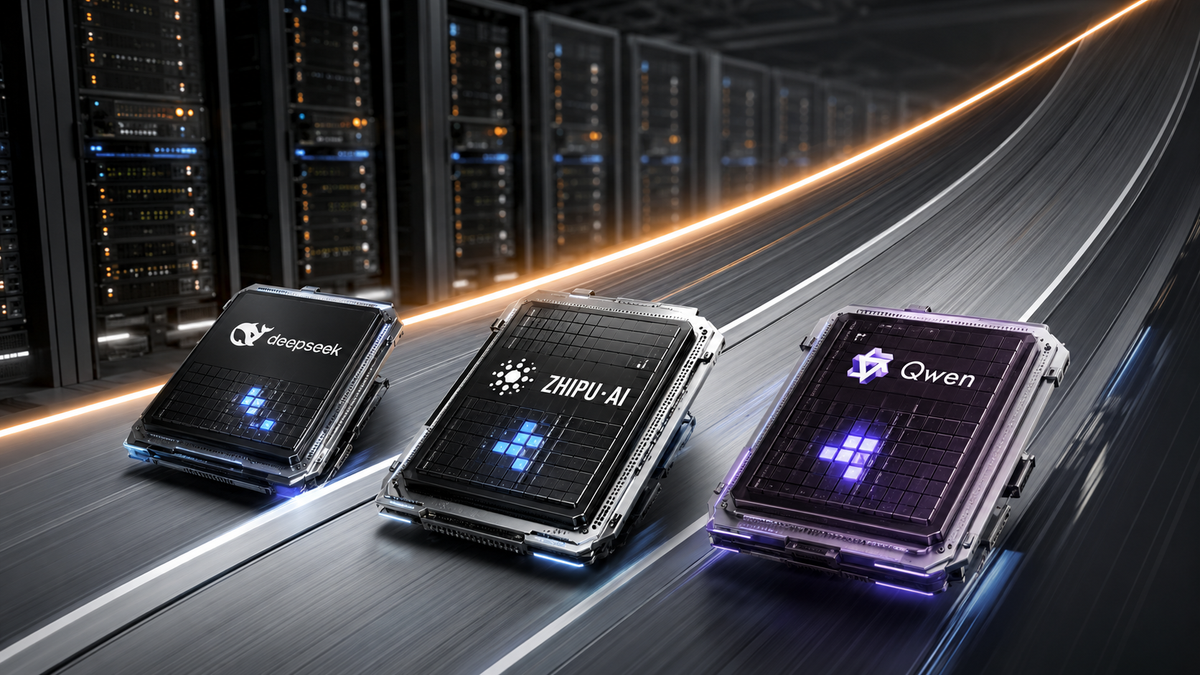
The battle among China's top AI labs has shifted from "who has the biggest model" to "who can do the most with the least." Here's why that matters — and what it means for the industry's future.
What Is a "Flash" Model — and Why Does It Matter?
A Flash model is not simply a stripped-down version of a flagship AI. The term originally referred to Google's lightweight product tier — fast, cheap, and "good enough." But the category has been fundamentally redefined.
The new generation of Flash models is built on a Mixture-of-Experts (MoE) architecture: a model retains a very large total parameter count (its full "knowledge base"), but during any single inference, only a small fraction of those parameters are actually activated. The result is a model that behaves like a large one but costs like a small one.
Three prominent examples illustrate the architecture:
- DeepSeek V4 Flash: 284B total parameters; only 13B activated per inference
- Zhipu GLM-5.3-Flash: 320B total parameters; only 18B activated per inference
- Alibaba Qwen3.8-Flash: 125B total parameters; only 6B activated per inference
This is not a compromise. It is an architectural choice — and it is now the dominant design philosophy among China's leading AI labs.
Why Did This Shift Happen Now?
Two structural forces converged in the second half of 2026 to push Flash models from the margins to the center of the industry.
1. The Agent economy exposed the cost problem
AI Agents — systems that autonomously chain together multiple model calls to complete complex tasks — are becoming the primary commercial deployment vehicle for large language models. A single Agent workflow may require dozens of sequential model calls: intent routing, information extraction, tool invocation, response synthesis.
If every one of those calls routes to a flagship model, costs compound with each step. At scale, that math does not work. Flash models solve this directly: they handle the majority of Agent subtasks — which do not require frontier reasoning depth — at a fraction of the cost, with lower latency and higher throughput.
Alibaba made this logic explicit: the launch of Qwen3.8-Flash was bundled with the simultaneous release of its Qianwen Office Agent product. Model and application were announced together, signaling that Flash is not a standalone product — it is the infrastructure layer for Agent deployment.
2. Open-source and price competition eroded the value of raw scale
Through the first half of 2026, the industry narrative centered on scale: more parameters, more data, more compute. But as open-source models proliferated and pricing fell, the performance gap between frontier and near-frontier models narrowed. The question shifted from "how capable?" to "how capable per dollar?"
Google's release of three Gemini Flash variants in July 2026 — without its flagship Gemini 3.5 Pro — sent a signal that even the leading Western lab was prioritizing the efficiency tier. Chinese labs read that signal clearly and accelerated their own Flash roadmaps.
What Is the "Kill Line" — and Who Draws It?
Independent evaluation platform Artificial Analysis introduced a useful concept: the "kill line" (斩杀线). On a price-vs-performance scatter plot, any model that is both more expensive and less capable than a given reference point is effectively eliminated from consideration. That reference point — the model sitting at the frontier of the price-performance curve — defines the kill line.
For much of 2026, DeepSeek held that position. Its models were not always the most capable in absolute terms, but they were cheap enough to make most alternatives look poor value. A significant portion of DeepSeek's user growth can be attributed to this structural advantage.
But kill lines are not permanent.
When DeepSeek announced a price increase and shifted to a peak/off-peak pricing structure, it vacated the low-price tier. Within days, Zhipu and Alibaba moved in:
|
Model |
Input
Price (per 1M tokens) |
Output
Price (per 1M tokens) |
|
GLM-5.3-Flash |
¥0.80 |
¥2.70 |
|
Qwen3.8-Flash |
¥0.80 |
¥2.80 |
|
DeepSeek
V4 Flash (peak) |
¥3.00 |
¥9.00 |
Zhipu added a time-limited 50% discount (through September 9), bringing its effective input price to ¥0.40 per million tokens. All three models support context caching, which further reduces real-world costs for Agent workloads with repetitive system prompts — Qwen's cached input price reaches ¥0.10 per million tokens; DeepSeek's off-peak cached price falls to ¥0.05.
On third-party benchmarks (Artificial Analysis Intelligence Index), the performance results were notable: GLM-5.3-Flash scored 57; DeepSeek V4 Flash scored 50. Zhipu achieved a higher score at a lower price — meaning the model that originally set the kill line was itself cut by the next one.
The kill line moves every few weeks. Each time it moves, fewer models survive.
What Are the Real Competitive Moats?
When MoE architecture becomes industry consensus and model weights are largely open-sourced, the structural differentiators are no longer in the model design itself. Two factors remain genuinely difficult to replicate.
Compute infrastructure
Flash models reduce per-inference cost, but they do not reduce the capital requirement for running inference at scale. Zhipu reportedly deployed a 100,000-chip domestic GPU cluster to support GLM-5.3-Flash inference. MiniMax has positioned itself as one of the few independent AI companies in China with a stable, large-scale infrastructure foundation. Tencent, notably, publicly acknowledged that its compute capacity is "severely insufficient" — a constraint it cited as a factor slowing iteration on its Hunyuan model line.
The paradox is that Flash models are partly a response to compute scarcity: a 320B model that activates only 18B parameters per inference allows the same hardware to serve far more concurrent users. Efficiency is not just a product feature — it is a coping mechanism for infrastructure constraints.
Data pipelines and alignment engineering
Compute can be purchased. Data pipelines cannot. The ability to curate pre-training corpora, build post-training data at scale, and execute reinforcement learning and alignment work effectively is where labs are actually differentiating.
- DeepSeek has invested heavily in reinforcement learning and distillation techniques to compress reasoning capability into small activation footprints
- Alibaba's Qwen team has focused on multimodal data composition
- Zhipu's differentiation lies in data curation and alignment engineering depth
The longer-term question is whether any of these advantages can compound into a data flywheel. Every Agent deployment generates real usage data. That data, fed back into training, improves the model. A better model attracts more Agent integrations. The lab that closes this loop at scale first acquires a structural moat that goes beyond any single model release.
Who Are the Key Players — and Why Will Few Survive?
The current competitive field includes DeepSeek, Zhipu AI, Alibaba (Qwen), Tencent (Hunyuan), and MiniMax, among others. Each has taken a distinct position:
- DeepSeek: Defined the efficiency-at-low-cost standard; now testing whether a price increase and differentiated vision capabilities can sustain its position
- Zhipu: Aggressive on price; strong third-party benchmark performance; backed by significant domestic chip infrastructure
- Alibaba: Tight integration between model and enterprise Agent products; leveraging cloud distribution and existing enterprise relationships
- Tencent: Acknowledged compute constraints; released a lightweight preview of its Hunyuan 4 (Hy4) flagship; integration with WeChat and enterprise WeChat remains a strategic asset
- MiniMax: Positioned as an infrastructure-stable independent; differentiated by multimodal capabilities
The structural logic of this market points toward consolidation. When architecture is commoditized and open-sourced, competition shifts to cost and distribution. Cost advantages accrue to those with the largest compute infrastructure and the most efficient data operations. Distribution advantages accrue to those embedded in existing enterprise or consumer ecosystems. Independent labs without either will face increasing pressure.
What Comes Next?
Several dynamics will shape the next phase of competition:
Price floors are approaching cost. As model pricing converges toward marginal inference cost, the model layer itself becomes a low-margin commodity. Monetization pressure shifts upstream (to compute and data infrastructure) and downstream (to Agent applications, vertical software, and cloud services).
Agent integration becomes the primary battleground. The lab that can demonstrate a closed-loop flywheel — model → Agent deployment → usage data → improved model → more Agent adoption — will have an advantage that price competition alone cannot erode.
Compute access remains a binding constraint. China's access to advanced semiconductors is structurally limited. Domestic chip ecosystems are developing but not yet at parity. Labs that can extract more performance per chip — which is precisely what Flash architecture enables — are better positioned to scale under these constraints.
The kill line will keep moving. There is no reason to expect the price-performance frontier to stabilize. Each new Flash release resets the baseline. The question is not who holds the kill line today, but who has the infrastructure and data depth to keep redrawing it.
Related Coverage:
DeepSeek's V4 Pro Undercuts Grok 4.6 by 7x as Agentic AI Race Heats Up
Zhipu Undercuts DeepSeek With GLM-5.3 Flash on 100,000+ Domestic Chips
Alibaba’s Qwen3.8-Max Challenge: How China’s AI Stack Is Closing the Gap With Silicon Valley