
China's Four E-Commerce Giants Diverge on Global Strategy as Growth Slows
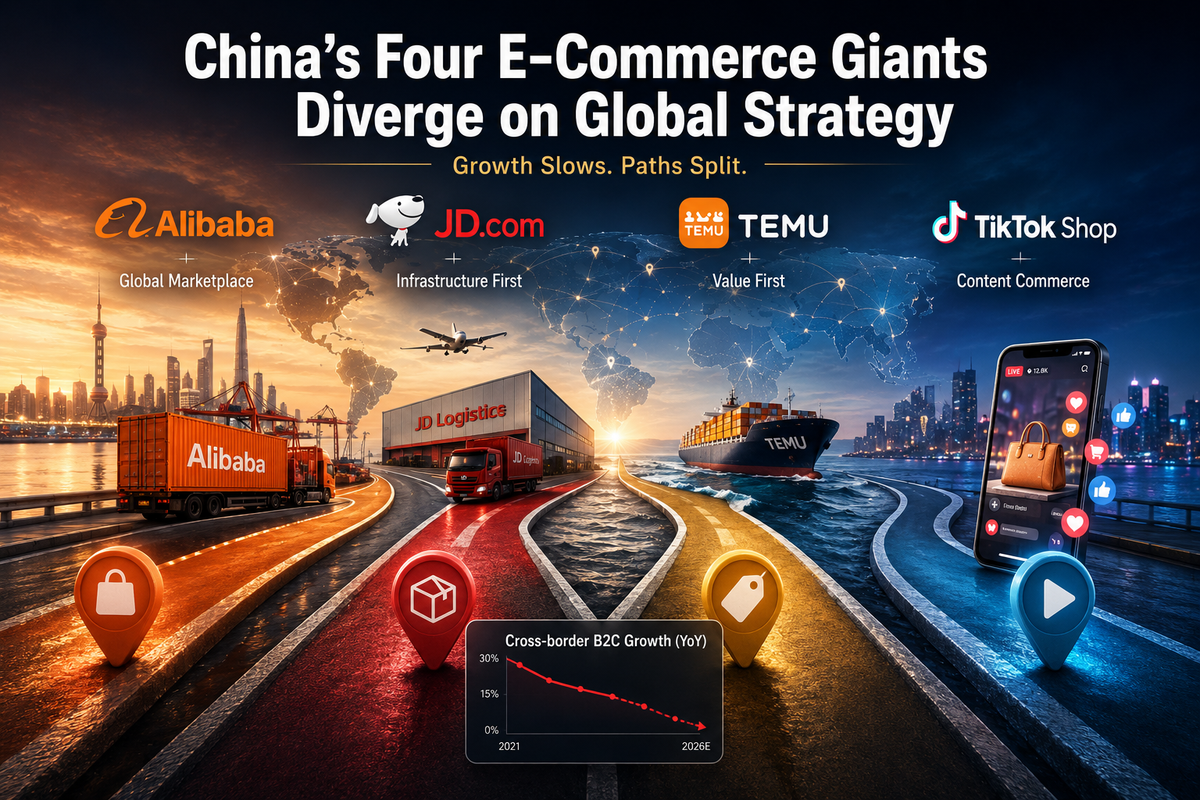
Alibaba, JD.com, Temu, and TikTok Shop are no longer competing on the same terms — Q1 2026 data reveals four structurally distinct overseas playbooks, with consequences that will define which platforms survive a maturing cross-border market.
The era of frictionless, parcel-direct globalization for Chinese e-commerce is over. Rising compliance costs, tightening import regulations in key Western markets, and surging last-mile fulfillment expenses have forced China's four largest cross-border platforms to make irreversible strategic bets — bets that are now diverging so sharply that sellers choosing the wrong platform risk absorbing losses that could reach seven figures annually.
Q1 2026 financials and operational disclosures confirm the split is structural, not cyclical. Alibaba International is narrowing losses through regional efficiency; JD.com is doubling down on logistics infrastructure before chasing volume; Temu is pivoting from pure cross-border arbitrage toward semi-managed local fulfillment; and TikTok Shop is quietly building the shelf-commerce backbone its content-first model always lacked.
Alibaba International Narrows Losses, Signaling a Shift From Scale to Efficiency
The most concrete financial signal of the strategic reset came from Alibaba International Digital Commerce Group. For the quarter ended March 31, 2026, its adjusted EBITA loss narrowed to RMB 138 million (approximately US$19.2 million) — a dramatic compression from the RMB 2.016 billion (US$280 million) loss recorded in the prior quarter ended December 31, 2025. The company attributed the improvement primarily to operational efficiency gains at AliExpress and optimization across multiple business units.
That sequential swing of nearly RMB 1.88 billion (US$261 million) in a single quarter is not a rounding error. It reflects a deliberate reorientation: Alibaba International is no longer prioritizing gross merchandise volume growth at any cost. Instead, the group is engineering a multi-layered regional architecture — AliExpress and Alibaba.com handle global reach and B2B trade, while Lazada (Southeast Asia), Daraz (South Asia), Trendyol (Turkey and the Middle East), and Miravia (Europe) operate as regionally autonomous platforms with localized merchant, consumer, and fulfillment ecosystems.
This "portfolio of regions" model provides meaningful risk diversification. A regulatory shock in one market — say, an EU digital services tax or a Southeast Asian customs crackdown — does not cascade across the entire network. However, running five distinct platform identities simultaneously creates persistent drag on operational efficiency, resource allocation, and brand coherence. The next test for Alibaba International is not whether it can stop bleeding, but whether regional fragmentation can generate network-level scale economies before competitors consolidate around simpler models.
JD.com Bets Infrastructure Margins Can Fund a Long Overseas Cycle
JD.com's overseas ambitions rest on a premise its rivals have largely rejected: that sustainable cross-border retail requires physical infrastructure first, volume second. For the quarter ended March 31, 2026, JD.com Group reported net revenue of RMB 315.7 billion (US$43.8 billion), up 4.9% year-over-year, with operating margin expanding to 5.6% from 4.9% a year earlier — a domestic earnings engine that provides the financial runway for prolonged overseas capital deployment.
JD Logistics (JDL) is the vehicle through which this strategy materializes internationally. The unit is systematically building overseas warehousing, automated sorting centers, and local delivery networks across target markets — replicating the integrated supply-chain model that made JD.com the dominant player in China's electronics and appliance categories. Critically, JDL is positioning itself not merely as JD.com's captive fulfillment arm, but as a third-party infrastructure provider for Chinese brands, independent direct-to-consumer sellers, and cross-border merchants who need bonded warehousing and local last-mile capability.
The strategic logic is sound given the direction of global trade policy: as import thresholds tighten, de minimis exemptions erode, and consumers in the US, UK, and EU increasingly demand Amazon-equivalent delivery speeds, platforms without pre-positioned local inventory will face structural cost disadvantages. JD.com is building the moat before the water rises.
The risk is capital intensity and time. Warehouse construction, automation capex, and local staffing carry multi-year payback periods. Single-warehouse throughput efficiency, order density per delivery zone, and cross-border fulfillment coordination will determine whether heavy investment converts to competitive advantage or becomes a drag on group returns.
Temu Abandons Pure Arbitrage, Rebuilds Around Semi-Managed Local Fulfillment
No platform in this cohort has undergone a more visible model transformation than Temu. Built on a formula of Chinese supply-chain pricing power, high-velocity digital advertising, algorithmic user acquisition, and direct small-parcel shipping, Temu captured international market share at a pace that alarmed incumbents from Amazon to Shein between 2023 and 2025.
That formula is now under stress. The partial rollback of US de minimis exemptions, rising shipping costs, and growing scrutiny of Chinese parcel volumes in European customs have materially altered the unit economics of direct cross-border fulfillment. Temu's response in 2026 is an accelerated pivot toward semi-managed fulfillment and local warehouse models, onboarding merchants who already hold overseas inventory and can execute local last-mile delivery, while the platform retains control of traffic allocation and transaction rules.
This is more than a logistics adjustment. It represents a fundamental change in Temu's value proposition. In its early phase, Temu was essentially a high-efficiency arbitrage machine — connecting Chinese factory pricing to Western consumer demand through a frictionless digital interface. The semi-managed model requires Temu to build competencies in inventory forecasting, local merchant governance, returns management, and regional compliance — capabilities that are operationally heavier and culturally more complex than running a centralized algorithm.
The central tension Temu must resolve: its competitive identity was forged on price. Local fulfillment and merchant governance add cost and complexity. Whether the platform can preserve its pricing differentiation while absorbing the operational overhead of a genuine local retail infrastructure is the defining question for its next growth phase.
TikTok Shop Quietly Builds the Shelf Commerce Layer Its Content Model Always Needed
TikTok Shop entered cross-border e-commerce with a structurally differentiated proposition: commerce triggered by content consumption rather than purchase intent. Where traditional platforms capture users who arrive with a product in mind, TikTok Shop intercepts users mid-scroll — converting passive entertainment into transactional behavior through creator endorsements, live-stream selling, and algorithmic product discovery.
This model generated rapid gross merchandise volume growth in markets including the United States, the United Kingdom, and Southeast Asia. But content-driven commerce has a ceiling. Creator ecosystems are volatile. Live-stream traffic is episodic. And platforms that depend entirely on top-of-funnel content to drive transactions lack the search infrastructure, category navigation, and price-comparison tools that convert browsing into habitual purchasing.
In 2026, TikTok Shop is visibly investing in exactly those missing layers: a formalized shelf-commerce storefront, strengthened search functionality, systematic merchant governance, and platform-level policy enforcement. The move signals that ByteDance recognizes TikTok Shop must evolve from a content-monetization channel into a full-stack retail platform capable of competing on product breadth, fulfillment reliability, and seller ecosystem depth — not just viral reach.
The strategic challenge is integration. TikTok Shop's content-commerce flywheel is its most defensible differentiator. Over-indexing on shelf commerce risks commoditizing the platform into a less-efficient version of Amazon or Shopee. The platform must build conventional e-commerce infrastructure without diluting the content-native experience that drives its user engagement advantage.
Impact Assessment: What Platform Divergence Means for Sellers and Investors
For the estimated tens of thousands of Chinese merchants currently evaluating overseas platform allocation, the divergence carries direct financial implications. Platform choice in 2026 is effectively a bet on which infrastructure model will dominate a given market in three to five years:
- Alibaba International suits sellers with regional product-market fit who can navigate multi-platform complexity and benefit from localized consumer bases in Southeast Asia, South Asia, or Europe.
- JD.com is best positioned for sellers in categories where delivery speed and return experience are purchase drivers — electronics, appliances, health products — and who can benefit from JDL's bonded warehouse network.
- Temu remains viable for high-volume, price-sensitive SKUs, but sellers must now evaluate whether semi-managed fulfillment requirements alter their working capital cycle.
- TikTok Shop offers disproportionate upside for brands with strong visual identity and creator-collaboration capability, but requires tolerance for platform-rule volatility and dependence on algorithmic distribution.
For institutional investors, the Q1 2026 data reinforces a broader thesis: the Chinese cross-border e-commerce sector is transitioning from a growth-at-all-costs phase to a capital-efficiency phase. Alibaba International's loss compression, JD Retail's margin expansion, and the structural pivots at Temu and TikTok Shop all point in the same direction — the platforms that survive the next regulatory and macroeconomic cycle will be those that have converted traffic and price advantages into durable operational infrastructure.
Speed to market was the competitive variable of 2021 to 2024. Fulfillment capability, merchant governance, and regional economic density are the variables that will determine winners through 2028.
Related Coverage:
Alibaba Pivots Future to AI Cloud as Core E-Commerce Engine Sputters in Q3
Tencent and JD.com Forge AI Agent Alliance to Close E-Commerce Fulfillment Gap
TikTok Races to Hit E-commerce Goals With Aggressive New Playbook
Temu Relaunches US Push With Aggressive Price Cuts to Recapture Market