
China's Lithium Battery Exports Hit $40B in Jan-May 2026, Even as Unit Prices Scrape Historic Lows
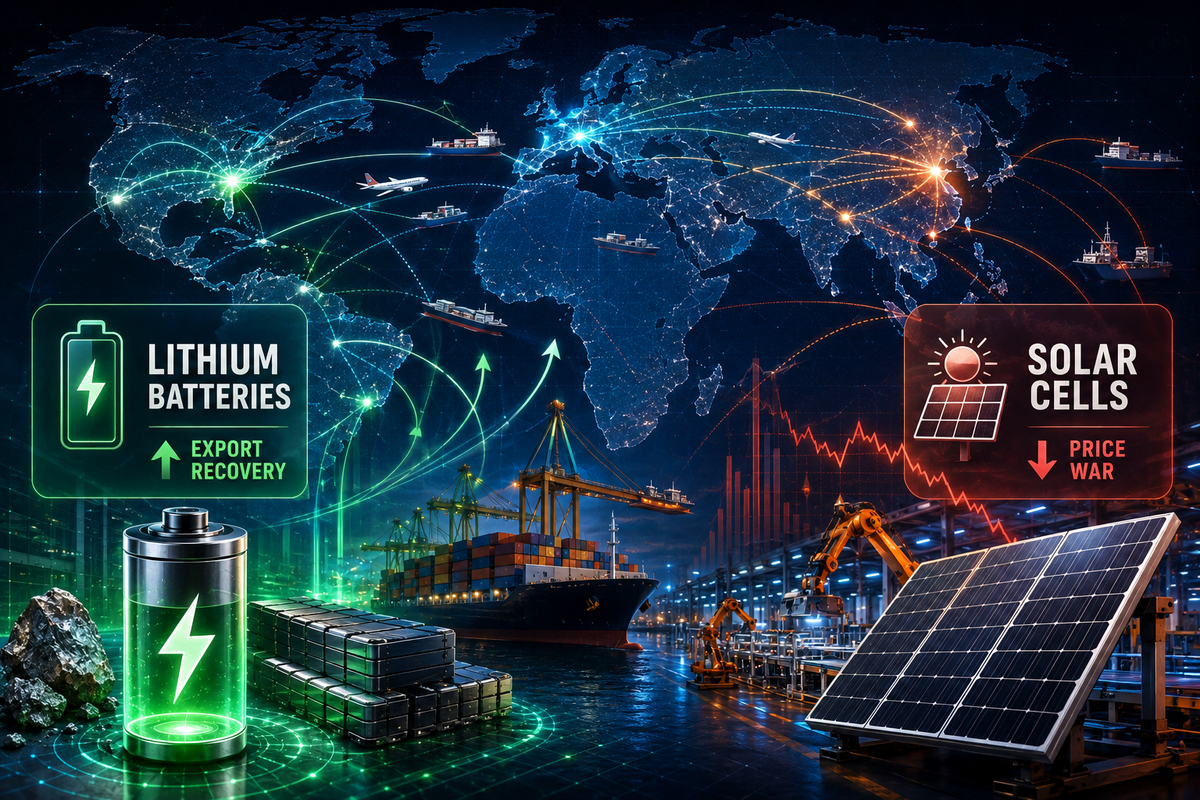
Price deflation is decelerating sharply — but the real story is a structural re-routing of trade flows that is permanently redrawing the global battery supply map.
China's lithium-ion battery exports surged 45% year-on-year to US$40 billion in the first five months of 2026, powered by volume expansion into Europe and emerging markets that more than offset a dramatic collapse in US-bound shipments, according to data compiled by the China Passenger Car Association. The acceleration marks a decisive rebound from 2024's 6% export contraction and validates a "price-down, volume-up" strategy that Chinese manufacturers have pursued under mounting geopolitical pressure.
May alone contributed US$8 billion — up 35% year-on-year, with an average export price of US$15,300 per tonne, still near a multi-year trough but showing sequential stabilization. The data, released June 30, arrives as China's domestic new-energy passenger vehicle retail sales fell nearly 20% year-on-year in 2026, forcing battery exporters to lean harder on overseas demand to absorb overcapacity.
Deflation Eases, But Unit Prices Remain Pinned at Cycle Lows
Dollar-denominated export unit prices fell 12% year-on-year to US$14,900/tonne for the January–May period, compared with declines of 26% in 2024 and 22% in 2025: US$27,300/tonne (2023) → US$20,100/tonne (2024) → US$15,700/tonne (2025) → US$14,900/tonne (2026 YTD).
The deceleration in price decline is a critical signal for investors tracking battery-sector margin recovery. However, the renminbi-denominated picture is more complex: yuan-denominated export ASPs fell from RMB 142,900/tonne (US$19,847/tonne) in 2024, down 26% year-on-year, to RMB 112,300/tonne in 2025, down 21%, and further to RMB 104,800/tonne in 2026, down 12%, with the post-VAT rebate reduction in April–May appearing to have contained incremental pricing pressure relative to the same period in 2025.
The divergence between dollar and yuan metrics is not cosmetic: it means Chinese exporters are absorbing a currency headwind on top of structural price compression, squeezing realized margins even as headline dollar revenues expand.
Europe Consolidates as the Anchor Market, Absorbing US Shortfall
The European Union has cemented its position as China's dominant lithium battery export destination, accounting for approximately 42% of total export value in 2026 — up two percentage points from 2025. In May, China shipped 201,000 tonnes worth US$3.26 billion to the EU, with an average unit price of US$16,200/tonne, down 12% year-on-year.
The EU's growing share is a direct counterweight to the accelerating US decline. China's battery exports to the United States have contracted to roughly 10% of total export volume in 2026, down six percentage points from 2025 — a structural retrenchment driven by tariff escalation rather than demand softness. US-bound shipments in May carried an ASP of US$13,500/tonne, down 1% year-on-year but recovering from the lows recorded in October–November 2025.
By destination, Germany led all markets in both May (US$1.147 billion) and the January–May cumulative period (US$5.813 billion), followed by the United States (US$3.609 billion), the Netherlands (US$2.908 billion), Vietnam (US$2.310 billion), and India (US$2.300 billion).
The fastest-growing incremental destinations year-to-date are the Netherlands (+US$1.602 billion vs. prior-year period), Australia (+US$1.187 billion), Japan (+US$1.053 billion), India (+US$1.034 billion), and Vietnam (+US$785 million) — a geographic spread that underscores how Chinese manufacturers are actively diversifying away from binary US–EU dependence.
Solar Cells Diverge, Highlighting Battery Sector's Relative Resilience
China's other flagship "New Three" export — solar cells — tells a contrasting story that sharpens the battery sector's outperformance. Solar cell exports reached US$27.9 billion in January–May 2026, up 26% year-on-year. However, May exports fell 7% year-on-year to US$4.5 billion, reflecting ongoing industry overcapacity and price wars that have dragged annual export values from a peak of US$92.8 billion in 2022 to US$56.4 billion in 2025 — a 39% cumulative decline over three years.
Lithium batteries, by contrast, have rebounded from their 2024 trough. Full-year exports rose from US$64.9 billion in 2023 to US$76.8 billion in 2025, and the January–May 2026 run-rate of US$40 billion annualizes to approximately US$96 billion — which would represent a roughly 25% year-on-year increase if the pace holds. The divergence between the two sectors reflects battery demand's tighter coupling to durable, policy-driven energy transition infrastructure (EV adoption, grid storage), versus solar's exposure to installation-cycle volatility.
Domestic Headwinds Accelerate the Export Imperative
The export surge is not occurring in a vacuum of strength — it is partly a pressure valve for an industry facing acute domestic stress. China's new-energy passenger vehicle retail sales declined nearly 20% year-on-year in 2026, while the broader automotive sector posted a profit margin of just 3.4% in January–May, with revenues up 1% but costs rising 2% and profits falling 20%. The domestic cost-push dynamic, combined with overcapacity built during the 2021–2023 boom, has made export market share a strategic necessity rather than an opportunistic supplement.
This structural dependency on export volumes means the US tariff impact — while partially offset by EU and emerging-market growth — represents a persistent vulnerability. The 6-percentage-point US share decline in a single year is among the sharpest demand-routing shifts recorded in the sector's export history. Whether Southeast Asia, the Middle East, and Australia can absorb further US-redirected volumes at scale will be the central question for the second half of 2026.
Related Coverage:
China’s Lithium Industry Faces Divergent Fortunes Amid Middle East Crisis