
China’s Long March 12A Rocket Fails Landing Attempt in Maiden Flight
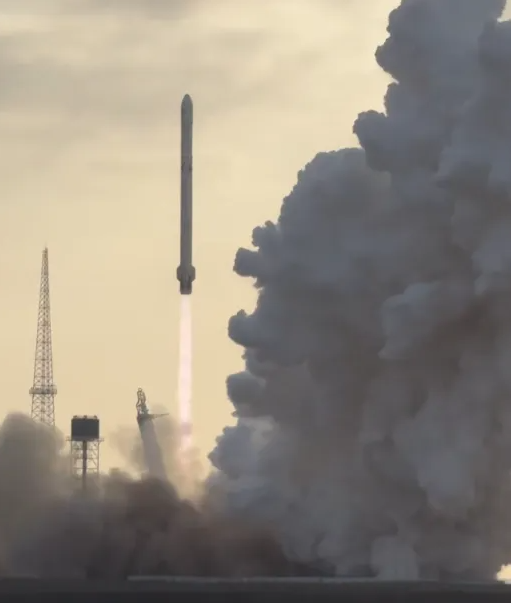
China’s latest effort to demonstrate reusable launch vehicle technology encountered a setback on Tuesday, as the Long March 12A rocket failed to complete its recovery landing during its maiden flight. While the vehicle achieved a successful ignition and liftoff, the booster stage suffered an anomaly during reentry, crashing at the designated recovery zone.
The mission, conducted at approximately 10:00 a.m. Beijing time from the Dongfeng Commercial Aerospace Innovation Pilot Zone in Jiuquan, marked the debut of the Long March 12A. Developed by the Shanghai Academy of Spaceflight Technology (SAST), a major subsidiary of the state-owned China Aerospace Science and Technology Corporation, this vehicle represents a key component of China's push to modernize its fleet with commercial, reusable capabilities.
Reports from the recovery site indicated that the first stage experienced an anomaly during the final phase of descent, resulting in an explosion described by observers as a "mushroom cloud," confirming the failure to land intact. The flight was China’s second attempt at an orbital launch combined with a vertical recovery of the booster, a technology essential for reducing launch costs.
Despite the landing failure, the mission underscores an aggressive pivot by China’s "national team" of state-owned aerospace manufacturers toward reusable technologies. With the sector poised for a surge in development, at least five new types of reusable rockets are scheduled to begin flight testing starting next year, intensifying competition to secure low-cost access to space.
Flight Details and Anomaly
The rocket lifted off smoothly from the newly built launch pad of the China Commercial Rocket Company, with the visual phase of the ascent appearing normal. However, the recovery attempt for the first stage, which was targeted for a landing zone in Minqin County, Gansu Province—approximately 248 kilometers from the launch site—ended in failure.
The recovery site features a circular pad with a diameter of roughly 115 meters, completed in the fourth quarter of 2025. While the precise technical cause of the reentry anomaly has not yet been disclosed, the resulting impact confirms the significant challenges remaining in perfecting vertical landing technology for orbit-class vehicles.
Technical Specifications and Supply Chain
The Long March 12A stands over 60 meters tall with a diameter of 3.8 meters. Its design draws upon the configuration of the expendable Long March 12 but integrates reusable technologies. The rocket features a multi-supplier propulsion system: the first stage is powered by seven "Longyun" liquid oxygen-methane engines manufactured by Jiuzhou Cloud Arrow, a private commercial engine maker, while the second stage utilizes a single vacuum-optimized YF-209 liquid oxygen-methane engine from the Academy of Aerospace Propulsion Technology.
The vehicle is designed to accommodate fairings with diameters of 5.2 meters or 4.2 meters, allowing adaptability for various mission payloads.
Strategic Pivot to Reusability
The push for the Long March 12A aligns with China’s "2035 Rocket Roadmap," where reusability has become a standard requirement for the fourth generation of launch vehicles. According to industry sources, earlier planning envisaged a transition where almost every new expendable rocket model would be paired with a reusable variant to foster technological iteration.
Under valid strategic planning, development was distributed between major state-owned institutes, with SAST focusing on 4-meter class vehicles (XLV series) and the China Academy of Launch Vehicle Technology (CALT) handling other diameter classes. This structured approach aims to verify new technologies progressively while maintaining operational capabilities.
Future Outlook and Market Dynamics
The sector is bracing for a "breakout" period for state-backed reusable rockets. Following the Long March 12A debut, the China Rocket announced at the Wenchang Aerospace Forum alongside the launch that its Long March 10B (CZ-10B) reusable rocket will be ready for its maiden flight by April 2026.
The CZ-10B is a massive 5-meter diameter liquid-propellant rocket capable of carrying 16 tons to Low Earth Orbit (LEO), designed for sea-based recovery using specialized vessels and net systems. It will utilize exclusive launch pads at the Hainan Commercial Aerospace Launch Site.
Looking ahead to 2026, the market will see the introduction of multiple reusable models, including the Long March 10A, Long March 10C, and Long March 12B. These will compete alongside traditional expendable commercial rockets like the Long March 8A and Long March 6A. The industry consensus suggests that market leadership will ultimately be claimed by high-capacity rockets that can successfully demonstrate reusability, cost reduction, and reliable mass production.