
Inside the "Hand-Assembled" Reality of China’s Humanoid Robot Industry
The burgeoning humanoid robot industry, projected by investors as the defining technology trend of 2025, is facing a critical bottleneck in manufacturing scalability that contradicts current market valuations. Despite the high-tech narrative surrounding "embodied artificial intelligence," the actual production process remains heavily reliant on manual labor and lacks the automated standardization required for mass commercialization.
Deep within Beijing's Houchangcun—a hub for China's technology giants—leading startups are assembling robots in office towers rather than factories. The production method resembles a workshop model where skilled workers manually assemble components using basic tools, a stark contrast to the automated assembly lines seen in the automotive or smartphone sectors.
This reliance on "hand-rubbed" assembly highlights a disconnect between R&D sophistication and manufacturing maturity. While algorithms advance rapidly, the physical consistency and production efficiency of these robots are constrained by human variability. This reality casts doubt on the industry's ability to meet the forecasted "mass production year" of 2026 without a significant overhaul in industrial engineering.
These insights are based on an undercover report by Yuan Zhang of the WeChat media outlet Hedgehog Commune, or CiWeiGongShe, who gained employment as an assembly line worker to document the operational reality of China’s burgeoning "embodied intelligence" sector.
Low-Tech in High-Tech Hubs
Workshop-Style Production
Contrary to the image of sleek, automated futuristic factories, the assembly floor of a major player in the sector—referred to here as XX Intelligence—operates more like a university laboratory or an appliance repair shop. Located inside a standard office building, the facility lacks heavy machinery or conveyor belts.
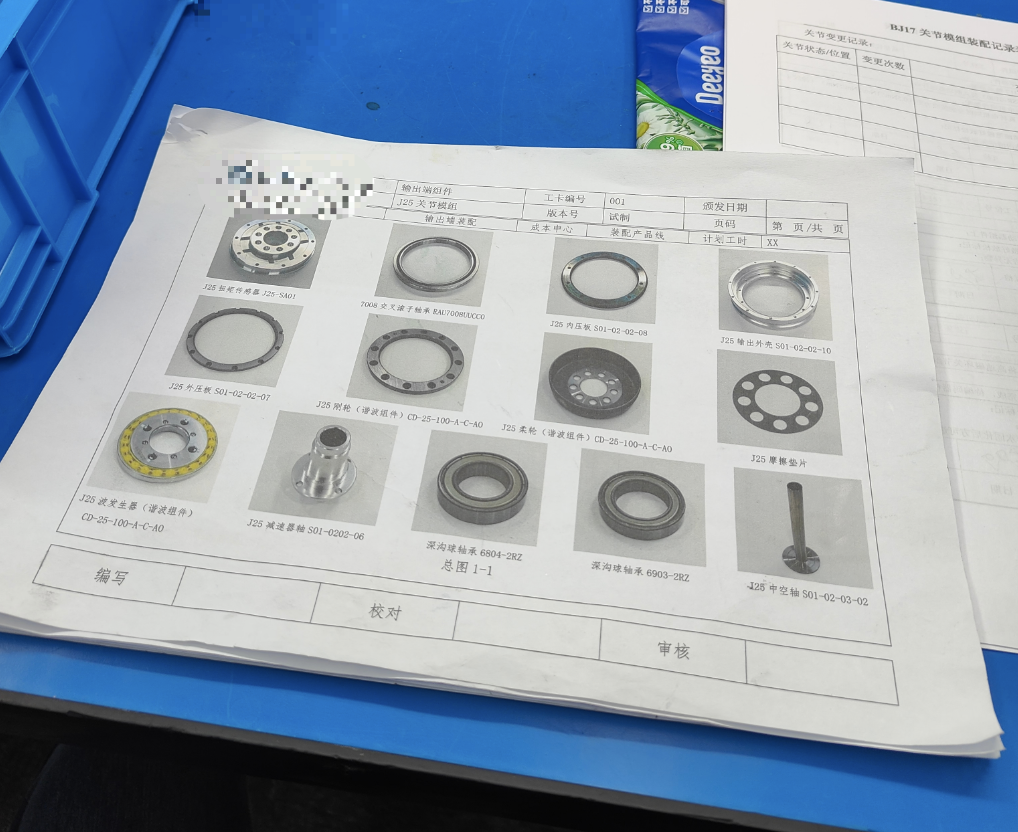
Production relies entirely on manual labor. Workers sit at desks with printed A4 paper manuals, assembling intricate parts using electric screwdrivers, hex keys, and soldering irons. The process involves physical force and dexterity, such as freezing components to fit them into bearings or soldering circuit boards by hand.
This lack of automation introduces significant challenges in standardization. A "craftsman" approach creates inconsistencies; when modules fail to operate, senior technicians often diagnose issues by ear rather than digital diagnostics. While this flexibility allows for rapid problem-solving, it results in a high scrap rate and prevents the rigorous quality control necessary for large-scale deployment.
The Complexity of Mechanical Assembly
The manufacturing challenge stems from the nature of the product. Humanoid robots have more in common with automobiles than consumer electronics. The core complexity lies in the joints, which require the precise assembly of bearings, motors, gears, and sensors.
Like the automotive industry, the mechanical quality of a robot depends heavily on assembly tolerances. However, unlike modern car plants, these robots are built without automated fixtures. Workers must rely on their own judgment and physical skill to align parts with tight tolerances.
The physical reality of the product is robust, often described by workers as "iron lumps." In some instances, assembly errors are corrected with rudimentary tools like hammers, further underscoring the gap between the product's intelligent software and its rough mechanical hardware.
Cost Structures and Scalability
The economics of this production model are driven by the need for R&D iteration rather than volume. XX Intelligence locates its "factory" in expensive Beijing office space to keep production and engineering teams in close proximity for immediate feedback.
Labor costs reflect this model. Assembly workers are outsourced, earning approximately RMB 300 yuan (US41)per day or RMB 30 yuan (US41)per hour. Despite a grueling "9-8-6" schedule (9 a.m. to 8 p.m., six days a week), the company struggles to find workers with the specific combination of manual dexterity and cognitive ability to interpret complex blueprints.
This reliance on skilled humans over machines creates a scalability trap. Increasing production currently means linearly adding headcount, which is inefficient and costly compared to the exponential gains of automated manufacturing.
Awaiting Real Commercial Demand
Industry experts caution that the sector is still awaiting its "Ford Model T moment." Wang Zhongyuan, Dean of the Beijing Academy of Artificial Intelligence (BAAI), notes that the industry must distinguish between legitimate commercial needs and pseudo-demand driven by policy subsidies or investment heat.
Current orders are sufficient to keep these "workshops" busy but are too small to justify the capital expenditure of building dedicated automated production lines. The focus remains on demonstration projects and exhibitions rather than practical industrial deployment.
Until humanoid robots prove their utility in real-world production or service scenarios, creating sustainable demand, the industry will likely remain stuck in this high-cost, low-volume "hand-assembled" phase. True mass production will only commence when the market pulls the technology out of the lab and into the assembly line.