
LimX Dynamics Unveils Modular Robot Platform to Cut Embodied AI Development Costs
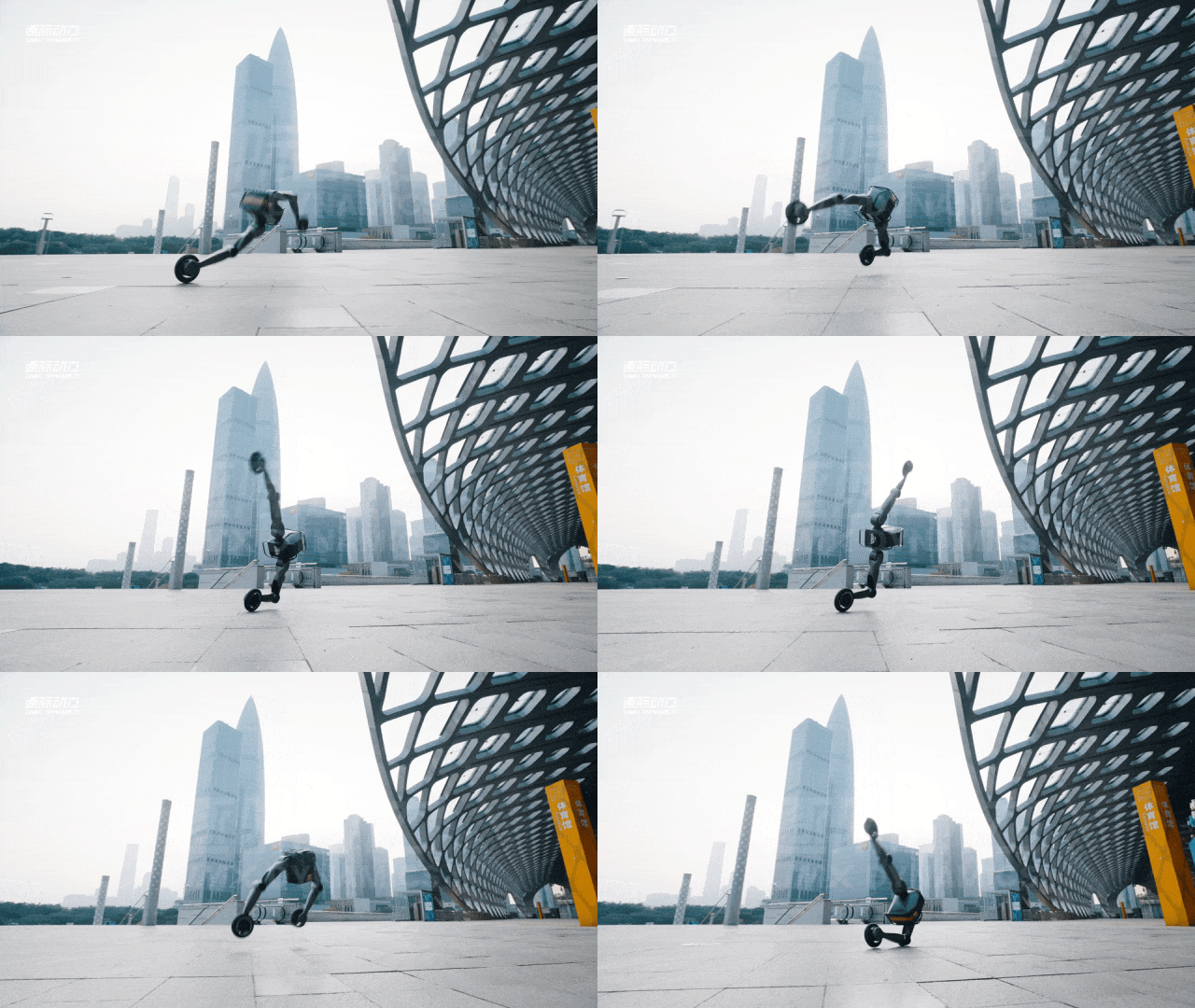
LimX Dynamics has launched TRON 2, a modular robot platform designed to address hardware fragmentation in the embodied AI sector by allowing a single core system to switch between bipedal, wheeled, and dual-arm manipulation configurations. The release marks a strategic shift toward standardized, multi-functional hardware bases intended to lower barriers for advanced robotics research and commercial application.
The Shenzhen-based robotics company officially announced the platform on December 18, with pricing starting at RMB 49,800 (US$6,868). The system is positioned as a "universal base" capable of supporting Vision-Language-Action (VLA) model research, mobile manipulation, and whole-body motion control. Pre-orders for the platform have officially opened, targeting developers and research institutions seeking cost-effective alternatives to purchasing multiple specialized machines.
According to company demonstrations, the TRON 2 integrates high-performance dual robotic arms with an all-terrain mobile chassis. Its control algorithms allow for complex physical tasks, including table tennis, backflips, and ballet-like maneuvers, demonstrating a balance between precision manipulation and dynamic stability. The system is designed to support the complete lifecycle of embodied AI development, from data collection and simulation to real-world deployment.
The launch occurs as the embodied AI sector faces significant bottlenecks in hardware costs and compatibility. By offering a reconfigurable platform, LimX Dynamics aims to resolve the inefficiency of using separate robots for mobility and manipulation tasks, potentially accelerating the deployment of AI models in industrial and service environments.
Modular Architecture Strategy
The central innovation of the TRON 2 is its "one machine, three forms" design philosophy. Traditional robotics hardware often forces researchers to choose between fixed morphologies—either mobile bases with limited manipulation or stationary arms with no mobility. This fragmentation drives up capital expenditure and complicates cross-scenario algorithm development.
TRON 2 utilizes a modular architecture that allows the central body to switch rapidly between dual-arm, bipedal, and wheeled-legged configurations. It also supports reconfiguration into humanoid or quadruped structures. This flexibility enables a single piece of hardware to cover diverse research requirements, significantly minimizing redundancy and hardware investment costs for laboratories and enterprises.
Hardware Performance and VLA Integration
To support VLA research, which requires robots to perceive, understand, and execute tasks, TRON 2 features competitive specifications in manipulation and compatibility. The robot is equipped with 7-DoF (degrees of freedom) arms that mimic human joint distribution, paired with a spherical wrist design to facilitate operation in confined spaces. The system supports a payload of 10kg per arm and a maximum body load of 60kg, allowing it to handle tasks ranging from delicate household table setting to industrial assembly.
On the software side, the platform is structured to lower development thresholds. It provides full compatibility with leading VLA models such as Pi 0.5 and ACT. LimX Dynamics claims that developers can achieve real-machine deployment within two hours of unboxing, supported by a comprehensive development toolkit and open APIs. This ecosystem is designed to minimize the time spent on environmental configuration and hardware debugging.
All-Terrain Mobility and Endurance
Addressing the limitations of traditional bipedal robots, TRON 2 combines bipedal mechanics with wheeled locomotion. The robot features enhanced perception systems capable of identifying stairs and slopes, utilizing proprietary motion control algorithms to navigate complex topography including multi-story buildings and outdoor steps.
The platform also offers improved energy efficiency and load capacity compared to industry averages. While many competing products are limited to 1-2 hours of operation with payloads under 20kg, TRON 2 features a battery life of up to 4 hours and a maximum motion payload of 30kg. This extended endurance is critical for continuous data collection and long-duration testing in realistic scenarios.
Market Context and Strategic Outlook
The release of TRON 2 represents the latest evolution in the product line of LimX Dynamics, following its P1 bipedal robot and full-sized humanoid LimX Oli. The company is focusing on solving the "fragmented scenario" problem in the robotics industry, where customized hardware for specific tasks prevents scalability.
By providing a standardized, high-performance base, the company is positioning itself to capture the growing demand for embodied AI infrastructure. As large models increasingly integrate with physical hardware, the availability of versatile, lower-cost platforms like TRON 2 is expected to play a key role in transitioning robotic technology from academic research to practical applications in industrial production and household services.