
Zhipu Unveils Flagship AI Model GLM-4.7 Ahead of IPO to Challenge Global Rivals
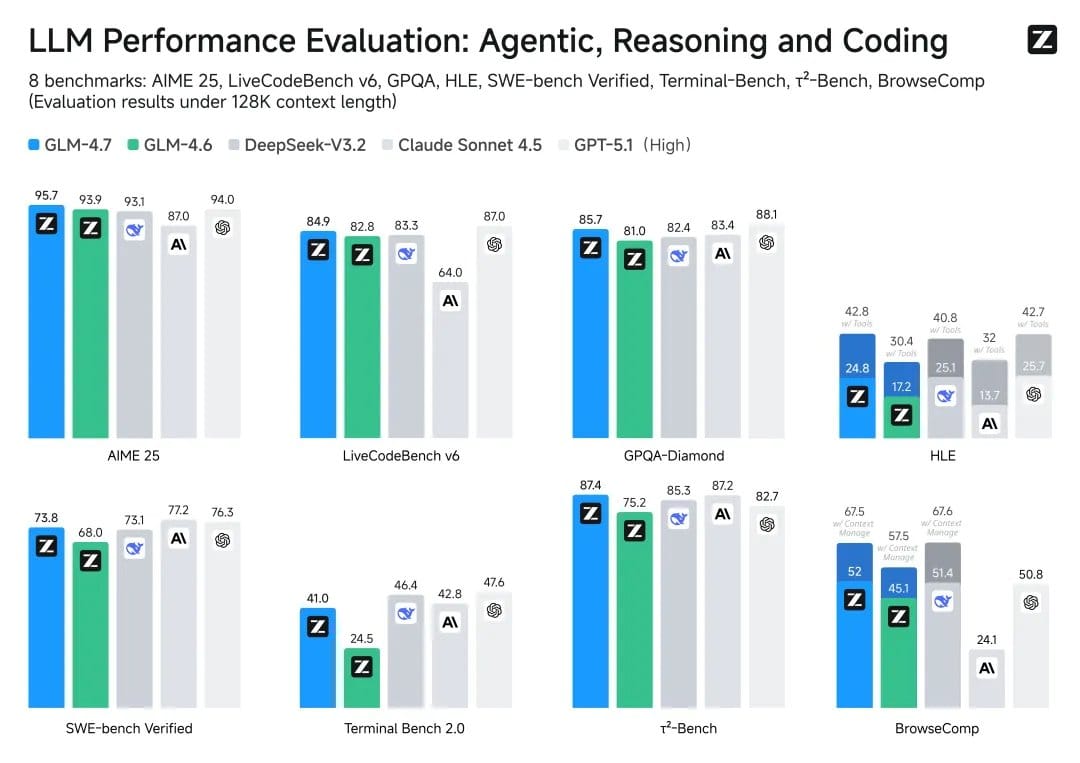
Zhipu AI has officially launched and open-sourced its latest flagship large language model, GLM-4.7, marking a significant technical update just prior to the company’s planned initial public offering. The new model focuses heavily on coding capabilities, utilizing advanced reasoning architectures to enhance performance in complex task planning and tool coordination.
In multiple mainstream public benchmarks, GLM-4.7 has demonstrated performance metrics that rival or surpass current global market leaders. According to data from Code Arena, a professional coding assessment system involving millions of users worldwide, GLM-4.7 ranks first among open-source models and domestic Chinese models. Notably, the data indicates the model has surpassed performance metrics associated with GPT-5.2 in specific blind tests.
The architecture of the new model introduces mechanisms such as "Reserved Thinking" and "Turn-level Thinking," designed to improve stability and controllability during complex tasks. This release is widely viewed by market observers as a strategic move to demonstrate technical competitiveness and solidify investor confidence as Zhipu AI prepares for its capital market debut.
Market feedback has highlighted the model's aggressive pricing strategy and improved cost-efficiency. Early user comparisons suggest that the subscription costs for GLM-4.7 are significantly lower than comparable Western alternatives, positioning the model as a direct challenger in the global AI development sector.
Surpassing Global Benchmarks
According to test data released on December 23, GLM-4.7 has achieved significant gains in programming and reasoning capabilities. In the "Humanity's Last Exam" (HLE) benchmark, the model scored 42.8%, a 41% improvement over its predecessor, GLM-4.6, and higher than GPT-5.1.
In the domain of code generation, GLM-4.7 has asserted dominance in multi-language coding tasks. It achieved a score of 73.8% on SWE-bench-Verified and 84.9% on LiveCodeBench V6, securing the top spot for open-source models in both categories and aligning with the performance of Claude Sonnet 4.5. Additionally, the model scored 87.4 in the τ²-Bench interactive tool calling evaluation, setting a new record for open-source systems.
Enhanced Reasoning Architecture
To address stability issues in complex workflows, GLM-4.7 incorporates a controllable evolution of "thinking" capabilities across three dimensions. "Interleaved Thinking" allows the model to deliberate before answering or calling tools, improving compliance with complex instructions.
Arechitecturally, the model introduces "Reserved Thinking," which supports the automatic retention of thought blocks across multi-round dialogues. This feature increases cache hit rates and reduces inference costs for long-range tasks. Furthermore, "Turn-level Thinking" allows users to control inference overhead by enabling reasoning only for complex tasks while toggling it off for simpler queries to reduce latency. These mechanisms enable the model to execute a "think first, act later" logic within mainstream frameworks like Claude Code and TRAE.
Full-Stack Development and UI Optimization
Zhipu AI has upgraded the model’s understanding of visual code specifically for frontend development scenarios. GLM-4.7 is designed to better adhere to UI design specifications, providing aesthetically pleasing default schemes for layout, color harmony, and component styling.
Official demonstrations show that the model’s proficiency in office creation tools has managed a significant leap, with the adaptation rate for 16:9 PowerPoint presentations rising from 52% to 91%. In practical application showcases, the model demonstrated the ability to independently develop highly interactive games, such as versions of Plants vs. Zombies and Fruit Ninja, indicating strong capabilities in task disassembly and technology stack integration.
Competitive Pricing and User Feedback
Following its release, GLM-4.7 has drawn immediate attention from the global developer community, particularly regarding its cost-performance ratio. User feedback on social media platforms has noted the model's ability to execute visualization tasks, such as coding traffic light simulations, with high accuracy.
The pricing structure has arguably become a primary point of market discussion. Industry observers note that the annual subscription cost for GLM-4.7 is roughly equivalent to a single month’s fee for top-tier plans from competitors like Codex or Claude Code. This aggressive pricing is expected to exert pressure on Western AI companies, with some users characterizing the model’s combination of performance and affordability as a disruptive force in the sector.