
China's 'Low-Altitude Economy' Shifts From Concept to Commercial Reality
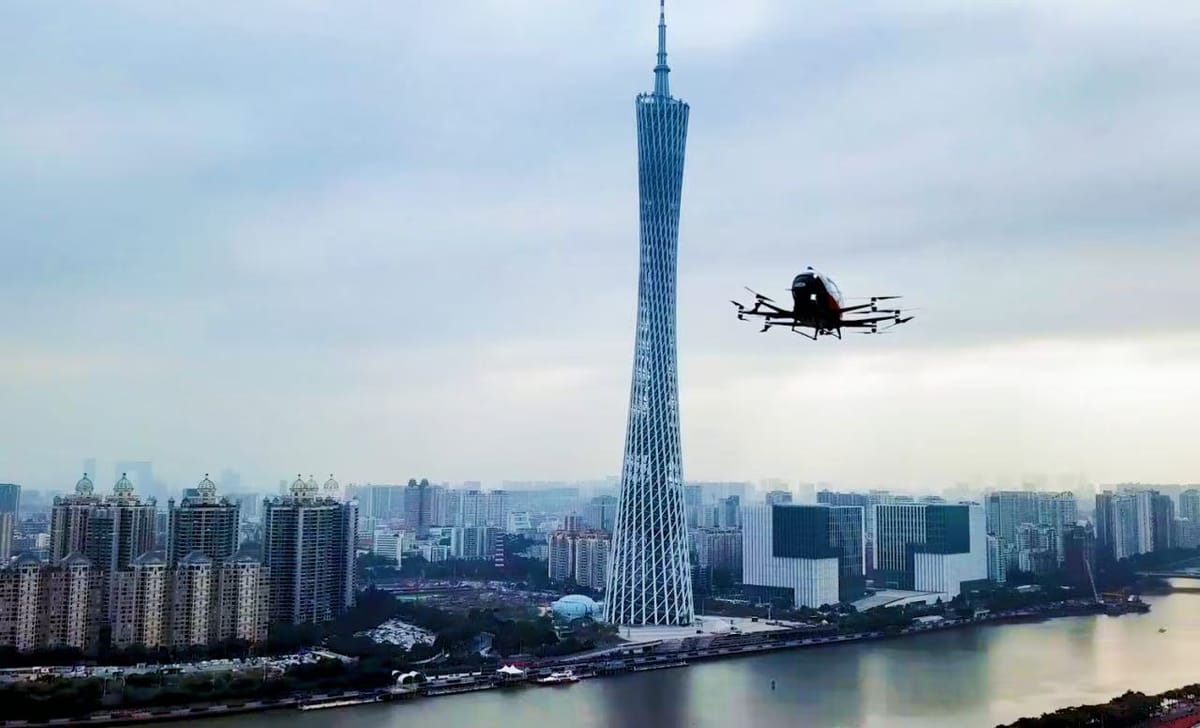
China’s low-altitude economy is rapidly transitioning from a policy-driven concept to a tangible, multi-trillion-yuan market, as commercial applications in transport, logistics, and public services begin to scale across the country.
Urban Air Mobility (UAM) is emerging as a key growth engine, with cities like Shenzhen pioneering “air taxi” services. Ticket prices for some routes have already dropped to levels competitive with high-end ground transportation, signaling a viable new mode of urban commuting. This progress is underpinned by key regulatory milestones, including the full certification of domestically produced electric vertical take-off and landing (eVTOL) aircraft.
Beyond passenger travel, drone technology is fundamentally reshaping logistics and industrial operations. E-commerce and food delivery giants are deploying drone networks to solve last-mile delivery challenges, while sectors from agriculture to emergency response are reporting significant efficiency gains and cost savings from unmanned aerial vehicles.
For investors, this shift is creating opportunities that extend beyond aircraft manufacturing to encompass critical supply chains and support systems. Significant government and private capital are now flowing into sectors like advanced batteries, airspace management software, and operational services, laying the groundwork for a comprehensive industrial ecosystem.
Redefining Urban Mobility and Logistics
China’s congested megacities are becoming a primary testing ground for the low-altitude economy’s consumer-facing potential. In Shenzhen, an eVTOL route connecting Nanshan Science and Technology Park to the Qianhai Free Trade Zone now offers single-trip fares under 100 yuan, comparable to premium ride-hailing services. The city aims to open over 500 such air routes by 2030, targeting more than 100 million passenger trips annually.
This expansion is enabled by certified aircraft like the EH216-S from EHang Holdings Limited (EHang, 亿航智能), the world's first fully certified passenger-carrying drone. Meanwhile, companies like AutoFlight (Shanghai AutoFlight Aviation Technology, 峰飞航空科技) are developing hybrid-electric models with heavy payload capacity and extended range, attracting over 200 pre-orders for its V2000CG aircraft.
In logistics, S.F. Holding Co., Ltd. (SF Express, 顺丰) has established a major drone logistics hub at Chengdu’s airport, processing over 500,000 parcels daily to cover 80% of the region's counties. In Shenzhen, Meituan (美团) “air delivery” service allows users to receive food orders in as little as 15 minutes, now accounting for 30% of orders in covered areas. This progress is supported by technological advancements, including 5G-A networks that enhance real-time monitoring and scheduling efficiency by 40%.
Expanding Into Public and Industrial Services
The utility of low-altitude aircraft extends deep into industrial and public-sector applications, where they are becoming critical tools for infrastructure management and emergency services. State Grid Corporation of China is using drones equipped with thermal imaging to inspect power lines, improving fault detection efficiency fivefold and reducing annual power outage times.
During natural disasters, these aircraft have served as vital lifelines. EHang’s drones were deployed to restore communications by creating temporary aerial base stations during severe floods in Henan province. In the medical field, Shanghai Jinhui General Aviation Co., Ltd. (上海金汇通航) provides helicopter emergency transport services, partnering with over 30 top-tier hospitals.
Precision agriculture is another rapidly growing segment. Drones from firms like DJI (大疆) and XAG Co., Ltd. (极飞科技) have achieved over 30% penetration in crop protection, reducing pesticide use by 30% and increasing yields. The efficiency gains are substantial, with projects like XAG's "Super Cotton Field" demonstrating how two operators can manage 3,000 acres, boosting output by 15%.
Forging New Profit Models
As the industry matures, a multi-faceted business model is taking shape, built on hardware, data, and integrated services.
Hardware and Certification: The sale of eVTOL aircraft and their core components—such as batteries, electric motors, and flight control systems—represents a high-barrier, high-margin segment. EHang’s EH216-S aircraft sells for approximately 2.14 million yuan with a gross margin of 55%. Advances in battery technology from suppliers like Contemporary Amperex Technology Co., Limited (CATL, 宁德时代) are expected to lower eVTOL costs by 40%, further accelerating adoption.
Data and Airspace Management: A new market is emerging for digital services that manage low-altitude airspace. Shenzhen’s SILAS system, an airspace management platform, has boosted airspace utilization by 30%. Similarly, Huawei Technologies Co., Ltd. (华为) "Low-Altitude Brain" system integrates communication and navigation infrastructure to raise facility sharing rates, generating significant service revenue.