
China’s Semiconductor Breakout: From Policy Support to Commercial Scale
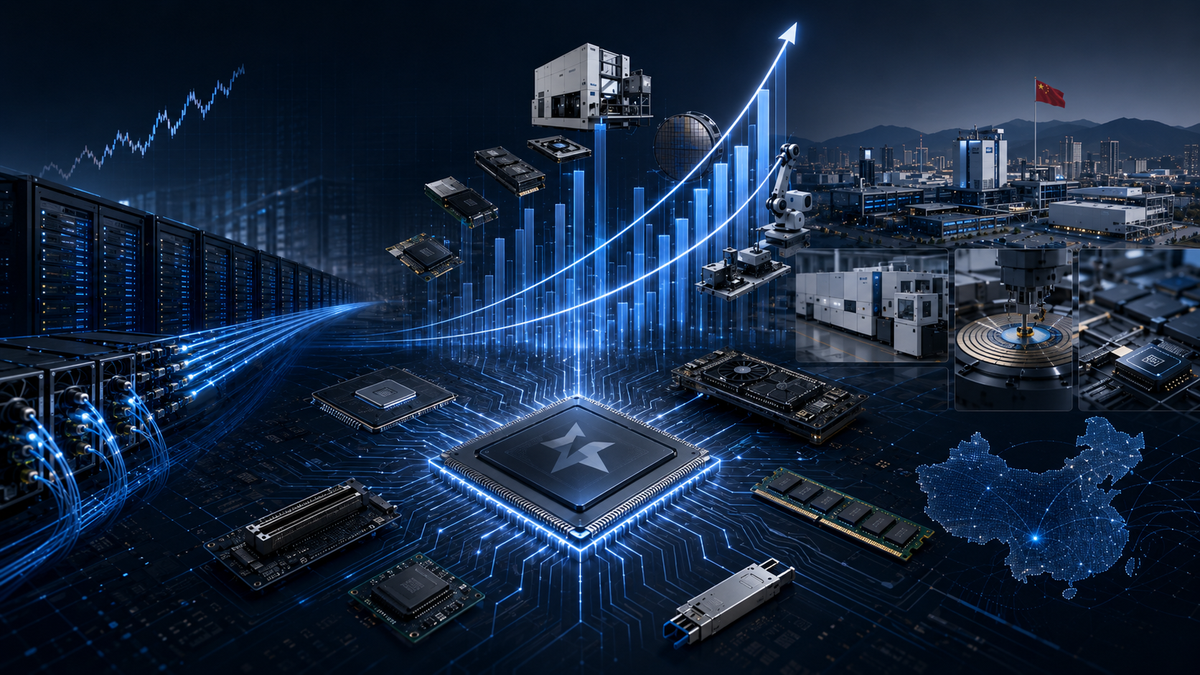
China's STAR Market semiconductor cohort is delivering its most compelling earnings cycle in years, with select companies posting revenue growth exceeding 300% in the first half of 2026 — a confluence of AI-driven compute demand, a memory industry upcycle, and Beijing's deepening domestic substitution mandate that is fundamentally reshaping the country's integrated circuit supply chain.
The preliminary earnings disclosures, released in late July, mark a decisive inflection point: domestic chip firms are no longer merely benefiting from policy tailwinds but are demonstrating measurable commercial traction — securing large-scale orders, achieving mass production on flagship products, and deploying capital market tools to consolidate supply chain gaps. For investors tracking China's technology self-reliance trajectory, the data signals that the substitution thesis is moving from aspiration to execution.
Yet beneath the headline figures lies a more nuanced story — one in which cyclical amplification, capital market dependency, and persistent structural gaps in advanced manufacturing equipment complicate what might otherwise appear to be a clean breakout narrative.
The AI Compute Pivot: From Policy Beneficiary to Commercial Contender
The most strategically significant earnings signals in this cycle come not from the memory segment — where upcycle mechanics are well understood — but from the AI compute layer, where domestic firms are making credible claims to commercial viability for the first time.
Hygon Information Technology, the most closely watched domestic CPU/DCU supplier, guided first-half 2026 net profit attributable to shareholders at RMB 1.7 billion to RMB 1.83 billion (approximately US$236 million to US$254 million), representing year-on-year growth of 41.5% to 52.3%. The range, while solid, understates the strategic significance: Haiguang's "CPU+DCU" architecture is now embedded in a growing share of domestic data center deployments as a direct architectural alternative to x86 and GPU-based compute stacks from U.S. vendors — stacks that remain subject to escalating export control pressure.
The more striking outperformance came from Moore Threads, a full-function GPU developer. The company guided H1 2026 revenue at RMB 1.65 billion to RMB 1.75 billion (US$229 million to US$243 million), representing growth of 135% to 149% year-on-year — approximately 2.4 times the prior-year period. The company attributed the acceleration to scaled commercial deployment of its MTT S5000 flagship training-and-inference GPU card, which it claims has entered mass production and reached market-leading domestic performance benchmarks.
MetaX Technology, a less widely covered but strategically significant GPU developer, appeared alongside Moore Threads at the 2026 World Artificial Intelligence Conference, unveiling a new product targeting hyper-node AI clusters — architectures designed for the most compute-intensive frontier model training workloads.
The combined public posture of these two companies at a major state-sanctioned AI showcase is analytically significant: it reflects a coordinated effort to demonstrate that domestic GPU alternatives have crossed a commercial viability threshold, not merely a laboratory one. The distinction matters enormously for investors — laboratory benchmarks have historically been used to inflate domestic chip valuations; mass production contracts and repeat enterprise orders are the metrics that validate durable revenue streams.
Memory Upcycle: When Cyclical Recovery Meets Structural Substitution
If the AI compute segment represents China's offensive push into frontier technology, the memory segment illustrates how cyclical recovery amplifies domestic substitution gains — and how the two dynamics can be difficult to disentangle.
Biwin Storage Technology issued the most dramatic preliminary guidance on the STAR Market: H1 2026 revenue of RMB 15 billion to RMB 16 billion (US$2.08 billion to US$2.22 billion), up 283% to 309% year-on-year. The magnitude of the increase reflects both the depth of the prior-year trough and the speed at which AI server buildouts have absorbed NAND and DRAM supply globally. Biwin's customer and product mix optimization — a deliberate shift toward higher-margin enterprise and AI storage solutions — suggests the revenue base is structurally more durable than a pure commodity rebound would imply. But investors should note that a significant portion of the triple-digit growth rate is a mathematical artifact of the prior downcycle: the base year was unusually depressed, and the growth rate will normalize sharply as comparables reset.
Montage Technology, the dominant domestic supplier of memory interface chips, reported a more measured but equally important earnings beat. H1 2026 net profit is guided at RMB 1.9 billion to RMB 2.1 billion (US$264 million to US$292 million), up 63.9% to 81.2% year-on-year. The growth engine is twofold: DDR5 penetration continues to rise as data center operators upgrade memory subsystems, and newer products — including MRCD/MDB chips and PCIe Retimer interconnect solutions — are generating meaningful incremental revenue.
Montage's position in the DDR5 ecosystem deserves particular analytical attention. Memory interface chips sit at the intersection of compute performance and supply chain security — they are the invisible but critical components that determine whether a memory subsystem can operate at full bandwidth. As Western and Taiwanese memory suppliers face increasing friction in serving Chinese data center customers, Montage's domestic incumbency becomes a structural moat, not merely a market share figure.
Capital Markets Mobilize: Filling Gaps or Signaling Dependency?
The earnings narrative is inseparable from an equally aggressive capital deployment cycle — and the pattern of transactions reveals both the ambition and the vulnerability of China's chip self-sufficiency push.
Shijia Photonics disclosed a private placement plan on July 16 to raise up to RMB 2.8 billion (US$389 million), directing proceeds toward high-speed optical chips, optical interconnect components, and laser chip production lines — infrastructure directly aligned with AI data center networking requirements, where silicon photonics is becoming a critical bottleneck.
One day later, Maxio Technology received Shanghai Stock Exchange approval for a RMB 2.062 billion (US$286 million) placement targeting PCIe Gen6/Gen7 SSD controllers and UFS 5.0 embedded storage controllers — a direct bet on the next generation of storage interface standards before Western incumbents have fully locked in their own roadmaps.
Piotech, a thin-film deposition equipment maker, completed a RMB 4.6 billion (US$639 million) placement in July, while Huafeng Test & Control issued RMB 750 million (US$104 million) in convertible bonds — both earmarked for equipment technology upgrades and capacity expansion in the semiconductor tools segment, where domestic substitution remains the least advanced and the stakes are highest.
The M&A activity carries equal strategic weight. On July 11, Tuojing Technology announced a plan to acquire 100% of Wuxi Shangji via a share-plus-cash transaction to acquire PVD and dry etch capabilities — filling critical gaps in its thin-film process portfolio and enabling one-stop procurement for domestic fab customers. On June 29, Galaxy Microelectronics announced the acquisition of Hunteck Semiconductor, a move that extends its product range from low-voltage small-signal devices into medium-to-high voltage power devices, repositioning the company from a discrete device manufacturer to a full-category power device platform.
The sheer volume of concurrent refinancing activity, while strategically necessary, also sends a cautionary signal: many STAR Market chip firms remain significantly cash-constrained relative to the investment cycle required to reach global competitiveness in advanced nodes. The capital market is being asked to bridge a gap that internal cash generation cannot yet close — a dynamic that introduces dilution risk for existing shareholders and execution risk if fundraising conditions deteriorate.
Order Momentum and State Validation: The Commercial Credibility Question
VeriSilicon, the leading domestic semiconductor IP and custom chip design services provider, disclosed that recently signed orders totaled RMB 6 billion (US$833 million), bringing cumulative new orders since the start of 2026 to nearly RMB 15 billion (US$2.08 billion). The order concentration in AI compute and data processing reflects both the scale of domestic AI infrastructure investment and the degree to which Chinese hyperscalers and system integrators are routing custom silicon design work to domestic suppliers — a shift that would have been unthinkable five years ago, when U.S. IP vendors dominated the custom chip design ecosystem.
On the technology recognition front, three STAR Market analog chip firms — Joulwatt Technology, Chipsea Technologies, and Silex Microsystems China — jointly received the 2025 National Science and Technology Progress Award (Second Class) for their work on high-precision, low-power analog front-end integrated circuit technology. State-level science prizes in China carry both reputational and procurement implications, often accelerating adoption in government-adjacent infrastructure projects — a procurement channel that is effectively closed to foreign suppliers.
Structural Implications: Three Risks That the Headlines Obscure
The H1 2026 data collectively illustrate a semiconductor sector that has moved beyond the early substitution phase — characterized by low-end component replacement — into a more complex second phase involving advanced compute chips, next-generation storage interfaces, and critical manufacturing equipment. This transition is harder to execute but carries substantially higher strategic and commercial value. Three structural dynamics, however, warrant close monitoring.
First, the low-base distortion. Moore Threads' 2.4x revenue surge and Biwin's 3x revenue jump are impressive, but they partly reflect a low base from a downcycle year. Sustaining that trajectory requires continued AI infrastructure capital expenditure at current levels — a demand assumption that is itself dependent on the pace of large language model deployment, data center construction timelines, and the willingness of Chinese technology companies to maintain aggressive AI capex in an uncertain macroeconomic environment.
Second, the equipment gap — the most underdeveloped link in the chain. Tuojing's acquisition of PVD and etch capabilities and its RMB 4.6 billion capacity expansion underscore that domestic semiconductor equipment — particularly for leading-edge processes at 7nm and below — remains the most structurally underdeveloped segment of China's chip supply chain. Without credible domestic alternatives to ASML's extreme ultraviolet lithography systems and the broader ecosystem of advanced process tools, the ceiling on China's self-sufficiency in cutting-edge chips remains firmly in place, regardless of how well fabless design firms perform.
Third, the capital market dependency loop. The volume of concurrent refinancing activity signals a structural reliance on public equity and debt markets to fund an investment cycle that exceeds what current operating cash flows can support. This creates a feedback loop: strong earnings attract capital, capital funds capacity expansion, capacity expansion is necessary to win larger orders, and larger orders are required to justify current valuations. The loop is self-reinforcing in a bull cycle — but fragile in a downturn.
Investment Thesis: A Rare Alignment, With Strings Attached
For investors, the STAR Market semiconductor cohort in H1 2026 presents a rare alignment of cyclical recovery and structural substitution — a combination that has historically produced multi-year outperformance in comparable technology upgrade cycles globally.
The risk is that this alignment is partly a function of external pressure — U.S. export controls forcing domestic procurement — rather than purely internal capability, and that the durability of the demand base depends on factors that extend well beyond domestic control: AI investment cycles, geopolitical trade policy trajectories, and global memory pricing dynamics that are set in Seoul and Tokyo as much as in Beijing.
The most defensible positions in this environment are companies with genuine technology differentiation — Montage in memory interface chips, Haiguang in compute architecture, VeriSilicon in IP and design services — rather than those whose growth is primarily a function of cyclical timing or policy-driven procurement mandates. The distinction between durable competitive advantage and policy-induced demand will define which of today's STAR Market outperformers remain relevant when the next downcycle arrives.
Related Coverage:
Moore Threads Leads China’s Chip IPO Wave with Record US$1.1 Billion STAR Market Listing