
Unitree’s As2-W Pushes Industrial Robotics Beyond Humanoids
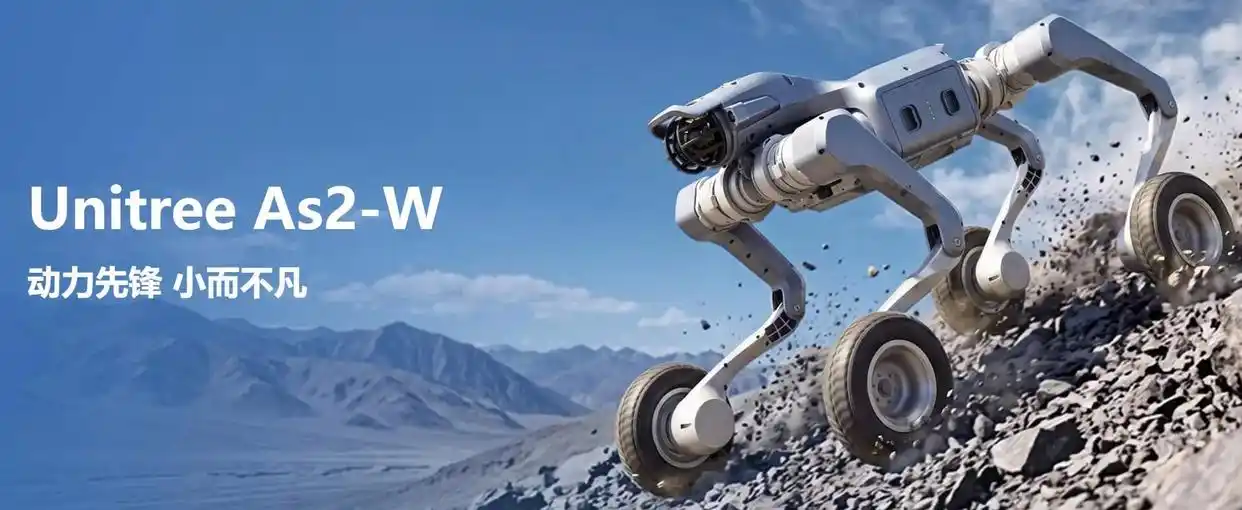
Unitree Robotics has unveiled the As2-W, a hybrid wheel-legged quadruped capable of carrying 180 kilograms—seven times its own body weight—marking a decisive shift in China's embodied-AI sector from laboratory spectacle to deployable industrial asset.
The July 24 launch arrives at a pivotal moment: Unitree completed its STAR Market IPO registration on July 2, 2026, in a record 104 days from acceptance to approval, raising RMB 4.202 billion (approximately US$583 million) at a minimum implied market capitalization of RMB 42 billion (US$5.83 billion). The compressed regulatory timeline signals that China's securities authorities are actively accelerating hard-technology listings, providing a visible policy tailwind for the broader robotics supply chain.
Initial market reaction has focused less on the IPO mechanics and more on what the As2-W's specifications imply for commercial addressable markets—particularly industrial inspection, last-mile logistics, and emergency response, three segments where human labor faces structural cost and safety constraints.
Wheel-Legged Fusion Solves a Core Engineering Trade-Off
The As2-W extends Unitree's February 2026 quadruped, the As2, by adding four active 7-inch wheels at each leg terminus, bringing the joint motor count from 12 to 16. The result is a machine that operates in wheeled mode on flat surfaces—reaching a top speed of 6 meters per second (21.6 km/h)—then autonomously switches to legged locomotion to surmount 80-centimeter platforms or 45-degree inclines.
The engineering significance is straightforward: wheeled robots offer speed and energy efficiency on even terrain but fail at obstacles; pure legged robots navigate complex terrain but sacrifice velocity. Hybrid architectures have existed in research settings for years, but the As2-W's payload-to-weight ratio of 7.2x (180kg demonstrated load on a 25kg chassis) and a continuous-motion range of more than 30 kilometers unloaded represent a step-change in commercial viability.
Underpinning the motion control is what Unitree calls its Pre-trained RL Model 6.0—a reinforcement-learning framework that trains locomotion policies in simulation before deployment on physical hardware, analogous to the thousands of hours logged in flight simulators before a pilot boards an actual aircraft. The ISS 3.0 intelligent lateral-follow system adds centimeter-level positioning for close-proximity human-robot teaming.
Operating parameters include an IP54 ingress-protection rating and a working temperature range of -20°C to 55°C, making the unit functional across outdoor industrial environments year-round in most Chinese geographies.
Three Commercial Scenarios Drive the Revenue Thesis
Unitree positions the As2-W as a "heavy-duty companion," but the commercially meaningful use cases are industrial rather than recreational.
Industrial inspection is the nearest-term opportunity. Substations, chemical plants, and underground utility corridors demand frequent monitoring in environments that impose significant personal protective equipment costs and physical risk on human workers. A robot with IP54 protection, stair-climbing capability, and wireless data uplink eliminates per-inspection labor costs and compresses inspection cycles. China's State Grid alone operates hundreds of thousands of substations nationally.
Last-mile logistics is structurally attractive but faces a longer regulatory runway. The "final 100 meters" problem—navigating stairwells in residential buildings without elevators, or unpaved rural paths—remains one of the highest unit-cost segments in Chinese e-commerce fulfillment. The As2-W's 180kg payload and 16-kilometer loaded range are technically sufficient for multi-parcel delivery runs. However, deployment at scale requires resolution of road-rights and municipal licensing frameworks that are still being drafted at the provincial level.
Emergency response represents a high-visibility, government-procurement-driven channel. In earthquake or flood scenarios where human entry is prohibited, a robot capable of carrying 180kg of rescue equipment across rubble fields addresses a capability gap that no wheeled drone or conventional ground vehicle can fill.
Market Size Remains Small but Acceleration Is Measurable
According to GIR Research data cited in industry analysis, the global wheel-legged robot market was valued at US$255 million in 2025, with a projected compound annual growth rate of 13.1% through 2032—implying a market of roughly US$600 million by the end of the forecast period. China is identified as the fastest-growing regional market.
The aggregate figure appears modest in isolation, but two contextual data points reframe it. First, embodied-AI sector financing in China grew 182.9% year-on-year in the first quarter of 2026, reflecting investor conviction that commercial scaling is imminent rather than speculative. Second, China's Ministry of Industry and Information Technology has projected humanoid robot production could exceed 100,000 units in 2026—a volume threshold that, if reached, would validate the manufacturing cost curves required for broader robotics adoption.
Supply Chain Map: Vertical Integration at the Core, Ecosystem at the Margins
Unitree's competitive moat rests partly on vertical integration. Co-founder Chen Li has stated publicly that the company's upstream suppliers are limited to raw materials such as copper wire and magnets, with joint motors, reducers, and encoders developed in-house. This architecture insulates Unitree from component supply shocks and preserves gross margin, a structural advantage that pure-assembly competitors cannot easily replicate.
Nevertheless, the broader supply chain presents investment exposure across multiple tiers.
At the component level, Moons' Industries holds an exclusive supply position for the hollow-cup motors used in Unitree's dexterous hand products—a relationship that illustrates how niche component suppliers can secure disproportionate leverage within a single OEM's bill of materials. Analog chip suppliers, power semiconductor vendors, and lithium battery manufacturers serving the robotics sector benefit from volume growth regardless of which robot platform ultimately wins market share, a dynamic that mirrors the battery and semiconductor supply chains that outperformed pure-play EV assemblers during China's electric vehicle expansion after 2020.
At the systems integration layer, Shenhao Technology has signed a strategic cooperation agreement with Unitree targeting industrial inspection deployments—positioning it as a downstream beneficiary of As2-W adoption in the utility and petrochemical sectors.
At the competing OEM level, DEEP Robotics displayed its Lynx M20S wheel-legged robot at the World Artificial Intelligence Conference (WAIC) 2026, confirming that the wheel-legged form factor is attracting multiple serious entrants. Competitive pressure at the platform level typically accelerates component demand rather than suppressing it, reinforcing the supply-chain investment thesis.
IPO Timeline Establishes a Benchmark for Hard-Tech Listings
Unitree's 104-day STAR Market approval process—from acceptance on March 20, 2026, to registration effectiveness on July 2, 2026—is the fastest on record for the exchange. The data point carries policy significance: it suggests that China's China Securities Regulatory Commission is prepared to compress review timelines for companies demonstrating tangible manufacturing capability and revenue, rather than pre-revenue concept pitches.
For the broader robotics sector, this creates a clearer path to domestic capital market access at earlier stages of commercial maturity, potentially reducing reliance on private venture rounds and increasing the pool of publicly traded proxies available to institutional investors.
Unitree has not yet disclosed a public offering price or trading date as of the time of publication. Pricing will be a key indicator of how domestic institutional investors are marking the sector's earnings multiple.
Analyst Takeaway: Productivity, Not Performance, Is the Differentiator
The As2-W's specifications—180kg payload, 30km unloaded range, 6 m/s top speed, IP54 protection—are individually impressive but collectively represent something more significant: a robot designed to replace labor costs rather than generate media coverage. That distinction matters for investors attempting to separate durable commercial value from cyclical hype in a sector that has attracted substantial speculative capital in 2025 and 2026.
The wheel-legged hybrid architecture addresses the terrain-versatility gap that has historically limited quadruped deployment to controlled environments. If Unitree can price the As2-W within the payback-period tolerance of industrial buyers—typically two to three years in Chinese manufacturing and utility sectors—the unit economics for mass adoption become viable without requiring further technology breakthroughs.
The pricing decision, expected to be announced in coming weeks, will be the single most important data point for assessing near-term commercial traction.
Related Coverage:
Unitree Clears China's Fastest STAR Market Review, Eyes RMB 4.2 Billion War Chest