
Unitree Clears China's Fastest STAR Market Review, Eyes RMB 4.2 Billion War Chest
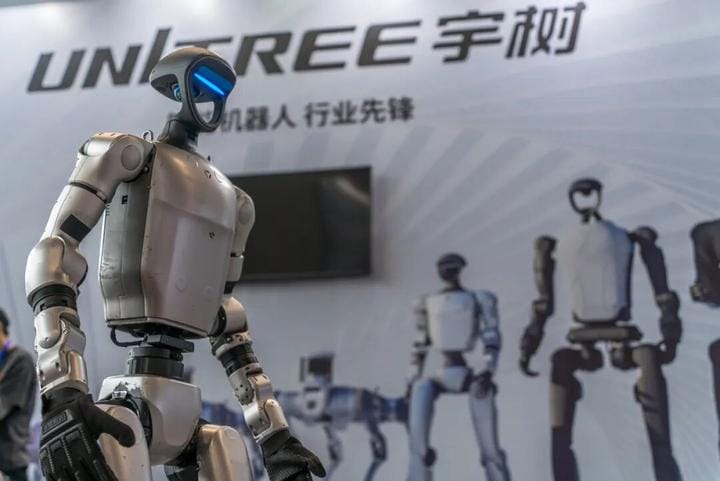
The only pure-play humanoid robot manufacturer on China's A-share market is now fully registered for a STAR Market IPO — but the harder question is whether RMB 4.2 billion (US$583 million) is enough to hold off Tesla, NVIDIA-backed rivals, and a domestic field of 140-plus competitors.
Unitree Robotics received formal registration approval from the China Securities Regulatory Commission on July 2, 2026, with the Shanghai Stock Exchange updating the IPO status to "registration effective" on July 6. The 104-day sprint from application acceptance to green light — with the SSE completing its own review in just 73 days — marks one of the fastest pre-approval cycles under the STAR Market's expedited review mechanism. Market participants are pricing the Hangzhou-based company's post-listing valuation at approximately RMB 50 billion (US$6.94 billion), a figure that would make it the benchmark equity instrument for China's entire embodied-intelligence sector.
The listing arrives at an inflection point. Unitree's revenue surged from RMB 159 million (US$22.1 million) in 2023 to RMB 1.71 billion (US$237.5 million) in 2025 — a tenfold jump in two years — while the company swung from a net loss to a net profit of RMB 288 million (US$40 million) in 2025. Those numbers give it a credibility that most humanoid-robot peers, still burning cash in pre-revenue stages, cannot match. The real test, however, begins the moment trading opens.
Revenue Acceleration Masks a Structural Concentration Risk
Unitree's commercial traction rests on two pillars that are simultaneously its greatest strength and its most exposed flank. The company commands more than 60% of global quadruped robot shipments as of 2023, with overseas revenue accounting for roughly 40–50% of total sales. In 2025 alone, it shipped more than 5,500 humanoid units and has cumulatively sold over 30,000 quadruped robots.
The price architecture is deliberately disruptive. The Go2 quadruped starts at RMB 9,997 (US$1,388); the R1 humanoid at RMB 29,900 (US$4,153); the G1 humanoid intelligence platform at RMB 99,000 (US$13,750). Two years ago, a six-figure renminbi entry point was considered the floor for humanoid robotics. Unitree has effectively demolished that assumption.
Yet concentration risk is real. The company's IPO prospectus earmarks the RMB 4.2 billion proceeds across three buckets: robot model R&D and embodied-intelligence training, hardware platform and new-product development, and construction of a new manufacturing base. In plain terms: smarter brains, better bodies, lower unit costs. What the prospectus does not resolve is the path-dependency problem — Unitree's margin profile is structurally thin precisely because its competitive moat is price, and defending that moat requires perpetual cost reduction even as rivals close the gap.
Global Pilots Signal Commercial Readiness — But Scale Remains Unproven
The most commercially significant data point in Unitree's pre-IPO disclosures is not a revenue figure but a deployment contract. Since May 2026, Japan Airlines has been running G1 humanoid robots at Tokyo Haneda Airport for baggage handling, cargo transfer, and conveyor coordination, with the pilot scheduled to run through 2028. For an industry where "proof of concept" and "commercial deployment" are frequently conflated, a live airport operation under one of Asia's largest carriers is a meaningful distinction.
The strategic logic of the Haneda pilot extends beyond aviation. Airports represent one of the most demanding operational environments for humanoid robots — variable payloads, dynamic human traffic, strict safety protocols. Success there provides a replicable template for logistics hubs, warehousing, and industrial inspection, the exact verticals Unitree has cited as near-term targets alongside existing reference accounts at BYD factory lines and State Grid Corporation inspection operations.
The gap between pilot and scaled contract, however, is where humanoid robotics companies have historically stumbled. Product stability, after-sales service infrastructure, and customization capability matter as much as unit economics once a buyer moves from evaluation to procurement.
NVIDIA Partnership Raises the Intelligence Ceiling on H2 Plus
In June 2026, Unitree unveiled the H2 Plus, its highest-specification humanoid platform to date, built on NVIDIA's Jetson Thor compute module and the Isaac GR00T foundation model framework. The integration is strategically significant for two reasons. First, it ties Unitree's hardware roadmap to the dominant compute infrastructure for embodied AI training, reducing the risk of being stranded on a proprietary stack. Second, it positions Unitree as a data-generation node within NVIDIA's broader GR00T ecosystem — a relationship that could prove more valuable than the hardware margin itself.
China Academy of Information and Communications Technology AI Research Institute Director Wei Kai has noted publicly that the single largest bottleneck for humanoid robot intelligence is the severe shortage of manipulation-task training data. The H2 Plus's simulation-to-real training pipeline directly addresses this constraint, but the distance from laboratory benchmark to factory-floor reliability remains, in his assessment, considerably greater than industry optimism suggests.
Competitive Divergence Sharpens as the Market Stratifies
Unitree's IPO crystallizes a strategic fork that is now visible across China's humanoid-robot landscape. UBTECH Robotics, listed on the Hong Kong Stock Exchange, generated its largest 2025 revenue segment from industrial manufacturing deployments — a commercialization logic Unitree shares — but pivoted sharply in June 2026 by launching the "YouWorld U1" full-size hyper-bionic humanoid series targeting family companionship. Pricing runs from RMB 119,800 (US$16,639) for a half-body Lite version to RMB 990,000 (US$137,500) for the Ultra male variant, with UBTECH reporting over 13,000 cross-channel pre-orders.
The consumer-emotional segment is also attracting lower-cost entrants. Chunshuitang Health Technologies has released a companion bionic robot priced at approximately RMB 15,000 (US$2,083), with a male companion variant and an elderly-care model planned for Q4 2026 — positioning it as a budget alternative to UBTECH's premium lineup.
On the industrial side, Fourier Intelligence brings its GRx series alongside a mature rehabilitation-robot cash-flow business. AGIBOT and EngineAI are expanding manufacturing capacity. Internationally, Tesla's Optimus Gen 2 — not yet in mass production but with Elon Musk publicly anchoring the price target at approximately US$30,000 — lands squarely on top of Unitree's R1 price point. Norway's 1X NEO has begun accepting pre-orders targeting home deployment.
The price compression that Unitree engineered as an offensive weapon is becoming a defensive liability as the competitive band narrows.
Three Execution Tests Will Define the Post-IPO Narrative
Analysts tracking the humanoid-robot sector broadly agree that Unitree's post-listing trajectory hinges on three variables.
Finding a second category anchor beyond quadrupeds and research humanoids. The quadruped business is a proven global franchise. The humanoid business, despite the Haneda pilot and factory references, has not yet demonstrated the repeatable, scalable contract structure that converts shipment volume into durable revenue.
Sustaining price leadership while improving capability. The current price gap between Unitree's R1 at RMB 29,900 and UBTECH's U1 Lite at RMB 119,800 is substantial but not permanent. As UBTECH scales production and Tesla approaches mass manufacturing, Unitree must simultaneously reduce bill-of-materials cost and close the performance gap — two objectives that pull capital in opposite directions.
Converting the NVIDIA partnership into a proprietary data moat. The H2 Plus's GR00T integration is the right architectural bet, but embodied-intelligence models require operational data at scale to differentiate. Unitree's advantage here is cumulative: every unit deployed generates manipulation data that competitors cannot easily replicate. The risk is timing — if the market consolidates before Unitree's data flywheel reaches critical mass, the moat may never fully form.
According to CCID Media's 2025 Humanoid Robot Market Research Report, China's humanoid-robot market reached RMB 1.55 billion (US$215 million) in 2025, representing 53.8% of global market value, with domestic manufacturers accounting for 84.7% of global unit shipments across 140-plus whole-robot companies. More than half of China's provincial governments included embodied intelligence and robotics in their 2026 government work reports. Industry consensus projects the market expanding from its current billion-renminbi scale to a trillion-renminbi scale within a decade.
The registration approval is the entry ticket. The capital allocation decisions made with RMB 4.2 billion over the next 18 to 24 months will determine whether Unitree writes the category's defining chapter — or merely its opening one.
Related Coverage:
Unitree's IPO Review Signals Robotics as the Next Semiconductor Growth Engine