
UBTECH's 13,000-Unit Pre-Order Surge Exposes a Deeper Delivery and Cash-Flow Crisis
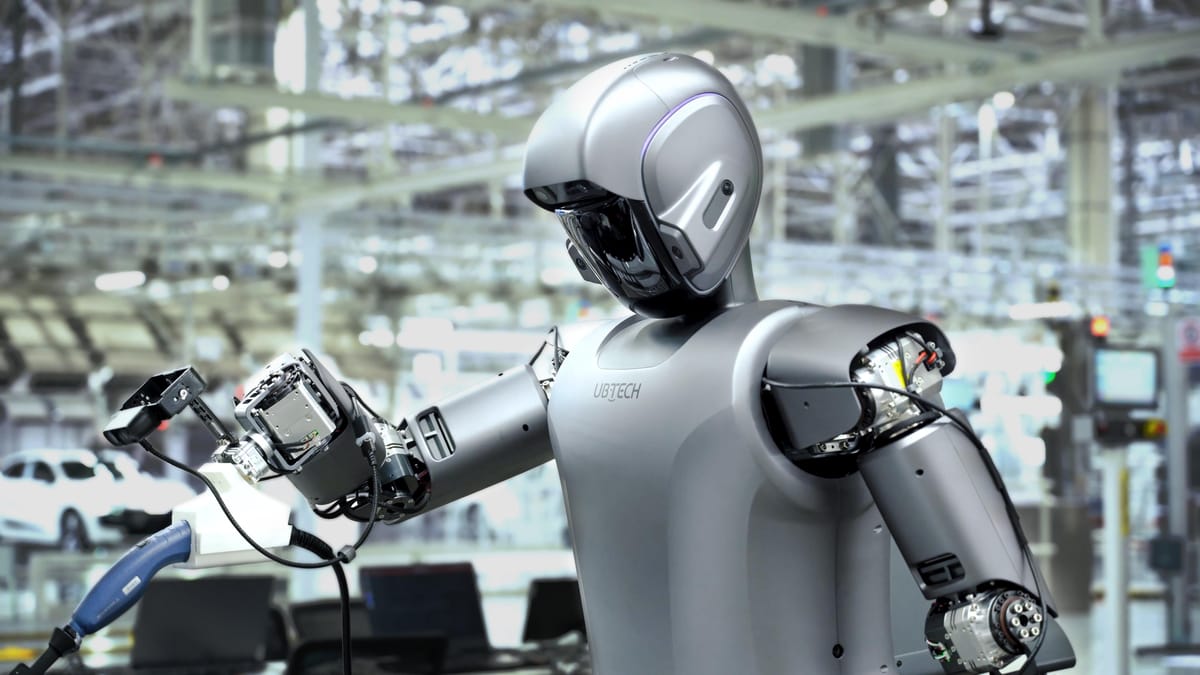
A RMB 40 million (US$5.6 million) deposit pool, a two-year production backlog, and a stock that swung 70% in six months: UBTECH Robotics (9880.HK) is simultaneously running two high-stakes experiments—and capital markets are not yet convinced it can win either.
The Hong Kong-listed humanoid robotics pioneer shed 10.42% on July 6, 2026, closing at HK$97.55 after touching an intraday low of HK$97.05, erasing more than half of the 17.6% rally it had posted just three sessions earlier. That prior surge was itself triggered by the June 30 launch of the U1 consumer humanoid series, which drew 13,361 pre-orders on JD.com. The violent reversal—a textbook inverted-V on the daily chart—crystallized a market consensus that the headline order number conceals as many risks as it reveals.
The split verdict reflects a structural tension embedded in UBTECH's business model: revenue is growing at 53% annually, gross margins are expanding, and humanoid robot shipments have exploded from near-zero to over 1,000 units. Yet operating cash flow remains deeply negative, receivables are ballooning, and the company's balance sheet is being sustained by dilutive equity issuances rather than commercial cash generation.
Refundable Deposits Undercut the Revenue Narrative
The 13,361 pre-orders for the U1 series carry a RMB 3,000 deposit per unit—fully refundable before shipment. At that deposit rate, actual cash collected amounts to roughly RMB 40 million (US$5.6 million). The headline revenue potential, calculated at the U1 Pro's list price of RMB 169,800 (US$23,583), reaches approximately RMB 2.27 billion (US$315 million)—exceeding UBTECH's entire 2025 full-year revenue of RMB 2.001 billion (US$278 million). However, that figure is entirely contingent on final payment conversion rates, a metric that falls outside Hong Kong Stock Exchange mandatory disclosure requirements.
Market participants flagged the discrepancy immediately. On the first trading day after the launch event (July 2), the stock dropped 9.92% to HK$92.60 before the subsequent three-day whipsaw. On-site media reported that the flagship U1 Ultra—priced at RMB 990,000 (US$137,500)—was displayed only as a static exhibit, with its advertised walking capability never demonstrated. The accessible U1 Pro units exhibited facial expression latency and conversational stuttering during live interactions. These observations circulated rapidly across Chinese social media platforms, providing a real-time stress test of the product's readiness.
The deposit structure creates an asymmetric information problem for investors: UBTECH can report order volume without disclosing cancellation rates, and the company is under no legal obligation to do so until final delivery. Three milestone dates now define the near-term risk calendar: July 15, when the companion app "U-World" goes live; July 16, when the final payment window opens and true conversion rates begin to emerge; and September 16, when first deliveries are scheduled to commence.
Production Capacity Arithmetic Signals a Multi-Year Execution Risk
The delivery math is unforgiving. UBTECH's 2025 annual report discloses annualized production capacity for full-size humanoid robots at 6,000 units. Against 13,361 confirmed pre-orders—assuming zero cancellations—full fulfillment would require more than two years of maximum-throughput production. UBTECH Vice President Jiao Jichao acknowledged the challenge directly at the launch event: "Mass production at the scale of 10,000-plus units is an enormous challenge."
Founder and CEO Zhou Jian has set a 2026 target of 50,000 units of bionic robot production capacity, a nearly ten-fold scale-up from current levels. The Walker S2—UBTECH's industrial humanoid—achieved small-batch production of 1,079 units in 2025, representing a 35,867% year-on-year increase. Clients include BYD, Dongfeng Liuzhou Motor, Geely, and FAW-Volkswagen. The jump from 1,000 units to 50,000 units is not a linear extrapolation; it requires supply chain re-engineering, component sourcing at scale, and manufacturing process validation that typically takes years, not months.
The U1's hardware complexity compounds the challenge. The consumer robot carries 88 degrees of freedom and 19 head servos, with silicone biometric skin. Each head unit alone contains 2,000 to 3,000 components—equivalent to 60-70% of the total bill of materials for an entire Walker S2 industrial unit. Eyelashes and eyebrows are still manually implanted. Until high-volume assembly processes are validated, each incremental order amplifies supply chain and quality-control risk rather than generating operational leverage.
Humanoid Revenue Surges 2,204%, But Cash Flow Tells a Different Story
UBTECH's 2025 financials contain a genuine structural inflection point that deserves separation from the U1 noise. Full-size embodied-intelligence humanoid robot revenue reached RMB 820 million (US$113.9 million), a 2,203.7% year-on-year increase, lifting the segment's share of total revenue from 2.7% in 2024 to 41.1%—making it the company's single largest revenue contributor for the first time. Gross margin on the humanoid segment exceeded 50%, contributing RMB 448 million (US$62.2 million) in gross profit and pushing the company-wide gross margin from 28.7% to 37.7%.
Total revenue reached RMB 2.001 billion (US$278 million), up 53.3%. Net loss narrowed 31.9% to RMB 789 million (US$109.6 million). On an income statement basis, the trajectory is unambiguously improving.
The cash flow statement tells a more cautious story. Net operating cash outflow in 2025 was RMB 784 million (US$108.9 million), marginally better than the RMB 884 million (US$122.8 million) outflow in 2024—a less than 11% improvement despite 53% revenue growth. The company is not yet converting revenue growth into cash generation. Accounts receivable expanded from RMB 1.31 billion to RMB 1.84 billion (US$255.6 million), with overdue receivables aged beyond 12 months exceeding RMB 780 million (US$108.3 million)—more than 40% of the total. The annual report notes, with deliberate understatement, "delayed payments from certain government-related clients," pointing to a structural mismatch between revenue recognition and actual cash collection in a customer base dominated by state-owned enterprises and government entities.
UBTECH ended 2025 with RMB 4.888 billion (US$679 million) in cash. However, approximately HK$6 billion of that balance was raised through three rounds of H-share placements during the year—equity dilution purchased at a discount, not operational cash generation. The company's ability to self-fund remains unproven.
Competing Against Unitree's Profitability and AGIBOT's Scale Velocity
The competitive context sharpens the valuation debate. Unitree Robotics, which has not yet listed, reported 2025 revenue of RMB 1.708 billion (US$237.2 million) with adjusted net profit of approximately RMB 600 million (US$83.3 million) and gross margins approaching 60%. UBTECH, with comparable revenue, posted a net loss of RMB 789 million. The divergence in profitability trajectories is driving a divergence in valuation logic: Unitree's pre-IPO valuation is anchored at approximately RMB 42 billion (US$5.83 billion) on earnings multiples, while UBTECH's market capitalization of approximately HK$50 billion (RMB 46 billion, or US$6.39 billion) remains narrative-dependent.
AGIBOT added further competitive pressure in March 2026, when its 10,000th Yuanzheng A3 general-purpose humanoid rolled off the production line—a doubling from 5,000 units accomplished in just over three months. Tesla's Optimus mass-production timeline is now public. Unitree opened its first direct retail store in Beijing's Wangfujing district. Changan Automobile announced the formation of a dedicated robotics subsidiary. The sector has decisively shifted from technology demonstration to competitive manufacturing scale-up.
UBTECH's strategic response operates on two tracks. Upstream integration: the company paid RMB 130 million (US$18.1 million) to increase its stake in Wuxi Youqi and RMB 1.665 billion (US$231.3 million) to acquire Fenglong Electric, consolidating precision gear and transmission component capacity. Intellectual property defense: UBTECH holds 2,985 granted patents—including 1,742 invention patents—and leads multiple national standards, a portfolio that dwarfs Unitree's 262 patents. The full-stack proprietary development model, covering servo actuators, integrated joints, and motion control, represents 14 years of accumulated engineering depth.
The strategic risk is that patent breadth becomes less decisive as the industry transitions from "can it be built" to "can it be built cheaply and at volume." Manufacturing efficiency, cost discipline, and supply chain resilience—areas where Unitree's price-performance orientation and AGIBOT 's compressed supply chain geography provide structural advantages—may carry more weight in the next competitive phase than IP portfolio size.
Three-Arrow Strategy Stretches Resources Across an Unproven Frontier
Zhou Jian's "three-arrow" framework—Walker S (industrial), Walker C (commercial service), and U1 (home companion)—represents a deliberate bet on parallel market development. Zhou has disclosed that he personally allocates approximately 50% of his attention to industrial and commercial applications and 50% to the home companion segment. With the core business not yet profitable, this resource allocation carries meaningful strategic risk.
The U1 product definition crystallizes the tension. With 88 degrees of freedom, biometric silicone skin, and an emotional large language model, the U1 is engineered as a high-fidelity companion device. Zhou acknowledged that physical task capabilities—laundry, cooking—remain a future roadmap item. Consumers paying between RMB 120,000 and RMB 990,000 (US$16,667 to US$137,500) are purchasing a conversational, expressive, customizable companion, not a domestic service robot. Whether that value proposition commands the price points on offer—and whether it can clear the "uncanny valley" threshold that has historically constrained consumer acceptance of humanoid robots—remains the central unanswered question.
The July 16 final payment deadline will provide the first hard data point. A high conversion rate would validate the consumer thesis and potentially reset the stock's narrative anchor. A wave of cancellations would confirm the market's skepticism and intensify pressure on a company that is burning through equity-funded cash reserves while racing to achieve manufacturing scale in one of the most capital-intensive segments of the global technology industry.
Related Coverage:
UBTECH’s Scarcity Premium Evaporates as Citi Slashes Target 34% Ahead of Unitree IPO