
China's Smartphone Makers Face a Pricing Trap as Apple Tightens Its Grip on the High End
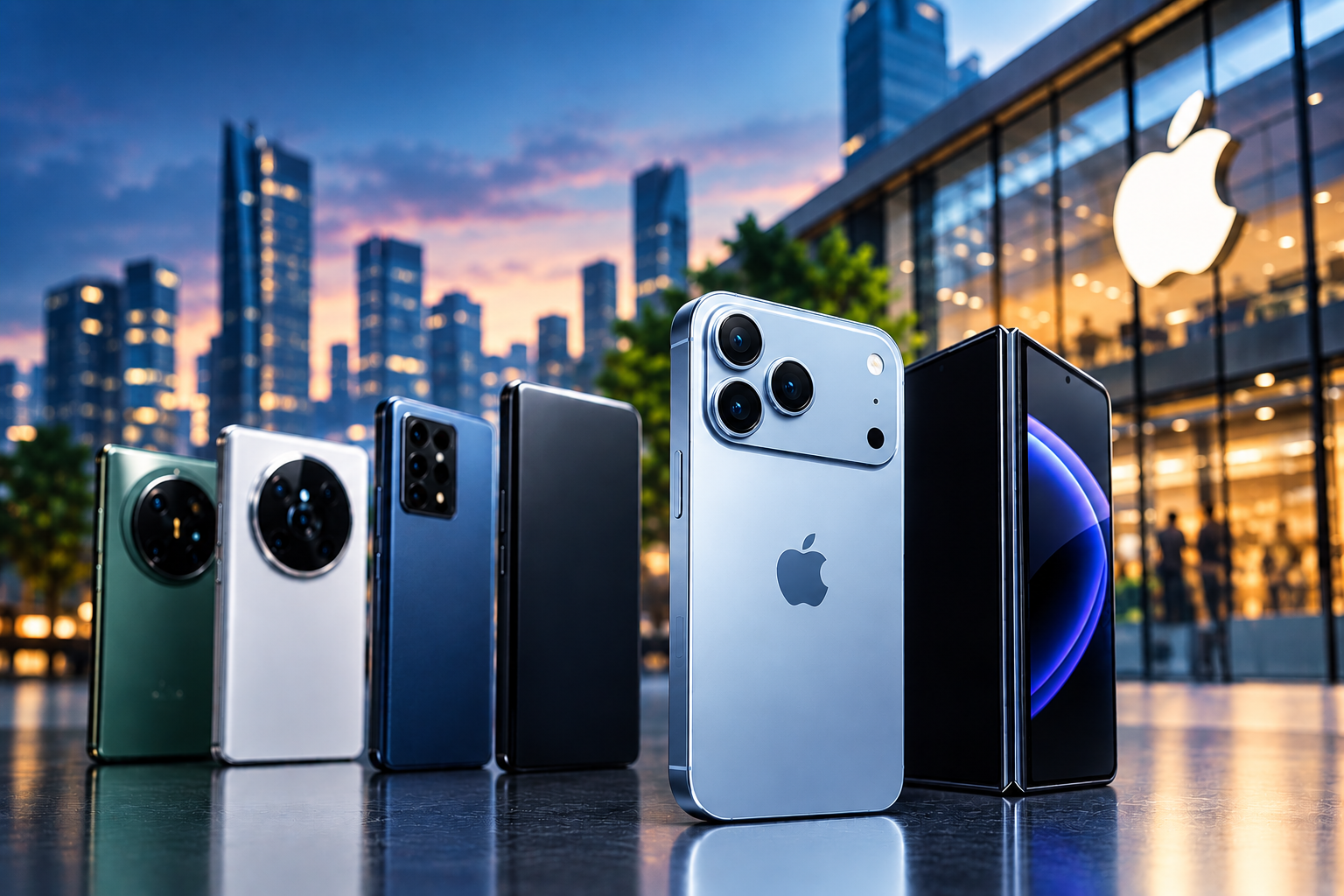
Apple's iPhone 18 Pro series outsold its predecessor by 30% on launch day while Android flagships cratered — exposing a structural contradiction at the heart of China's premium smartphone push: manufacturers are raising prices faster than they are building brand equity.
The September 2026 launch cycle delivered a brutal verdict. A leading domestic Android brand — whose identity has been withheld pending confirmation — saw its flagship series post first-day sales equivalent to just 30% of the prior generation, a collapse of roughly 70%. OPPO Find X10 managed only 40% of the Find X9's opening-day volume. Meanwhile, Apple Inc.'s iPhone 18 Pro series moved approximately 322,800 units on day one, 130% of the iPhone 17 Pro's comparable figure, and claimed 31.3% of China's weekly handset market in Week 38 (Sept. 14–20), leading the second-place brand by 12.3 percentage points.
The divergence is not coincidental. It is the direct consequence of a pricing strategy that has closed the gap between domestic flagships and Apple — without closing the gap in perceived value.
Price Hikes Converge at the Top, Leaving Consumers Nowhere to Hide
September's launch calendar was unusually dense. Huawei and Xiaomi staged a deliberate same-day collision: the Huawei Mate XT2, priced up to RMB 24,999 (US$3,472), launched alongside the Xiaomi 18 Fold at RMB 14,999 (US$2,083) top configuration. Apple then entered with the iPhone 18 Pro lineup and its first foldable, the iPhone Duo, whose 2TB variant carries a RMB 26,499 (US$3,680) price tag.
The straight-bar flagship wave that followed was equally aggressive on pricing. Vivo raised its X500 series by RMB 1,100–2,800 across the range, anchoring the entry point at RMB 5,499. OPPO's Find X10 series held its base price but layered in RMB 1,100–2,300 increases across configurations. Xiaomi's 18 Pro series — excluding the iPhone 18 Pro Max 2TB — recorded the steepest hikes of any straight-bar lineup: RMB 1,000–3,000 depending on SKU.
Honor was the notable outlier. Its Magic9 trio — Pro Max, standard, and an enhanced "Super Edition" — carried increases of only RMB 500–800, a deliberate act of restraint that positions the brand as a relative value anchor in a field that has largely abandoned that positioning.
The pricing convergence has a structural logic: upstream memory costs have surged. Counterpoint Research data show smartphone DRAM prices rose more than 80% quarter-on-quarter in Q2 2026, lifting memory's share of bill-of-materials costs from a historical 10–15% to above 20%, and approaching 30% for mid-range devices. One industry source cited a 12+256GB memory module now costing approximately RMB 2,200 in procurement — versus roughly RMB 500 a year earlier. That single line-item increase exceeds the entire retail price of a budget handset.
Sub-RMB 1,000 Phones Disappear, Compressing the Demand Funnel
The cost shock is not confined to the flagship tier. IDC data show sub-RMB 1,000 handsets accounted for 22% of new-phone shipments in China in 2023; by Q1 2026, that share had fallen to 2.7%. Xiaomi, OPPO, Vivo, and Honor have effectively exited the sub-RMB 999 new-device market, with entry-level new models now floored at RMB 1,299 or above.
The macro price trajectory reinforces the structural shift. GfK China data show the average selling price of a domestic smartphone rose from RMB 2,685 in 2019 to approximately RMB 4,000 in 2024. IDC projects global average smartphone ASPs will rise a further 14% in 2026 to US$523 (approximately RMB 3,766), though China's domestic mix skews higher.
For consumers seeking a sub-RMB 2,000 device — a category that represented tens of millions of annual units as recently as three years ago — the practical choice has narrowed to refurbished or second-hand channels. One retail store employee near Beijing's Guomao district described a visible drop in foot traffic since the September price resets, with budget shoppers increasingly deferring purchases entirely.
The demand compression creates a secondary risk for Android vendors: the RMB 5,000–8,000 band, where most of the new flagship volume is now priced, sits in direct competition with Apple's iPhone 17 series, which remains available and has not been discounted out of the market. A frontline sales representative at a Vivo outlet told Tech Planet that customers inquiring about the X500 frequently paused at the price and said they would "wait and see" — or pivoted to asking about the iPhone 17.
Apple Consolidates Pricing Power While Android Scrambles for Differentiation
Apple's structural advantage in China's premium segment has been building for over a decade, but the September 2026 data crystallize how durable it has become. In the above-RMB 4,000 segment, Apple once held more than 80% share at its peak. That dominance has eroded as Huawei, Xiaomi, Vivo, OPPO, and Honor collectively invested in camera systems, display technology, and AI features. Yet the first-day sales data suggest the erosion has stalled — or reversed.
The iPhone Duo's entry into the foldable category is instructive. Chinese manufacturers — led by Huawei and Samsung's domestic competitors — have dominated the foldable segment for several years. The Duo launched with visible crease issues, constrained initial production, and a specification sheet that trails the Mate XT2 on several dimensions. Counterpoint Research's latest shipment forecast nonetheless projects the Duo will rank second globally in foldable sales in its first year, threatening to break the domestic brands' hold on a category they pioneered.
The dynamic echoes a pattern identified in a September 29, 2026 UBS Global Research note comparing China's automotive rise in Europe to Japan's penetration of the US market in the 1970s and 1980s. The parallel is imperfect — Apple is not imposing tariffs — but the underlying mechanism is similar: an incumbent with deep ecosystem lock-in and brand equity can absorb product-cycle weakness in ways that newer premium entrants cannot. Japanese automakers eventually responded by localizing production in the US; China's Android vendors are responding by localizing their software stacks, building proprietary operating systems and AI agent ecosystems to reduce dependence on Google services and create switching costs that mirror Apple's.
AI Features Fail to Shift Purchase Decisions at Scale
Domestic vendors have invested heavily in on-device AI since 2024, deploying large language models, intelligent agent interfaces, and scene-aware services across their flagship lines. The strategic rationale is sound: if hardware specifications have converged, software differentiation — particularly AI — becomes the primary lever for sustaining premium pricing.
The September sales data suggest that lever has not yet engaged at the consumer level. Vivo's decision to initially strip the 16GB RAM option from the X500 and X500 Pro — retaining it only on the Pro Max — drew immediate backlash and was quietly reversed the following day, with 16+512GB and 16+1TB configurations added to e-commerce listings. The episode illustrates the tension between cost management and consumer expectations: buyers paying above RMB 5,499 for a flagship are unwilling to accept configuration trade-offs, regardless of AI feature sets.
For the AI differentiation thesis to translate into pricing power, vendors need to demonstrate measurable daily utility — not benchmark performance. That transition has not yet occurred at sufficient scale to alter purchase behavior in the RMB 5,000–10,000 band.
Impact Assessment: What Investors Should Watch
The September data establish three near-term pressure points for China's listed handset and component ecosystem:
1. ASP-driven revenue risk for Android OEMs. If first-day sell-through rates for major Android flagships are running at 30–40% of prior-generation levels, sell-in volumes to channel partners will compress in Q4 2026. Brands that have already committed to higher-cost memory configurations face margin pressure from both directions: elevated BOM costs and weaker-than-expected channel absorption.
2. Memory supplier exposure. The 80%-plus quarterly surge in DRAM pricing has been a tailwind for upstream suppliers including SK Hynix and Micron Technology. However, if Android OEM sell-through weakens materially, inventory build at the brand level could trigger order pullbacks in Q1 2027, creating a cyclical correction risk for memory pricing.
3. Apple's China share trajectory. With iPhone 18 Pro outperforming its predecessor and the Duo entering a new category, Apple is positioned to recapture high-end share in H2 2026. Brands with significant revenue concentration in the RMB 6,000-and-above segment — particularly those whose September launches underperformed — face user-retention risk as the iPhone 18 cycle matures into broader distribution.
The structural question for 2027 is whether any domestic Android vendor can build an ecosystem moat deep enough to justify premium pricing independent of hardware specifications. Honor's disciplined pricing restraint in September may prove prescient: in a market where consumers are increasingly price-sensitive and Apple's brand equity remains intact, the path to sustainable high-end share may run through credibility, not escalation.
Related Coverage:
Apple’s China Memory Push Collides With Washington’s Chip Strategy