
China's State-Owned Aviation Giant Clears First Hurdle for 1.5-Ton Autonomous Cargo Drone
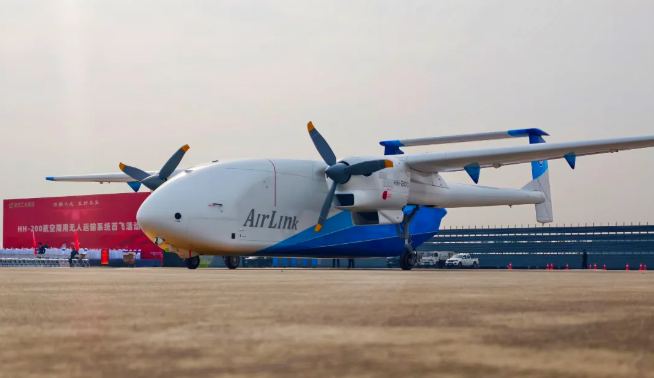
China Aviation Industry Corporation, the state-owned aerospace conglomerate known as AVIC, successfully flew its HH-200 commercial unmanned transport system for the first time on April 15, 2026 — a milestone that signals Beijing's push to commercialize heavy-lift drone logistics at a scale no private operator has yet achieved in China.
The 22-minute test flight, conducted at Pucheng airfield in Shaanxi province, confirmed stable flight attitude and normal operation across all onboard systems, AVIC said in a statement. The aircraft completed all pre-planned test objectives without incident, clearing the path for a multi-phase flight certification program before commercial deployment.
The market context matters: China's drone logistics sector has been dominated by sub-100-kilogram platforms from DJI and SF Technology. The HH-200's 1,500-kilogram payload capacity and 2,360-kilometer maximum range place it in a different competitive tier entirely — closer to light manned cargo aircraft than to conventional commercial drones — and position AVIC to capture government contracts in emergency relief, remote-area supply chains, and agricultural services where no existing unmanned platform currently qualifies.
Payload Architecture Targets Logistics Bottlenecks, Not Just Showcase Metrics
The HH-200's design choices reveal deliberate commercial engineering rather than a pure technology demonstration. The standard cargo hold measures 12 cubic meters — expandable to 14 or 18 cubic meters depending on mission configuration — and features a straight-through low-floor bay compatible with standard forklifts. AVIC states that two ground crew can complete a full load-unload cycle in five minutes, a figure that directly addresses turnaround economics at remote airstrips where specialized handling equipment is unavailable.
That ground-handling interoperability is a non-trivial differentiator. Most heavy-lift unmanned platforms require proprietary loading infrastructure, raising per-flight fixed costs and limiting deployment flexibility. By engineering to standard forklift interface specifications from the outset, AVIC has reduced the barrier to entry for logistics operators considering fleet adoption.
The aircraft's environmental certification targets are equally commercially oriented. AVIC has specified operation in short-runway environments, high-altitude plateaus, extreme temperatures, and severe weather — a capability envelope that maps directly onto China's western provinces, where road infrastructure remains sparse and manned aviation economics are unfavorable for sub-three-ton payloads.
Regulatory and Commercial Timeline Remains the Critical Variable
The HH-200 now enters a multi-stage flight test program before receiving Civil Aviation Administration of China type certification for commercial operations. AVIC has not disclosed a certification timeline, and the gap between first flight and revenue service for aircraft in this weight class typically spans two to four years under CAAC frameworks — a constraint that applies regardless of the platform's technical maturity.
Announced application domains — emergency rescue, aerial remote sensing, and agricultural and forestry operations — suggest AVIC is initially targeting government-procured or government-subsidized missions rather than competing directly with commercial express carriers. This sequencing is consistent with how AVIC has commercialized previous aviation platforms: government contracts provide initial revenue and operational data, with broader commercial licensing following certification expansion.
The competitive landscape will also shift during that window. Privately backed heavy-lift drone developers including Autoflight and Zipline's China-facing competitors are advancing their own platforms. AVIC's state backing provides access to airspace coordination and procurement channels that private developers cannot easily replicate, but it does not guarantee first-mover advantage in commercial logistics contracts if certification timelines lag.
AVIC's Drone Push Reflects Broader Dual-Use Infrastructure Strategy
The HH-200 program fits within a larger pattern of Chinese state aerospace investment in unmanned systems with explicit dual-use potential. The platform's payload range, environmental adaptability, and autonomous operation capability are attributes valued equally in military logistics support and civilian disaster response — a convergence that has characterized Chinese unmanned aviation development since at least 2020.
Zhejiang, Shaanxi, and several other provinces have allocated infrastructure funding specifically for unmanned aviation logistics corridors under the 14th Five-Year Plan framework. The HH-200's Pucheng test site in Shaanxi is geographically proximate to planned western logistics hubs, suggesting site selection was not incidental.
For investors tracking China's low-altitude economy — a policy category that received explicit State Council endorsement in 2024 and has driven a wave of drone-sector listings — the HH-200's first flight adds a state-enterprise data point to a segment previously dominated by private-sector narratives. Whether AVIC pursues a capital markets event around the HH-200 program, or retains it within the group's existing listed subsidiaries, will be a secondary signal worth monitoring as the certification program advances.