
Smartphone Maker Honor Sweeps Beijing Humanoid Robot Marathon, Disrupting Pure-Play Robotics
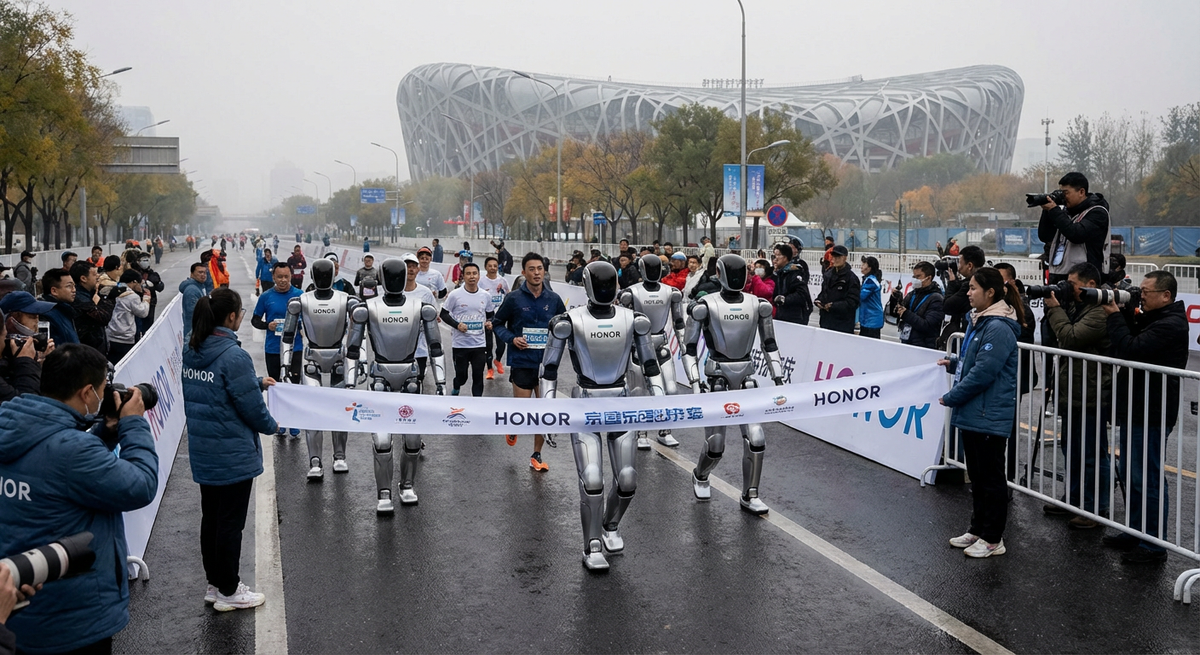
Consumer electronics heavyweight Honor swept the podium at the 2026 Beijing Yizhuang Humanoid Robot Half Marathon, deploying autonomous navigation systems to shatter human world records and signal a structural shift in the commercial robotics landscape.
The unprecedented clean sweep by a traditional smartphone manufacturer underscores a critical industry pivot where advanced mobile computing and AI algorithms are outpacing legacy electromechanical engineering. Honor’s proprietary "Lightning" robots clocked net times starting at 50 minutes and 26 seconds, comfortably beating the human male half-marathon world record of 57 minutes and 20 seconds, while pure-play robotics pioneer Unitree saw its hardware physically collapse at the finish line.
This outcome resets investor expectations for the commercialization of humanoid robots, suggesting that consumer device giants possess a distinct capitalization and R&D advantage in edge computing and sensor integration necessary for autonomous mobility in unpredictable physical environments.
Autonomous Algorithms Outperform Remote Hardware
The 21.0975-kilometer circuit integrated over 10 varied terrains, including sharp 90-degree turns and complex ecological pathways. Race organizers implemented a strict algorithmic weighting system, applying a 1.0 multiplier for autonomous navigation and a 1.2 penalty for remote-controlled entries. While a remote-controlled Honor unit crossed the line first at an absolute time of 48 minutes and 19 seconds—shaving two hours off the 2025 championship time—the penalty pushed it off the podium.
Consequently, Honor's three fully autonomous teams secured the top three official spots with final times of 50:26, 50:56, and 53:01. The strategic reliance on spatial computing and real-time path planning highlights the rapid transfer of smartphone AI technologies into bipedal mechanics, proving that software supremacy is becoming the primary differentiator in robotics.
Legacy Pioneers Expose Hardware Limitations
The contrast in corporate development cycles was evident on the track. Unitree, a prominent Chinese robotics startup, fielded a modestly updated version of its 2023 H1 model due to resource constraints. Despite demonstrating strong burst capabilities in the qualifiers—covering 1.9 kilometers in 4 minutes and 13 seconds to outpace human 1500-meter world records—the older mechanical architecture struggled with prolonged endurance.
The Unitree robot suffered a catastrophic posture failure immediately after crossing the finish line, losing balance and requiring a stretcher extraction. This physical breakdown exposes the persistent endurance and dynamic balance bottlenecks facing hardware-first developers when capital constraints limit iterative generational upgrades.
Scale Signals Supply Chain Maturation
The 2026 event expanded fivefold from the previous year, drawing over 100 teams across 13 provinces and five international entries. Participants ranged from consumer giants and specialized firms like Songyan Dynamics to top-tier academic institutions. Guan Haitao, Honor's Global Chief Marketing Officer, emphasized the company's status as the first global terminal device manufacturer to compete in this arena.
The influx of smartphone supply chain integration into bipedal robotics indicates an imminent reduction in component costs. As terminal device manufacturers leverage their existing economies of scale in chips, sensors, and battery management systems, the mass production timeline for commercial humanoid deployment is poised for significant acceleration.
Related Coverage:
Honor Enters Humanoid Robotics Race as Billions Flood China's Embodied AI Sector