
Embodied AI’s Data Arms Race: Daimon Launches 10,000-Hour Multi-Modal Dataset to Redefine Robotics Scaling Limits
The global race for embodied artificial intelligence has pivoted from algorithmic architecture to high-fidelity data acquisition, marking a critical infrastructure phase in 2026. As hardware capabilities standardize, proprietary data pipelines have emerged as the definitive moat for robotics developers.
Daimon Robotics escalated this transition today by launching Daimon-Infinity, a multi-modal embodied dataset containing 10,000 hours of tactile, visual, and trajectory logs. Open-sourced via Alibaba's ModelScope community, the release underscores a market-wide shift where data volume and quality now dictate the valuation ceilings of robotics startups.
The strategic release follows a frenetic first quarter of 2026 that saw "embodied brain" developers like Xinghaitu, Zhi Pingfang, and Zibianliang secure massive funding rounds to achieve unicorn status. With algorithmic competition intensifying, venture capital and corporate strategy are aggressively reallocating capital toward foundational data generation and distributed collection networks.
Tactile Sensors Rewrite Training Efficiency
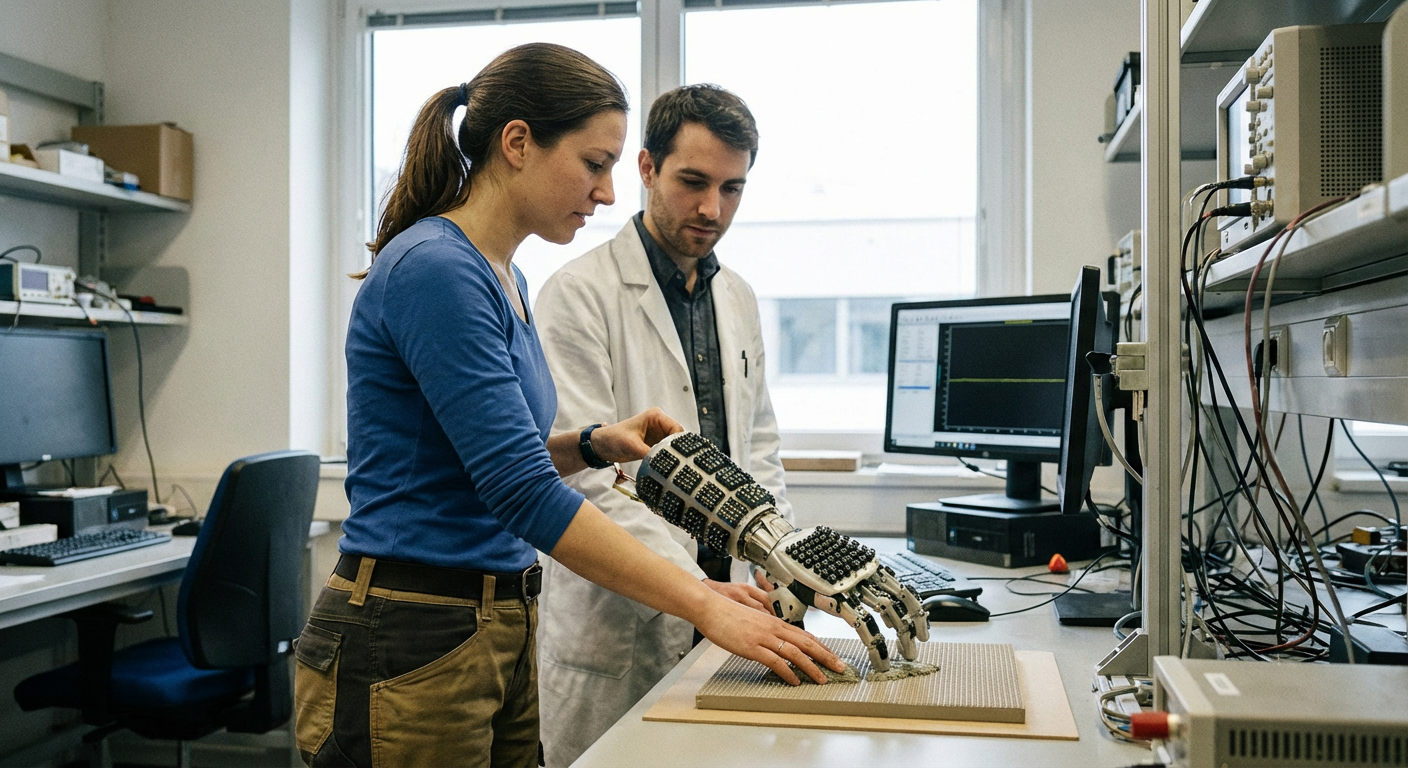
Incubated by a research team at the Hong Kong University of Science and Technology and backed by China Mobile and China Merchants Venture, Daimon Robotics specializes in dexterous manipulation. The Daimon-Infinity dataset introduces a critical variable to the training paradigm: high-resolution tactile feedback. Utilizing proprietary dual-finger grippers and five-finger sensory gloves, the dataset records contact force, material deformation, and surface texture.
According to Daimon executives, integrating tactile metrics significantly reduces the gross data volume required for model training. By bypassing visual occlusions and directly mapping physical interactions, models deployed in tactile-heavy environments demonstrate marked improvements in task success rates. Validated across multiple models including OmniVTA, the dataset is projected to scale to millions of hours encompassing nearly one billion data points by the end of the year.
Corporate Providers Monetize Raw Inputs
The commercialization of robotic data is rapidly formalizing into a distinct sub-sector. In April 2026, Baidu launched an "Embodied AI Data Supermarket," offering on-demand data retrieval and customized collection services to model developers. Earlier in January, the Hubei Humanoid Robot Innovation Center delivered thousands of hours of proprietary training data to Zhiyuan Robotics, signaling the viability of data-as-a-service (DaaS) business models in hardware development.
Daimon's strategic open-sourcing operates on a dual mandate: validating its proprietary data production capabilities while leveraging third-party developers to accelerate model iteration. The company confirmed it is already supplying curated datasets to leading algorithmic research institutions under bespoke commercial agreements, actively shaping the data requirements for next-generation AI brains.
Scaling Law Dictates Multi-Tier Infrastructure
Empirical evidence of a "Scaling Law" in embodied AI is crystallizing across the industry. Generalist AI's GEN-1 model, released in April 2026, ingested 500,000 hours of real-world operational data—nearly double the volume of its late-2025 GEN-0 iteration. This scaling catalyzed a performance jump, elevating task success rates from 64% to 99%. Concurrently, NVIDIA's EgoScale project recorded continuous model improvements using over 20,000 hours of action-annotated, first-person video data.
To sustain this voracious data appetite, the industry is adopting a tiered acquisition architecture. Daimon outlines a pyramid strategy: the apex comprises high-precision data captured directly by robot hardware for complex manipulation tasks; the middle tier utilizes scalable handheld devices to capture transferable structural data; the base relies on massive, human-centric first-person recordings acquired via low-cost wearables to ensure broad model generalization. As the Scaling Law dictates the upper limits of machine intelligence, securing robust, multi-tiered data pipelines remains the paramount strategic imperative for the robotics sector in 2026.
Related Coverage:
Agibot Showcases Embodied AI Ecosystem and Unveils Simulation Platform at CES 2026
Unitree Robotics Founder Predicts Embodied AI’s 'ChatGPT Moment' Is Still Years Away