
China Puts Embodied Special-Purpose Robots Into Real Operations, Signaling Faster Industrial Automation
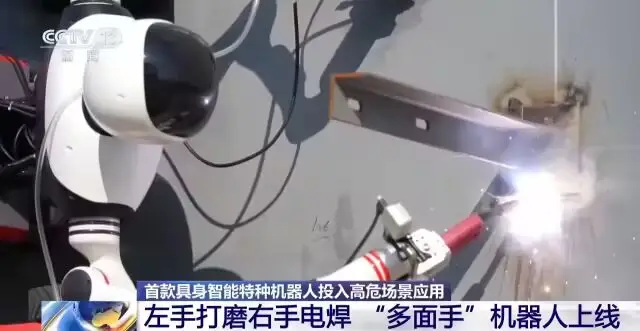
China has moved embodied intelligence from demos to deployment in special-purpose robots, with multiple domestically developed systems now operating in hazardous industrial and infrastructure scenarios, a step that could accelerate demand for industrial AI models and field-ready robotics across energy, shipping and grain logistics.
State broadcaster CCTV reported that China’s “first embodied-intelligence special-purpose robot” has entered use in chemical storage tanks, ships and energy facilities, while new land inspection, subsea cable detection and grain-silo leveling robots have also been put into service.
The immediate market signal is not consumer robotics hype but operational proof points: longer duty cycles via tethered power, safer remote operation through VR-based telepresence, and measurable productivity gains such as a tenfold improvement in subsea detection efficiency versus manual methods, according to CCTV.
For investors tracking industrial automation, the deployments highlight where embodied AI may monetize first in 2026: high-risk, repetitive and compliance-heavy tasks where downtime, safety incidents and inspection failures carry outsized costs.
Deployments Shift Embodied AI Toward High-Risk Work
CCTV said the embodied-intelligence special-purpose robot combines a humanoid upper body with a wheeled magnetic-adhesion base. With 15 degrees of freedom, it can conduct welding, flaw detection and rust removal, and switch tasks by rapidly changing hand tools.
Its electromagnetic adhesion allows the robot, weighing 90 kilograms, to attach to vertical metal walls and continue walking and working even while carrying an additional adult, the report said. Operators can control the robot remotely using a controller and VR headset, enabling 1:1 synchronized dual-arm movements while working at heights of hundreds of meters.
A tethered power design supports extended continuous operations, positioning the system for use cases where battery swaps would otherwise become a bottleneck, and where uninterrupted inspection or repair windows matter.
Model-Backed Operations Build Data Moats
R&D lead Pu Xiao told CCTV the system is supported by what he described as China’s largest special-purpose robotics large model, with cumulative operating time exceeding 100,000 hours. The fleet has logged 22,500 kilometers of work distance, covering more than 5,000 square kilometers, according to the report.
Those metrics point to a key competitive lever in special-purpose robotics: data collected under real industrial constraints. As robots move into chemical, maritime and energy facilities, the resulting operational dataset can improve perception, control and task planning, reinforcing a flywheel between deployments and model capability.
A paired land inspection robot, equipped with a flexible six-axis arm, can replace humans in dangerous scenarios such as fires or toxic gas leaks by performing actions like valve shutoff. It also provides fire and fault warnings within a 2,000-meter range, CCTV said.
Undersea Cable Inspection Raises the Bar on Infrastructure Monitoring
CCTV reported that China’s first domestically developed subsea cable detection robot has also entered use, capable of autonomously inspecting seafloor cables at depths of 300 meters. It carries sonar, electromagnetic sensors and five lighting arrays, using electromagnetic waves to locate cables buried in silt and detect wear and breakage.
The robot uses eight thrusters, with four for vertical movement and four for horizontal travel, and moves underwater at 5 to 7 kilometers per hour. Its shell uses a special glass microsphere material designed to provide buoyancy underwater, according to the report.
With additional magnetic and spectral detectors for what CCTV described as “super CT”-like autonomous inspection, and coordinated operations with an unmanned surface vessel, detection efficiency is said to be ten times higher than traditional manual methods, sharpening the economic case for replacing diver- and vessel-intensive workflows.
Grain-Silo Robots Quantify Productivity Gains in Logistics
In grain storage, CCTV said China’s first intelligent silo leveling robot has been deployed, using a spiral-wheel design to travel across loose grain surfaces at speeds up to 2 meters per second. A roof-mounted lidar system and wall positioning sensors help plan optimal routes in real time.
Guo Fengmin, head of the leveling robot team, said that leveling a grain warehouse of more than 1,400 square meters traditionally requires three people working for three days, while three robots working together can finish in under a day.
The report also highlighted swarm-style collaboration: multiple robots can coordinate routes via intelligent algorithms while maintaining autonomous obstacle avoidance, reducing collision risk even in close-quarters operations.
Related Coverage:
Unitree Robotics Founder Predicts Embodied AI’s 'ChatGPT Moment' Is Still Years Away