
Beijing’s Humanoid Robot Half Marathon Adds Autonomous Scoring as Honor Joins a 100-Team Field
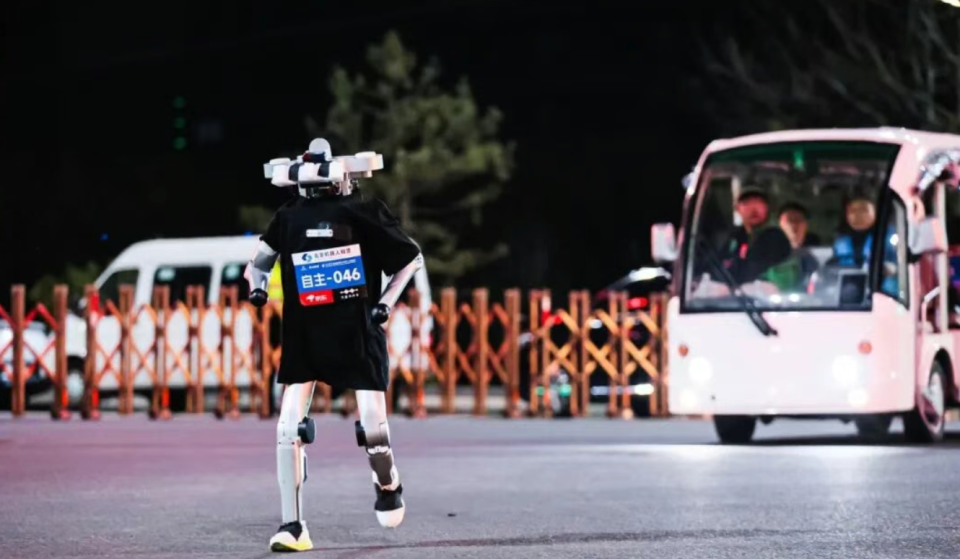
Beijing’s 2026 Humanoid Robot Half Marathon is turning from a spectacle into a technology benchmark, as organizers push teams toward autonomy and consumer-electronics brand Honor joins a field that has quintupled from last year.
Honor said its “Lightning” and “Yuanqizai” robots will race on April 19 in Beijing’s Yizhuang district, marking what it described as the first time a global terminal-device maker has entered a robot marathon. Footage from an April 11–12 overnight full-course test — designed to rehearse dispatch, safety and emergency response — has already driven attention to speed and stability, two metrics investors increasingly treat as shorthand for engineering maturity.
The rulebook changes matter more than viral clips. The event now scores autonomous navigation teams and remote-controlled teams on the same course under a mixed timing system that penalizes remote assistance, effectively making autonomy a competitive requirement rather than a marketing claim.
Rule Changes Tilt Competition Toward Autonomous Navigation
Organizers kept a remote-control category but added an autonomous navigation category, which now accounts for nearly 40% of participants, according to event information. Autonomous teams are ranked by net time plus penalties, while remote-control teams are ranked by net time multiplied by a 1.2 weighting factor plus penalties.
An event official said the 1.2 coefficient was set after expert review, participant feedback and multiple rounds of test data, aiming to encourage deeper autonomous R&D and protect fairness. Robots will carry labels such as “Autonomous Navigation” or “Remote Control,” but both categories will compete together on the same track with a unified ranking.
A Larger Field Signals Faster Industrial Scaling
The April 19 race runs 21.0975 kilometers, with human runners and humanoid robots on the same course separated by barriers. Organizers said they received applications from 76 entities across 13 provincial-level regions, totaling more than 100 teams, including four overseas teams — about five times the scale of 2025.
Universities are also scaling up: 20 schools are participating via direct registration, joint labs with companies, or training camps. The number of robot brands in the field has reached 26. Xinhua previously reported that China’s Ministry of Industry and Information Technology said on Jan. 21 that, in 2025, China had more than 140 domestic humanoid robot makers and had released more than 330 humanoid robot products.
Honor and Unitree Spotlight the Shift From Demos to Performance Metrics
Honor’s participation puts a consumer-device brand into a race dominated by robotics specialists, broadening the competitive set around embodied AI and manufacturing know-how. Honor’s team said “Lightning” integrates its latest work in intelligent manufacturing and embodied AI, including high-dynamic motion control, real-time perception and autonomous decision-making.
Speed is becoming a headline metric ahead of the race. Honor previously disclosed in May 2025 that its humanoid robot had reached a running speed of 4 meters per second. Unitree posted a pre-race video saying its H1 robot hit a peak tested speed of 10 meters per second. Industry participants quoted in the material cautioned that a half marathon tests more than sprint speed, including endurance, energy management, dynamic balance and gait control.
Testing and Operations Focus on Batteries, Hot-Swaps and Limited Human Intervention
The overnight test followed the full official route and time nodes, spanning urban arterial roads and an ecological park section, aiming to identify operational failures before race day. More than 70 teams joined the test, including the four international teams, with autonomous and remote-control teams running together.
Battery strategy is becoming a differentiator. The race includes replenishment and battery-swap procedures, and rules encourage finishing without swapping batteries or robots. The material noted that many teams in 2025 used a power-down swap process, while 2026 is expected to see more hot-swappable approaches.
Autonomy still comes with guardrails. Rules require teams to follow behind their robot in a support vehicle, with up to three team members allowed. They may intervene only after signaling and receiving referee confirmation, such as during battery swaps or when a robot falls. Battery swaps at supply stations do not stop the clock and do not incur penalties, while swapping to a backup robot triggers time penalties under any circumstances.
Related Coverage:
Unitree’s H1 Claims 10 m/s Sprint, Shifting China’s Humanoid Race From Stunts to Deployable Mobility
Honor Unveils 'Robot Phone' and Humanoid Robot at MWC 2026, Signals Deeper AI Pivot