
Kepler Robotics pivots to force-tactile data after securing A++ round
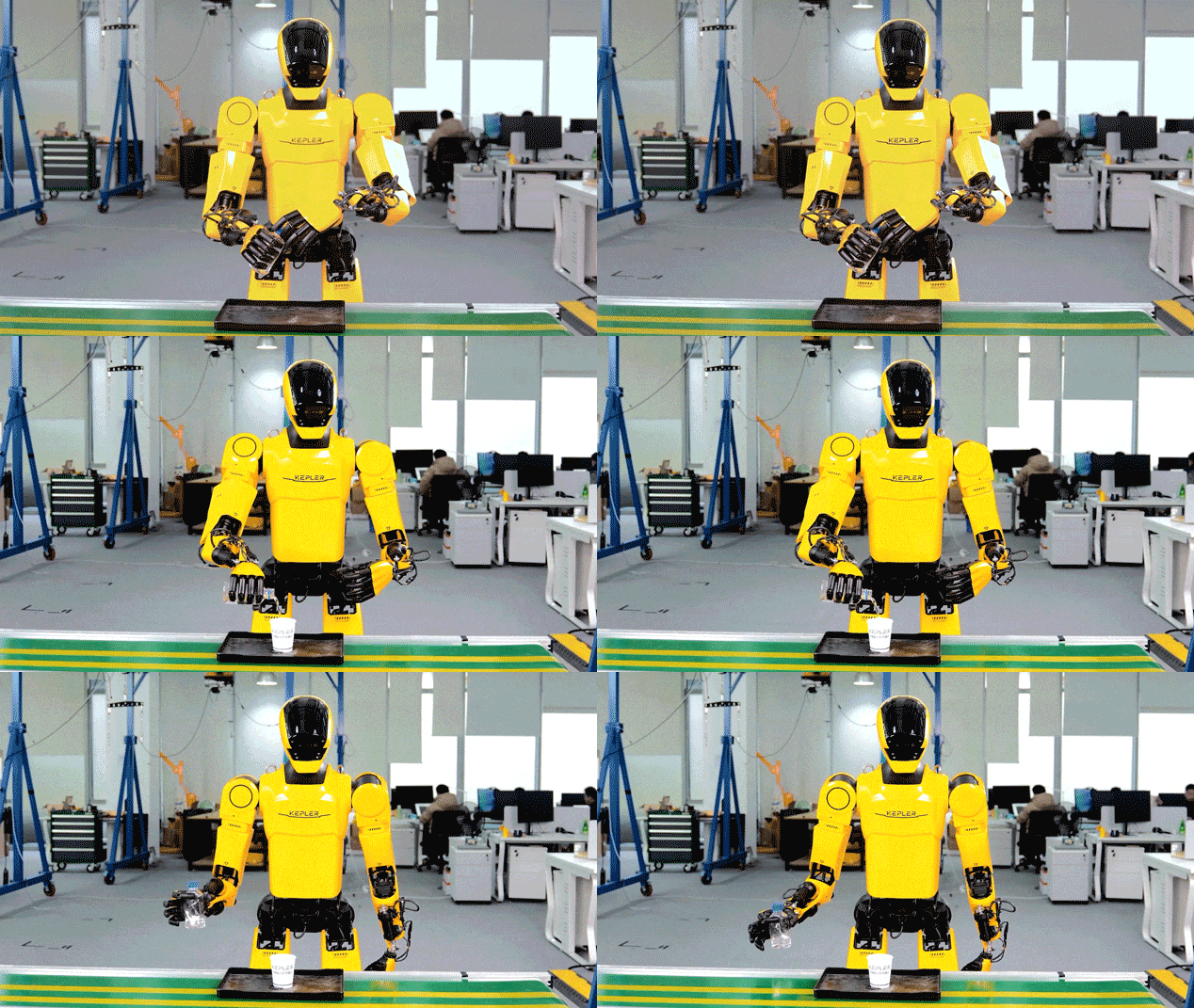
China’s industrial humanoid race is shifting from model architecture to data ownership, as Kepler Robotics rolled out what it calls the country’s first “native full-perception force-tactile data collection system” and said it has closed an “hundreds of millions of yuan” A++ funding round to double down on robot “brains” and tactile data pipelines.
The release comes as global peers argue that embodied AI’s scaling law is increasingly constrained by real-world interaction data, not internet text. Silicon Valley-based Generalist AI’s latest foundation model, GEN-1, highlighted the point this month by leaning on more than 500,000 hours of real physical-interaction data gathered via wearables, lifting average success rates in live tasks such as phone packaging and box folding to 99% and cutting box-folding time to 12.1 seconds from 34 seconds.
Investors’ near-term question is whether Kepler can turn a hardware-heavy data moat into lower training cost, faster iteration cycles and higher factory uptime—metrics that matter more to industrial buyers than benchmark demos.
Reframing Data Collection Attacks the Industrial “Last Meter”
Kepler is positioning data acquisition—not algorithms—as the binding constraint for robots that must grasp, insert, fasten and assemble in messy production environments. The company argues that vision-only and simulation-heavy training pipelines leave robots blind to contact stability and applied force, contributing to weak transfer into factories where generalization success can drop to 25%-30%.
That gap has a direct economic impact. Kepler cites industry patterns in which “horizontal” data collection across many scenarios produces fragmented datasets and low conversion into deployable industrial capability, with industrial ROI as low as 15% when teams try to cover home, service and factory tasks at once.
By designing a collection stack around force and tactile signals—rather than treating them as optional add-ons—Kepler is betting it can compress the trial-and-error loop that currently makes industrial robot learning expensive and slow.
Building Dual Pipelines Balances Fidelity With Scale
Kepler’s system splits data production into two complementary tracks: one optimized for high-fidelity contact dynamics, the other for volume and scenario coverage.
For high precision, it uses a bidirectional teleoperation loop that combines a force-feedback exoskeleton, tactile-feedback gloves and high-resolution tactile sensors on the robot hand. The operator’s actions map to the robot while tactile and force signals—pressure, slip and contact-state changes—are converted into feedback the operator can feel and then use to adjust. Kepler says this approach achieves 99% data fidelity, with latency controlled at millisecond level and noise error reduced to below 1%.
For scale, a “human demonstration” track moves collection away from robot bodies and onto people wearing high-density tactile gloves. The system records synchronized multi-modal signals—vision, hand joint angles, tactile pressure arrays and muscle motion—then maps them to target robot kinematics. Kepler says it uses multi-robot mapping and policy distillation so one dataset can be reused across dozens of robot embodiments, while head- and wrist-mounted multi-view cameras mitigate first-person occlusion.
For investors and supply-chain partners, the platform claim—standardized capture hardware, unified data structures, and “native” model compatibility—signals a push toward reusable data assets rather than one-off project datasets, a key step toward lowering marginal costs per new task.
Upgrading From VLA to VTLA Raises the Value of Tactile Data
Kepler says it has developed a VTLA model—Vision, Tactile, Language and Action—that elevates tactile/force inputs to the same level as vision and language, shifting learning from “seeing” to “contact-aware” control. Unlike traditional VLA stacks that often separate sensing and control modules, Kepler describes an end-to-end approach that jointly encodes multi-view RGB-D, language instructions, proprioceptive joint states, and tactile/force features such as pressure distributions, force vectors and slip events.
This architectural choice increases dependence on synchronized contact-rich datasets, making the data collection system a strategic asset rather than a support tool. It also aligns with the industrial reality that many failures are not visual—misalignment, insufficient insertion force, micro-slips, or over-torque—problems that force-torque (Fx, Fy, Fz; Mx, My, Mz) and tactile arrays can detect during execution.
Demonstrating Factory Uptime Shifts the Commercial Conversation
Kepler points to a validation in an automotive production line where its force-tactile-trained VTLA system completed 1,000 consecutive high-precision assembly operations with a 99.4% success rate—an improvement of 19.4 percentage points over a vision-only model—without human intervention. If reproducible across sites, the claim implies a path to lower rework rates and labor intensity, two levers that typically drive automation payback in discrete manufacturing.
The strategic upgrade announced alongside the A++ round—prioritizing “embodied intelligence brain” development and force-tactile data capture—suggests Kepler expects competition in China’s humanoid sector to consolidate around proprietary datasets and tooling, not just robot bill-of-materials or demo performance. For suppliers, that raises demand for tactile sensors, force-torque transducers, wearable haptics and low-latency edge compute. For buyers, it reframes vendor selection around measurable stability under contact, not only vision benchmarks.
Related Coverage:
Chinese Startup Kepler Challenges Tesla in Humanoid Race With Upgraded Robot, Fresh Funding