
Kepler's 30-Kilogram Payload Robot Crosses Industrial Viability Threshold in High-Altitude Welding Trial
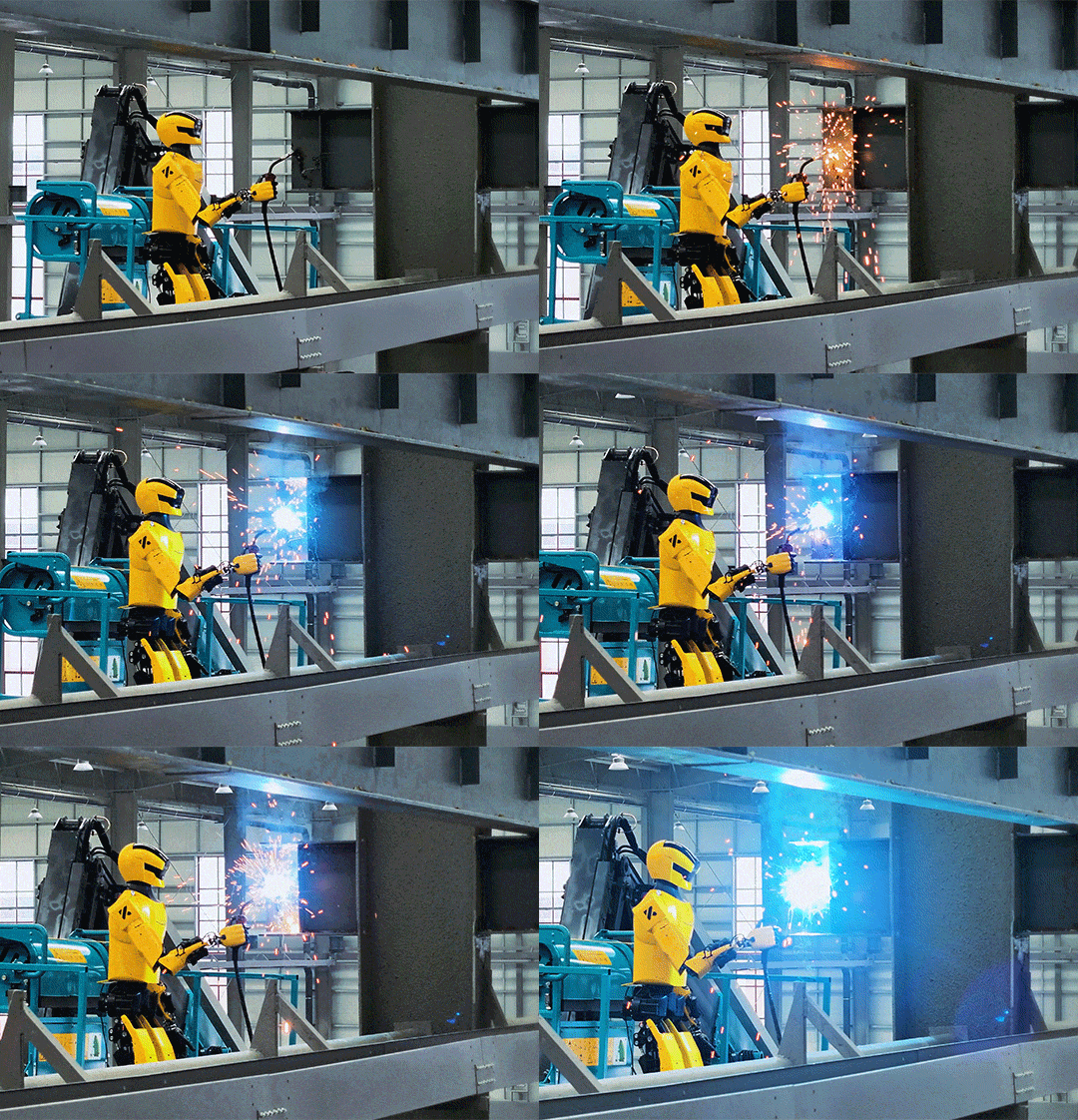
A teleoperated humanoid robot completed an eight-hour welding shift 20 meters above ground at Luoxiao Technology's manufacturing facility in Zhejiang, marking the first deployment of full-body remote control systems in China's high-risk industrial environments. The demonstration by Kepler Robotics positions its K2 Bumblebee platform as the first humanoid system combining sufficient payload capacity, operational endurance, and sensory fidelity to economically substitute human labor in hazardous manufacturing scenarios where annual workplace fatalities exceed 1,000 incidents.
The trial's significance extends beyond automation theatrics. Kepler's system maintained sub-100-millisecond latency across multi-modal feedback channels—force, visual, tactile, and auditory—while sustaining 30-kilogram dual-arm loads throughout a full production shift. This performance envelope addresses the core economic barrier that has confined humanoid robots to laboratory settings: the inability to match human workers' strength-endurance combination within acceptable cost-recovery timeframes.
Payload-Endurance Economics Reshaping ROI Calculations
Traditional industrial teleoperation systems have foundered on three constraints: upper-body-only control limiting task scope, weak load capacity requiring auxiliary equipment, and short operational cycles disrupting production continuity. Kepler's architecture resolves these through planetary roller screw actuators that maintain joint positions without power draw during static loads, enabling one-hour charging cycles to support eight-hour shifts—double the duration of conventional battery-powered systems.
The 30-kilogram bilateral payload capacity directly addresses manufacturing bottlenecks in automotive component handling, heavy fabrication assembly, and material transfer operations where existing collaborative robots require 50% higher unit counts to achieve equivalent throughput. At current deployment costs, enterprises report break-even horizons of 18-24 months when replacing two-shift human crews, compared to 36-48 months for lower-capacity alternatives requiring supplementary lifting infrastructure.
This cost structure gains urgency as China's industrial safety regulations tighten enforcement following State Council directives to reduce high-altitude work fatalities. Compliance expenses for scaffolding, harness systems, and insurance premiums now approach 40% of direct labor costs in steel fabrication and construction sectors, creating acquisition budgets for capital equipment that eliminates human exposure entirely.
Data Accumulation Architecture Beneath Teleoperation Interface
The Luoxiao facility trial functioned simultaneously as production work and training data generation. Kepler's system captured high-fidelity motion data across the eight-hour welding sequence—force modulation patterns, path correction responses, thermal management adjustments—feeding what the company terms "self-evolution" algorithms that compress new task training from weeks to minutes.
This data strategy mirrors approaches by Figure AI and Tesla's Optimus program, where teleoperation serves as scaffolding for autonomous capability development rather than an end-state solution. Each operator-guided session populates simulation environments with real-world variability—material tolerance deviations, positional drift, tool wear compensation—that pure synthetic training cannot adequately model.
The economic logic pivots on operational scaling. Initial deployments require continuous human oversight through VR interfaces, limiting productivity gains to safety risk transfer. As motion libraries accumulate across 3-5 repetitions of standardized tasks, the system transitions to supervisory control where operators intervene only during exception conditions. In high-volume manufacturing, this progression enables single operators to oversee multiple robot units across distributed facilities, fundamentally altering labor economics.
Kepler's claimed 2,000-kilometer maximum teleoperation range positions this model for technician-pooling arrangements where specialized welders in industrial hubs remotely service factories in lower-tier cities lacking skilled labor concentrations. Such geographic arbitrage models depend entirely on the robot's capacity to execute unsupervised between intervention events—a capability that hinges on data volume and algorithmic maturity still under development.
Integration Friction Points Tempering Adoption Velocity
Despite performance benchmarks, systemic adoption faces non-trivial barriers. Existing manufacturing execution systems lack integration protocols for humanoid platforms, requiring custom middleware development that extends deployment timelines beyond enterprises' comfort thresholds. The K2's human-analogous form factor eliminates facility retrofitting needs but introduces software complexity absent in purpose-built automation.
Operational reliability under production variance remains unproven at scale. The Luoxiao demonstration occurred in controlled conditions with pre-positioned materials and standardized workpieces. Industrial environments present contamination, lighting variability, and workflow interruptions that stress sensor systems and decision algorithms beyond laboratory validation. Early adopters report 20-30% productivity degradation during initial months as edge cases emerge, tempering enthusiasm among manufacturing executives operating on slim margins.
Workforce transition costs also constrain velocity. While Kepler's interface requires minimal technical training, organizational resistance persists in sectors where craft skills define professional identity. Welding communities particularly view remote operation as deskilling, creating labor relations friction that delays pilots regardless of technical readiness. Successful deployments have required extensive change management and operator involvement in system design—soft costs rarely captured in ROI models.
The humanoid robotics sector stands at an inflection point where technical capability begins meeting industrial requirements, yet practical deployment still navigates gaps between demonstration and production reality. Kepler's high-altitude welding trial demonstrates that payload and endurance thresholds have been crossed. The remaining challenge lies in accumulating operational data at sufficient scale to transition from teleoperated tools to autonomous agents—a progression that will determine whether humanoid platforms become manufacturing mainstays or remain niche solutions for hazardous edge cases.
By ChinaBiz Insider Analysis Desk