
Galaxea Raises RMB 2 Billion in B+ Round as China’s Embodied AI Valuations Reprice on “Robot Brain” Scarcity
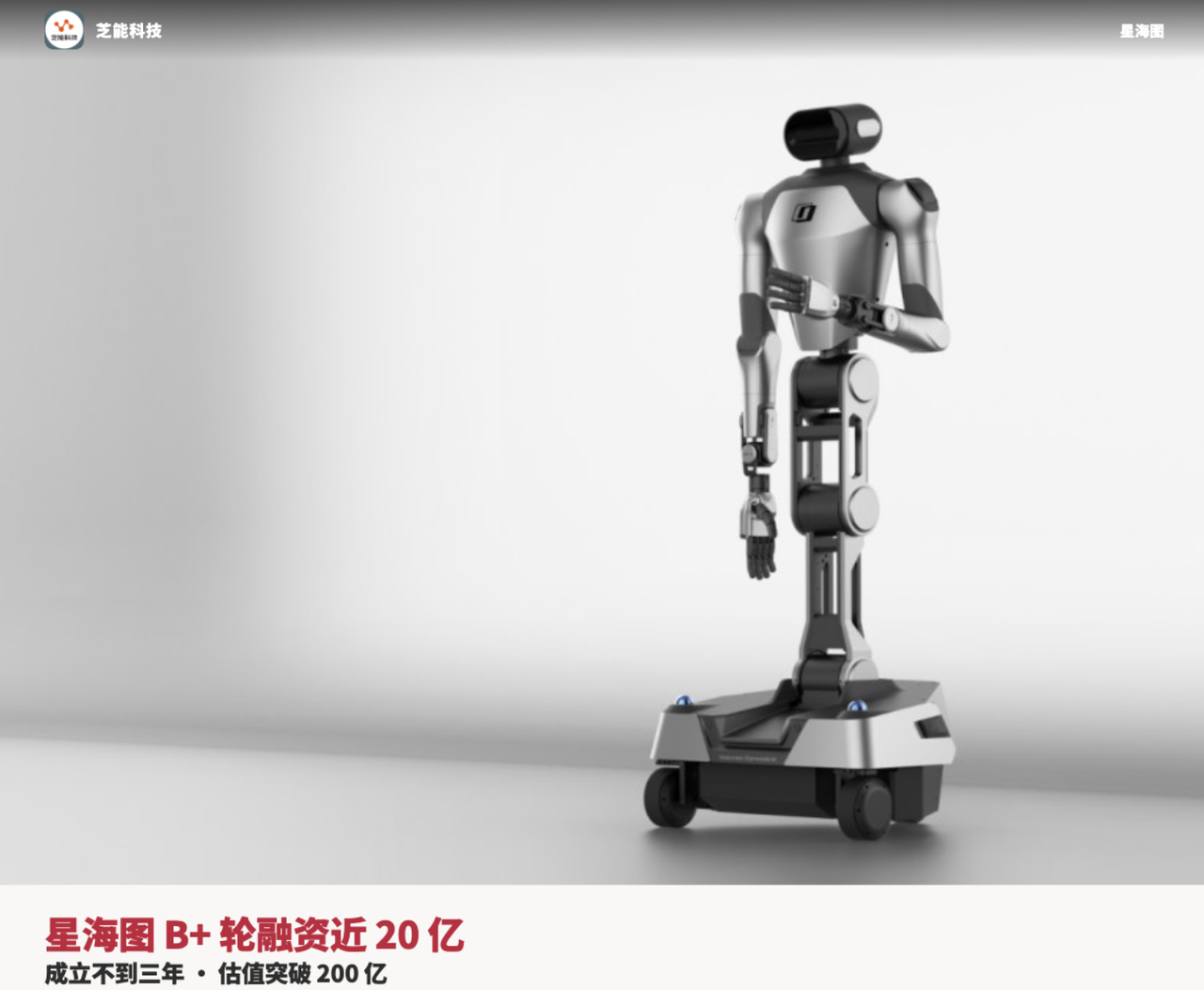
Galaxea has raised nearly RMB 2 billion (US$278 million) in a B+ round that lifts its valuation above RMB 20 billion (US$2.78 billion), underscoring how China’s capital markets in 2026 are rapidly repricing embodied artificial intelligence toward model-and-data platforms rather than robot hardware.
The step-up is abrupt even by current AI funding standards: the company’s valuation crossed RMB 10 billion (US$1.39 billion) roughly two months earlier, implying a near-doubling in less than a quarter. The financing comes as public-market investors assign premium multiples to large-model developers after recent listings—an equity benchmark that has pushed venture investors to pay up for assets seen as the “brains” behind next-generation robotics.
Galaxea’s pitch centers on accelerated R&D execution, an aggressive open-source cadence, and a data strategy that prioritizes real-world robot telemetry over simulation-heavy pipelines—three levers that directly impact time-to-deployment and defensibility in a field where model generalization remains the core bottleneck.
Open-Sourcing Accelerates Signaling to Capital Markets
Galaxea has tightened the link between product milestones and financing by compressing its model release cycle. It open-sourced the G0 Vision-Language-Action (VLA) model in August 2025, followed by G0 Plus in January 2026. In February 2026, it released two additional components: a vertical model optimized for garment folding and G0 Tiny, a lightweight on-device model designed for edge deployment.
This cadence matters because it provides an externally verifiable record of iteration speed—an important signal for assessing whether an embodied AI team can keep pace as foundation models commoditize. The company has also indicated that a G0.5 model is in development, pointing toward broader general-purpose task capabilities rather than single-demo specialization.
Dual Model Tracks Reframe Risk as Portfolio Strategy
Rather than committing to a single paradigm, Galaxea is pursuing two tracks in parallel: VLA models for perception-to-action control, and a world-model approach aimed at improving real-time reasoning.
The company recently released Fast-WAM, which it describes as a re-architected system designed to reduce reliance on “imagination” while increasing inference speed—an attribute that directly affects robotics throughput and failure rates in industrial environments.
The trade-off is higher cost. Parallel tracks consume both talent and compute resources, but Galaxea frames this as risk management in a pre-standardization phase. For investors, this creates option value: if the industry converges on VLA stacks, Galaxea claims early lead time; if world models become dominant, it avoids structural lag.
Real-World Data Becomes the Core Moat
Data quality—not model architecture—has emerged as the most expensive constraint in embodied AI in 2026. Real-world interaction data is costly to collect, while simulation data often fails to transfer effectively into real environments.
Galaxea has prioritized real-scene data collection and built a “no-ontology” dataset approach covering UMI and egocentric (first-person) data.
In 2025, the company open-sourced an open-environment real-robot dataset called GOD. It said the dataset topped global downloads within one month of release and has since exceeded 600,000 downloads. For investors, this kind of distribution acts as both a talent magnet and an ecosystem wedge—encouraging third-party experimentation while positioning Galaxea’s data schema as a de facto reference.
The company’s emphasis is not just scale but systemization: whether robots are designed for data capture, whether collection reflects real tasks, and whether labeling, post-processing, and governance can be standardized. The underlying thesis is a compounding data flywheel—deployment generates better data, which improves models, which in turn expands deployment.
Scaling to 10,000 Units Tests Operational Readiness
Commercially, Galaxea is focusing on five standardized industrial scenarios: material handling, pick-and-place, sealing and packing, garment folding, and equipment interconnection.
These use cases share clear unit economics, allowing customers to evaluate ROI rather than novelty.
The company said it has completed “thousand-unit” order validation and is targeting “ten-thousand-unit” scale shipments in 2026. This transition is critical, shifting proof points from single-site performance to full-system capability: deployment tooling, field maintenance, data feedback, and model iteration as a closed loop.
If executed successfully, this operational stack could become a key competitive moat—one that hardware-centric robotics vendors often struggle to replicate.
Conclusion
The broader signal from this round is a structural shift within embodied AI: from showcasing mechanical capability to monetizing model intelligence, data infrastructure, and full-stack execution.
As capital reallocates toward “embodied brains,” valuations are increasingly tied to scalable deployment and data compounding—rather than lab performance alone.
Related Coverage:
Leju Robotics and Dongfang Precision Launch “Super Factory” for Humanoid Robots
Huayan Robotics Debuts on Hong Kong Exchange, Testing Investor Appetite for Automation