
China’s Robot Rental Boom Signals Faster Commercialisation Push
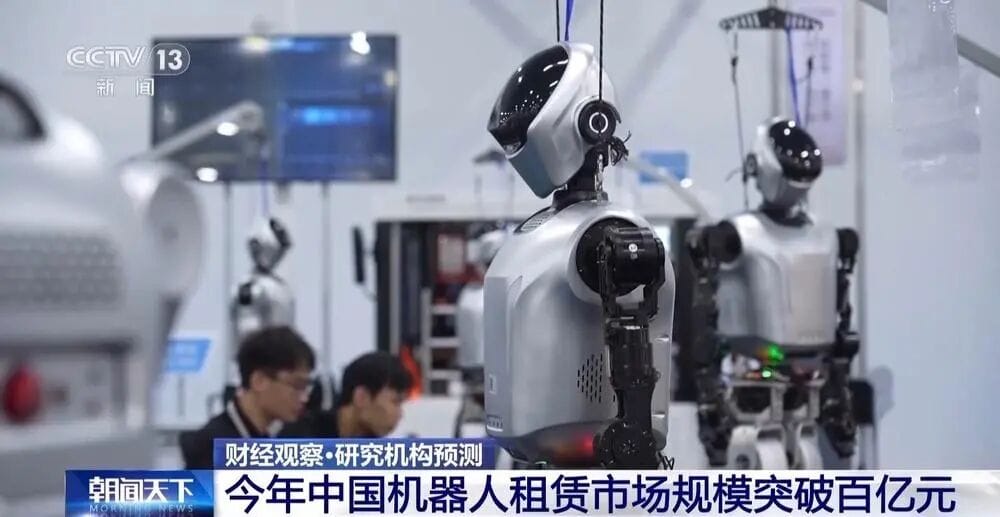
China’s robot rental market is poised for a sharp expansion in 2026, as service providers and investors bet that leasing can turn eye-catching hardware into repeatable revenue.
A research institution forecast that the country’s robot rental market will exceed RMB 100 billion (about US$13.9 billion) in 2026, a tenfold jump from around RMB 10 billion in 2025. The projection points to what industry participants describe as an inflection point: broader deployment is no longer driven only by lab demos and headline technology milestones, but by monetisable, short-cycle use cases.
In March, a robot rental company in Jinan, Shandong, said several robots under its management went on nearly 20 business trips in a single month. It added that bookings for the Qingming and May Day holidays were already fully scheduled early, reflecting tightening supply during peak tourism and promotional periods.
Capital is following demand. A global open robot rental platform established at the end of last year has already raised over RMB 100 million (about US$13.9 million), underscoring growing investor confidence that leasing can accelerate adoption by lowering upfront costs.
For much of the sector’s development, commercialisation has been constrained by a familiar gap: strong technical performance but limited deployment at scale. High purchase prices—often hundreds of thousands of yuan per unit—combined with ongoing spending on deployment, tuning and maintenance have deterred many potential users. Without sufficient real-world operating loops, attention sparked by technical progress has not always translated into sustained growth.
Leasing is emerging as a practical bridge between suppliers and end users. The model allows scenic spots, shopping malls, corporate events and cultural tourism activities to access robots through flexible, short-term contracts, helping organisers test demand, draw traffic and generate incremental revenue without committing to ownership. In some cases, operators can recover costs quickly through event-related income.
The surge in rentals is also reshaping incentives across the supply chain. A larger volume of live deployments generates data and user feedback that push companies to improve motion control, environmental adaptability, human-machine interaction and endurance stability. At the same time, scaling rental demand pressures manufacturers, core component suppliers and system integrators to coordinate cost reductions, shifting competition from isolated technological breakthroughs to ecosystem-level execution.
Policy measures aimed at strengthening the industrial ecosystem, expanding use cases and improving the business environment are also supporting the sector’s marketisation, according to the material. Together, policy support and market-led leasing are helping create a self-sustaining cycle in which product iteration and cost declines reinforce broader adoption.
With costs falling, technology maturing and scenarios multiplying, robots are expected to move deeper into daily life and business settings—an evolution that could make rental-led deployment a key test of which players can convert engineering capability into durable cash flow.
Related Coverage:
China’s Robot Rental Market in 2025: Demand Surge, Falling Prices, and the Rise of RaaS
China's Robot Rental Prices Plunge Over 90% as Market Faces Shakeout