
Chinese Startup Kepler Challenges Tesla in Humanoid Race With Upgraded Robot, Fresh Funding
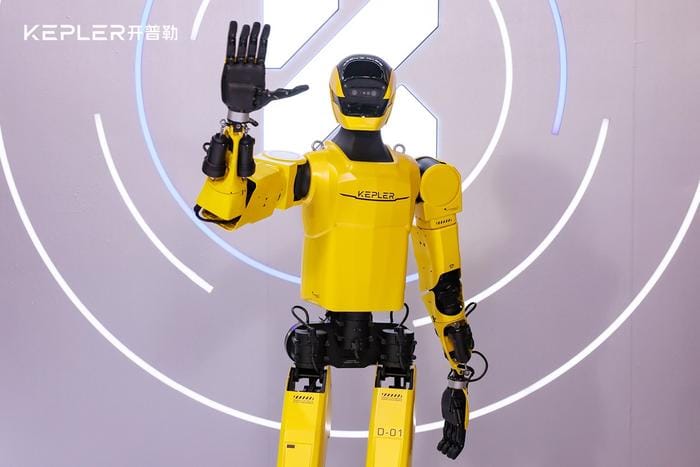
A Shanghai-based robotics startup is emerging as a credible challenger to Tesla in the race to build humanoid robots, after unveiling significant technical upgrades and securing a rapid succession of financing from strategic industry investors.
Shanghai Kepler Robotics, known as Kepler, recently showcased its K2 “Hornet” robot performing a stable, human-like walk while resisting external disturbances. The company, founded in August 2023, is positioning the K2 as the world’s first commercially available humanoid robot featuring a hybrid powertrain architecture similar to that of Tesla’s Optimus.
The technical demonstration comes as Kepler completed four funding rounds in as many months in 2025, attracting seven publicly-listed companies from China’s automotive and robotics supply chains as shareholders. This flurry of investment underscores growing industry confidence in Kepler’s approach and its push toward commercialization.
Reflecting its move to market, Kepler has opened pre-sales for the K2 robot with a starting price of RMB 248,000 yuan (US$34,206), a fraction of the cost of domestic rivals. The company aims to produce several hundred units this year and is building a new assembly plant to scale manufacturing, signaling its intent to capture a share of the nascent market for industrial and service robots.
Hybrid Architecture Mimics Tesla
The K2 Hornet’s key innovation lies in its hybrid architecture, a design shared by only a few others, including Tesla’s Optimus and a robot from Xpeng. This system combines planetary roller screw linear actuators, which act as the robot's primary "muscles" for power and load-bearing, with rotary motors for fine adjustments and gait switching. The company says this approach is the optimal solution for both efficiency and stability.
According to Kepler, the design leads to significant performance advantages. The high energy efficiency of the actuators allows the K2 to operate for eight hours on a single hour of charging, a feat demonstrated at the 2025 World Artificial Intelligence Conference. The robust structure also enables a dual-arm payload capacity of 30 kilograms, suiting it for "blue-collar" tasks in manufacturing and logistics.
While the hybrid architecture is gaining traction, it presents significant technical hurdles, including complex dynamic modeling and precise force control. Kepler states it has overcome these challenges by combining machine learning techniques with advanced control of its self-developed actuators. This allows the K2 to maintain a stable, human-like gait even on complex terrain or when pushed, a critical capability for real-world applications.
Strategic Funding Fuels Growth
Kepler has successfully raised five rounds of financing since its inception. An angel round in April 2024 was followed by four consecutive rounds between April and July of 2025 from Pre-A to A+, a pace that highlights intense investor interest.
The backers are not traditional venture capitalists but strategic partners. Investors include Weichuang Electric and Keli Sensing, which specialize in servo systems and sensors; Zhaofeng Shares, Hanwei Technology, and Qiaofeng Intelligent, which focus on precision parts, sensors and machine tools; and auto-parts suppliers Taotao Vehicle Industry and Furande Shares.
According to CFO and Head of Ecosystem Tan Zhengrong, this strategy is intentional. In a July interview, he stated the company’s primary goal this year was to secure capabilities and resources from industrial partners to address key component gaps, rather than seeking capital from financial institutions that offer less strategic value.
Path to Commercialization
With its latest upgrades, Kepler has officially launched pre-sales for the K2 Hornet, making it the first commercially sold humanoid robot with a planetary roller screw design. The robot is available in three versions—a basic bipedal model, a developer edition, and a wheeled developer variant. It is priced significantly below the RMB 500,000 to 700,000 yuan(US$69,400 to $97,200) range of comparable domestic models.
The company plans to produce several hundred units in 2025, with a target of scaling to thousands next year. To support this, a new assembly plant with an annual capacity of approximately 500 units is under construction in Foshan, Guangdong province. Kepler has already established strategic partnerships with its industrial shareholders and completed on-site training for the K2 robot at SAIC-GM. Initial applications are targeted for education, research, logistics, and manufacturing tasks like machine tending and material handling.
From Hardware to Full Stack
Kepler has pursued a “hardware-first” strategy, working closely with industry leaders to co-develop core components like joint modules and dexterous hands, achieving over 80% in-house development for its hardware. This has allowed the company to build what it calls a “hardware dream team” for the humanoid robot supply chain.
Now, the company is transitioning to a "hardware and software in parallel" approach. On the software side, Kepler is collaborating with leading large model providers for high-level reasoning while developing its own smaller, specialized models for perception and decision-making. This dual focus on both a robust physical platform and an intelligent "brain" forms the foundation of its plan to deploy capable, "blue-collar" humanoid robots across multiple industries.